Asian Manufacturing Takes off in February While North America Contracts: GEP Global Supply Chain Volatility Index
- Supply chains into Asia are the busiest since October 2022 due to sharp rises in manufacturing activity in China, Japan, India, South Korea and Taiwan
- North American factory input demand softens, reflecting a cooling of U.S. manufacturing growth
- Europe’s industrial recovery gains momentum, driven by Germany, but supply bottlenecks reported
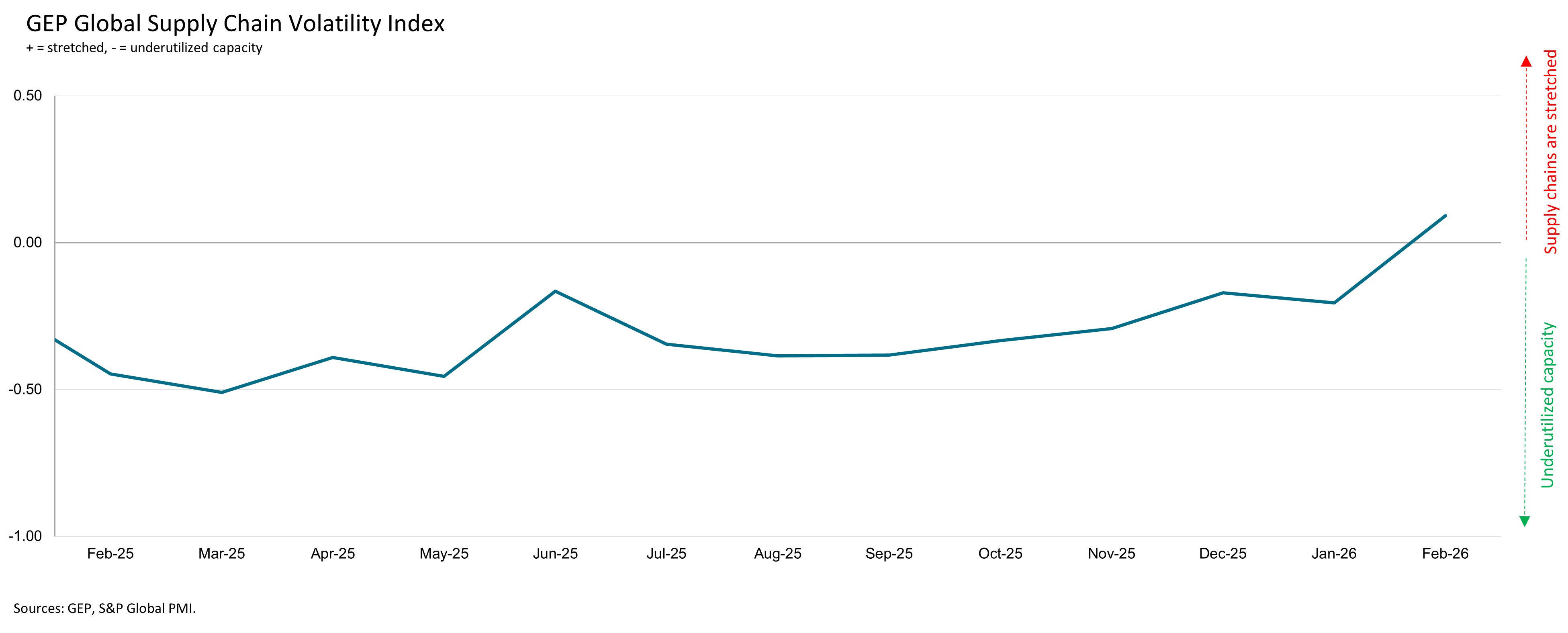
Clark, N.J., March 11, 2026 — GEP Global Supply Chain Volatility Index — a leading indicator tracking demand conditions, shortages, transportation costs, inventories and backlogs, based on a monthly survey of 27,000 businesses — showed that worldwide purchases of raw materials, commodities and critical components rose at the fastest pace in almost four years. Underlying data suggest the upturn was broad-based across sectors, with procurement activity rising in both capital-intensive and consumer-facing industries, pointing to a cyclical upswing prior to the war in the Middle East.
Asia was the key driving force behind a resurgence in global factory demand. China, Japan, India, South Korea and Taiwan reported strong rates of purchasing growth among key markets, leading Asia’s supply networks to record their busiest month in three-and-a-half years.
North America, on the other hand, saw a weaker trend in factory purchasing in February, reflecting a loss of momentum in the U.S. manufacturing economy. Canadian goods producers, by comparison, lifted their purchases of raw materials and intermediate products for the first time in more than a year.
Meanwhile, Europe’s industrial recovery continued to progress as the manufacturing sector of the continent’s largest economy, Germany, gathered momentum. The rise in procurement activity across Europe has led to the emergence of bottlenecks, with supply capacity becoming slightly stretched. A similar story was recorded for the U.K. in February.
“The war with Iran is already creating an oil supply shock that will disrupt global supply chains,” said John Piatek, vice president of consulting at GEP. “Companies need to assess their exposure to energy, petrochemical and shipping costs now, while U.S. manufacturers should also move quickly to proactively secure price reductions from suppliers following the Supreme Court’s tariff ruling.”
Interpreting the data:
Index > 0, supply chain capacity is being stretched. The further above 0, the more stretched supply chains are.
Index < 0, supply chain capacity is being underutilized. The further below 0, the more underutilized supply chains are.
Interpreting the data:
Index > 0, supply chain capacity is being stretched. The further above 0, the more stretched supply chains are.
Index < 0, supply chain capacity is being underutilized. The further below 0, the more underutilized supply chains are.
FEBRUARY 2026 REGIONAL KEY FINDINGS
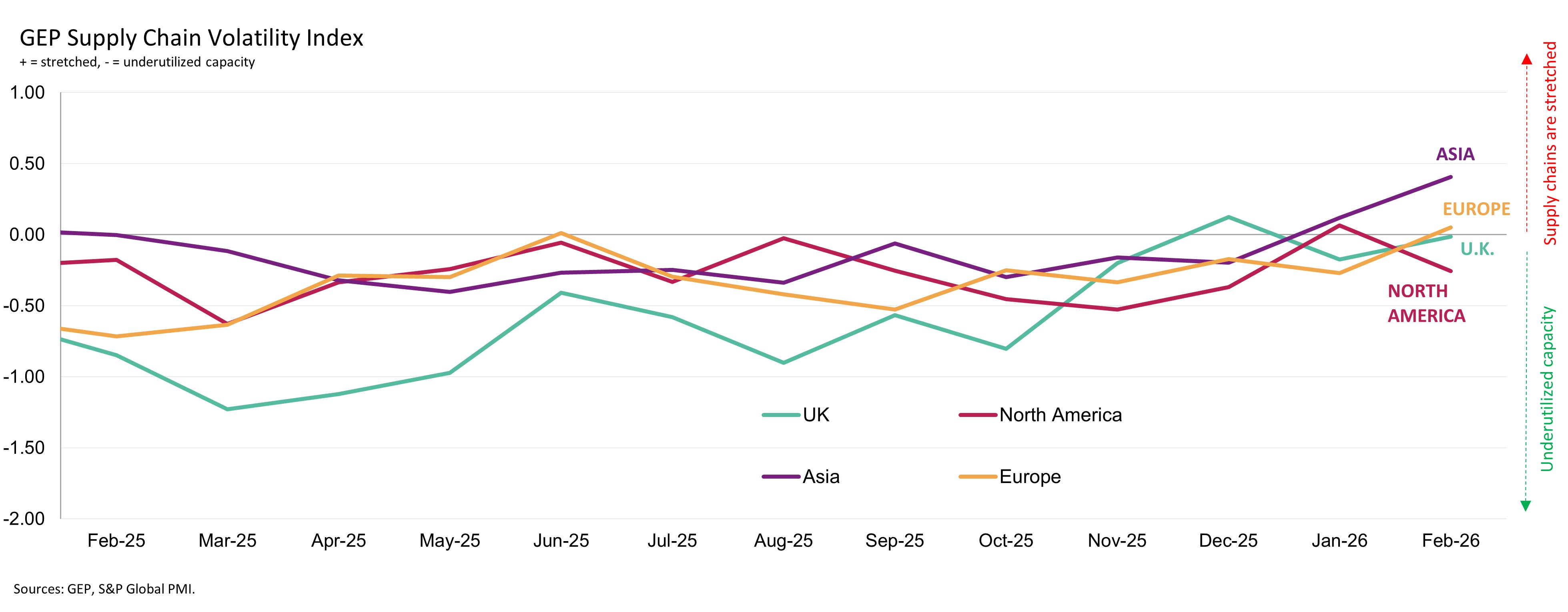
- ASIA: Index jumps to 0.40, from 0.12, its highest level since October 2022, signaling that supply chains into Asia were their busiest in nearly three-and-a-half years.
- NORTH AMERICA: Index slips from 0.06 to -0.26, signaling underused supplier capacity in North America after a pickup in January. U.S. factories tapered purchasing activity.
- EUROPE: Index rises to 0.05, from -0.27, indicating further progress in Europe’s industrial recovery.
- U.K.: Index increases to -0.01, from -0.17, suggesting that the U.K.’s supply chains are running at full capacity.
FEBRUARY 2026 KEY FINDINGS
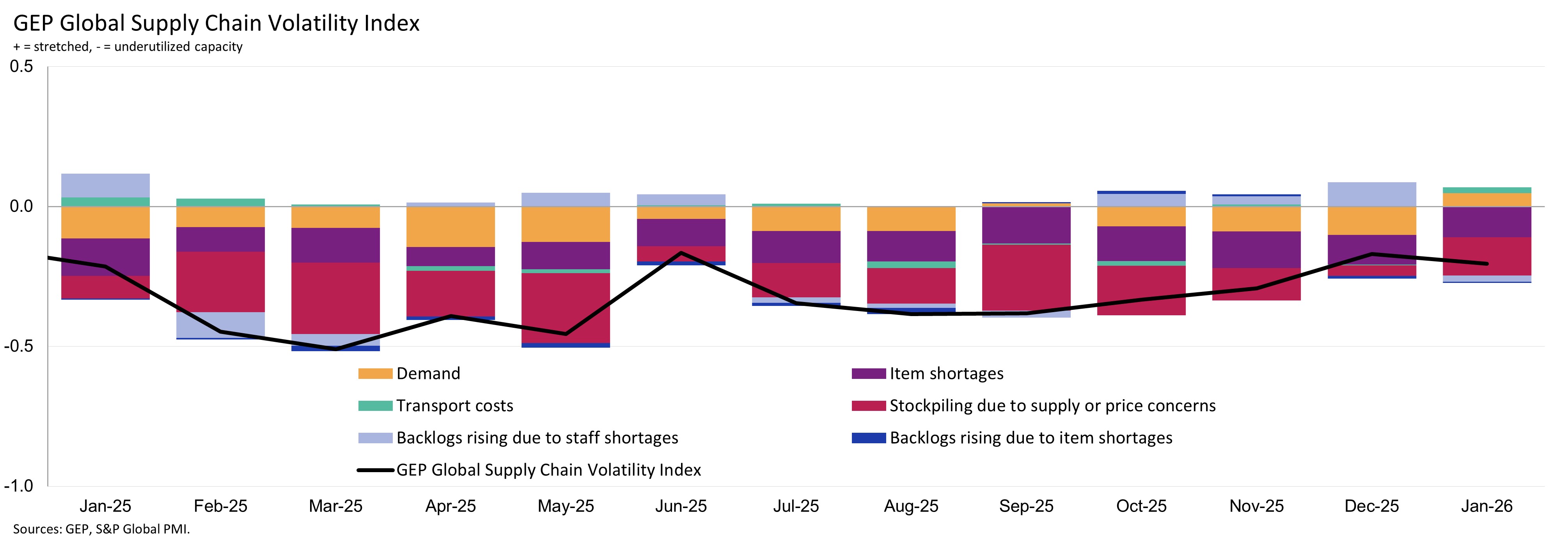
- DEMAND: Global demand for raw materials, commodities and intermediate products rose substantially in February to its strongest level since March 2022. Asia was a key factor behind this resurgence, with stronger growth in factory purchasing seen in key manufacturing economies across the region such as China, Japan, India, South Korea and Taiwan.
- INVENTORIES: Global reports of manufacturers stockpiling materials due to concerns regarding supply or price were below historically typical levels in February. This is in line with the general trend seen over the past two years, where firms have strongly favored lean inventories.
- MATERIAL SHORTAGES:The items in short supply indicator rose markedly in February, signaling a rise in reports of shortages from global manufacturers. That said, the overall frequency at which supply issues were noted was contained, recording in line with the long-run average level.
- LABOR SHORTAGES: Reports of backlogs rising at manufacturers due to shortages of staff were anchored around the level seen on average, historically, during February. This indicates that labor is not a restrictive factor for global production.
- TRANSPORTATION: The global transportation costs indicator posted in line with its historical average during February.
For more information, visit the GEP Global Supply Chain Volatility Index page.
Note: Full historical data dating back to January 2005 is available for subscription. Please contact economics@spglobal.com.
The next release of the GEP Global Supply Chain Volatility Index will be 8 a.m. ET, April 10, 2026.
About the GEP Global Supply Chain Volatility Index
The GEP Global Supply Chain Volatility Index is produced by S&P Global and GEP. It is derived from S&P Global’s PMI® surveys, sent to companies in over 40 countries, totaling around 27,000 companies. The headline figure is a weighted sum of six sub-indices derived from PMI data, PMI Comments Trackers and PMI Commodity Price & Supply Indicators compiled by S&P Global.
- A value above 0 indicates that supply chain capacity is being stretched and supply chain volatility is increasing. The further above 0, the greater the extent to which capacity is being stretched.
- A value below 0 indicates that supply chain capacity is being underutilized, reducing supply chain volatility. The further below 0, the greater the extent to which capacity is being underutilized.
A Supply Chain Volatility Index is also published at a regional level for Europe, Asia, North America and the U.K. For more information about the methodology, click here.
About GEP
GEP® delivers AI-powered procurement and supply chain solutions that help global enterprises become more agile and resilient, operate more efficiently and effectively, gain competitive advantage, boost profitability and increase shareholder value. Fresh thinking, innovative products, unrivaled domain expertise, smart, passionate people — this is how GEP SOFTWARE™, GEP STRATEGY™ and GEP MANAGED SERVICES™ together deliver procurement and supply chain solutions of unprecedented scale, power and effectiveness. Our customers are the world’s best companies, including more than 1,000 Fortune 500 and Global 2000 industry leaders who rely on GEP to meet ambitious strategic, financial and operational goals. A leader in multiple Gartner Magic Quadrants, GEP’s cloud-native software and digital business platforms consistently win awards and recognition from industry analysts, research firms and media outlets, including Gartner, Forrester, IDC, ISG, and Spend Matters. GEP is also regularly ranked a top procurement and supply chain consulting and strategy firm, and a leading managed services provider by ALM, Everest Group, NelsonHall, IDC, ISG and HFS, among others. Headquartered in Clark, New Jersey, GEP has offices and operations centers across Europe, Asia, Africa and the Americas. To learn more, visit www.gep.com.
About S&P Global
S&P Global (NYSE: SPGI) S&P Global provides essential intelligence. We enable governments, businesses and individuals with the right data, expertise and connected technology so that they can make decisions with conviction. From helping our customers assess new investments to guiding them through ESG and energy transition across supply chains, we unlock new opportunities, solve challenges and accelerate progress for the world. We are widely sought after by many of the world’s leading organizations to provide credit ratings, benchmarks, analytics and workflow solutions in the global capital, commodity and automotive markets. With every one of our offerings, we help the world’s leading organizations plan for tomorrow, today.
Disclaimer
The intellectual property rights to the data provided herein are owned by or licensed to S&P Global and/or its affiliates. Any unauthorised use, including but not limited to copying, distributing, transmitting or otherwise of any data appearing is not permitted without S&P Global’s prior consent. S&P Global shall not have any liability, duty or obligation for or relating to the content or information (“Data”) contained herein, any errors, inaccuracies, omissions or delays in the Data, or for any actions taken in reliance thereon. In no event shall S&P Global be liable for any special, incidental, or consequential damages, arising out of the use of the Data. Purchasing Managers’ Index™ and PMI® are either trade marks or registered trade marks of S&P Global Inc or licensed to S&P Global Inc and/or its affiliates.
This Content was published by S&P Global Market Intelligence and not by S&P Global Ratings, which is a separately managed division of S&P Global. Reproduction of any information, data or material, including ratings (“Content”) in any form is prohibited except with the prior written permission of the relevant party. Such party, its affiliates and suppliers (“Content Providers”) do not guarantee the accuracy, adequacy, completeness, timeliness or availability of any Content and are not responsible for any errors or omissions (negligent or otherwise), regardless of the cause, or for the results obtained from the use of such Content. In no event shall Content Providers be liable for any damages, costs, expenses, legal fees, or losses (including lost income or lost profit and opportunity costs) in connection with any use of the Content.
Media Contacts
| Derek Creevey Director, Public Relations GEP Phone: +1 732-382-6565 Email: derek.creevey@gep.com | Joe Hayes Principal Economist S&P Global Market Intelligence Phone: +44-1344-328-099 Email: joe.hayes@spglobal.com | S&P Global Market Intelligence Email: Press.mi@spglobal.com |
Media contact