The Inherent Value Behind AI-Driven Supplier Negotiations
- Teams can use AI agents to negotiate with suppliers or use them as assistants.
- Programmed to be endlessly polite and collaborative, AI agents can negotiate tactfully and build rapport.
- With agentic AI, you’ll be managing a single, collective brain that learns from every interaction in real time.
March 10, 2026 | Supplier Management Strategy 7 minutes read
With a broad mix of contracts arriving at different times, each carrying its own targets and constraints, even the most experienced procurement teams eventually hit capacity. To add to that, teams also have to keep up with changing regulations, tighter budgets, and management shifts in response to unforeseen risks or material scarcity.
To solve this, companies are adopting AI agents not just to automate tasks but to gain control at scale. This approach prevents master negotiators from burning out on low-value tasks while negotiating with confidence.
The "Tail Spend Paradox" has plagued procurement for decades: the bottom 80% of your suppliers collectively account for millions in spending, yet individually their contracts are too small to justify the cost of a human negotiator.
This is where AI delivers its highest immediate ROI.
The inherent value of an AI agent is its ability to conduct simultaneous, high-quality negotiations with zero fatigue. This opens up a previously inaccessible layer of value: found money from the unmanaged middle.
A human negotiator’s performance may fluctuate with mood and workload. But an AI agent follows your guardrails with mathematical precision every single time. It doesn't just stick to a script, though; these agents ingest contracts, pull external market signals, and compare them with internal data to know where they stand and which levers to pull.
Now let’s look at how AI-backed negotiation works in real life, where it delivers the most value and where human oversight matters.
How AI-Powered Supplier Negotiation Plays Out
AI negotiation uses advanced models to process your goals, benchmarks, and past agreements, handling parts of the exchange for you.
How it works: Traditionally, teams provide AI with relevant context, such as target prices, contractual conditions, and historical and behavioral data, like past negotiations, updated company policies, and past negotiation transcripts with similar suppliers.
Now, with AI agents, systems can gather all of this (and other external market data) on their own, which may be needed to understand context and keep the discussion moving.
Depending on the level of confidence or complexity, teams can use AI negotiators to either directly negotiate with suppliers or use them as assistants that suggest offers or counteroffers, document meetings, translate, and so on.
Many teams use these agents to run events or prepare language for multi-party negotiations, and each cycle helps the system improve its judgment.
Ready to Double Down on Negotiations?
Arm every exchange with instant, actionable market intelligence
Speak to an Expert
Using your rules, the agent runs structured strategies across many suppliers at once, adjusting in real time as responses come in and managing the full lifecycle from initiating sourcing rounds to refining terms and drafting final language. This automation allows large numbers of smaller deals to move in parallel.
It also helps close long-tail agreements that often receive limited attention, following up on renewals and repetitive exchanges without slowing down. Many suppliers respond well to the structure because the steps are consistent and the communication is timely.
Where AI Agents Create the Most Negotiation Value

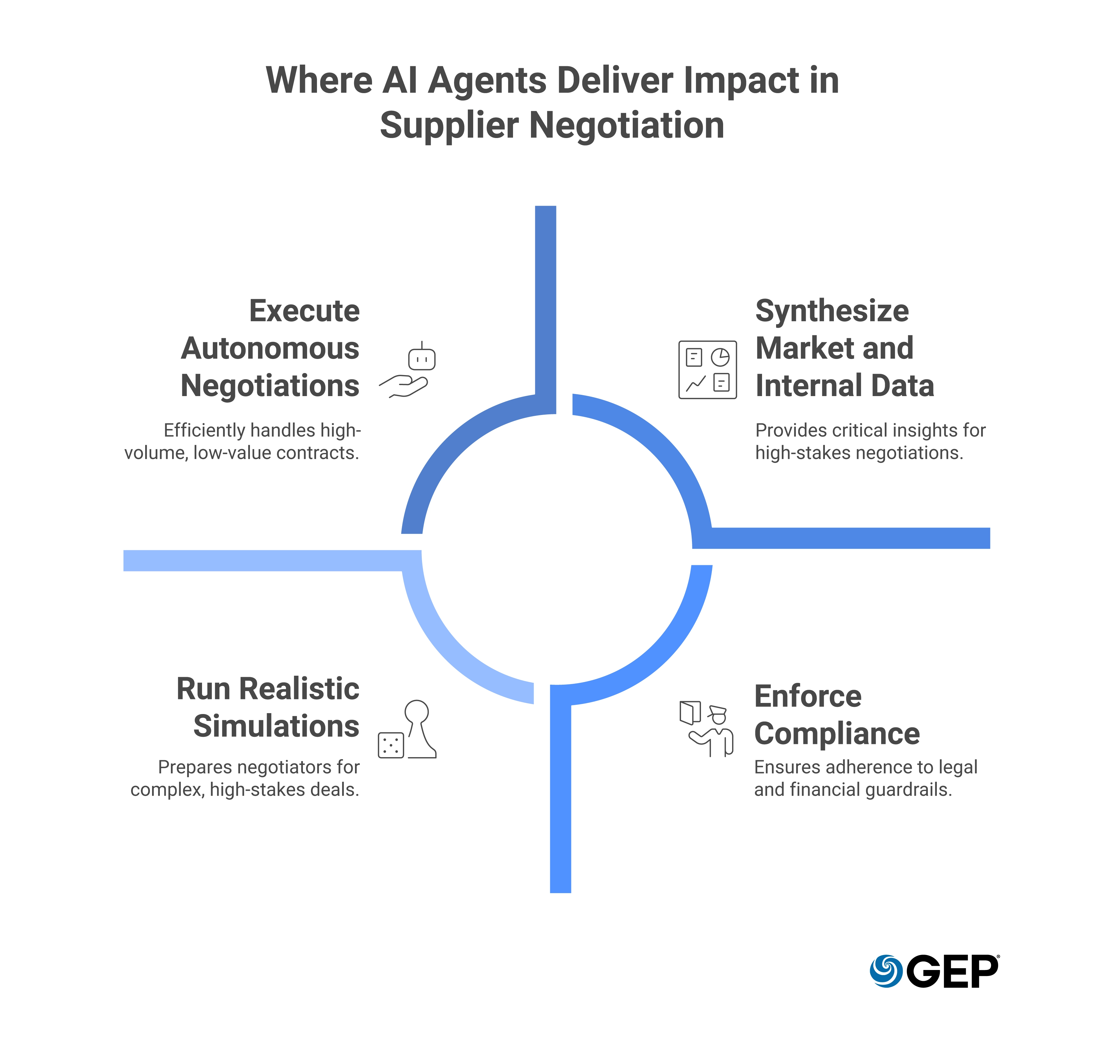
1. Autonomous Tail Spend Negotiation
This is the clearest area of impact. Most teams concentrate on the suppliers that dominate total spend. The remaining suppliers generate a mix of minor contracts that take as much effort to negotiate as the larger ones, so teams renew them out of habit. AI agents cover this gap.
How the agents operate: They launch thousands of parallel conversations with suppliers through simple chat interfaces. Each conversation stays within guardrails approved by procurement, such as acceptable price thresholds or payment-term trade-offs.
Value created:
- They recover savings that would normally slip through untouched.
- They scale instantly; one agent can complete more negotiations in a week than a human team completes in a quarter.
- They align varied suppliers to consistent terms without manual intervention.
Example: A major retailer used an automated negotiation bot for non-core suppliers. The bot secured agreements with most participants, captured measurable savings, and brought payment terms to a more favorable baseline across the board.
2. Strategic Support for High-Stakes Deals
For critical contracts, the agent shifts from negotiator to advisor. Human judgment leads these discussions, and the agent supplies the analysis needed to prepare and navigate them.
How the agents operate: They draw from prior contracts, correspondence, performance data, and external market signals. The agent uses this information to model different negotiation paths.
Value created:
- Teams can practice against simulated supplier responses based on real financial and behavioral data.
- Negotiators receive timely market information during live discussions, strengthening their position.
- The process stays steady and fact-driven, which helps keep high-pressure conversations on track.
3. Contract Discipline and Compliance
Savings disappear when negotiated terms lose traction during execution. Agents monitor this stage continuously.
Value created:
- They identify purchases that bypass preferred suppliers or contracted rates.
- They check invoices against negotiated terms and spot gradual cost drift before it turns into a pattern.
You can use AI agents in:
Maintenance, Repair, and Operations (MRO): Renewing contracts for office supplies, cleaning services, or spare parts.
Logistics: Spot-bidding for freight lanes or one-off shipping routes.
Renewals: Renegotiating software licenses where usage has dropped or terms need standardizing.
When Agentic AI Orchestrates Source-to-Pay
Learn how unified agents drive efficiency across complex workflows
Read the Report
How to Set Guardrails for Autonomous Negotiation Agents

1. Commercial Limits
These parameters define the financial boundaries of any conversation. The agent needs precise numbers to understand the company's standing.
Reservation Price
This is the firm walk-away point. If the supplier refuses to meet it, the agent closes the chat or seeks human review.
Target Price
This is the preferred outcome. The agent uses it to guide initial positioning and overall strategy.
Concession Steps
Define how much the agent can move during a single round. You might allow only small step changes to prevent rapid, unnecessary concessions. (For example, "Do not improve the offer by more than 2% per round.")
2. Concession and Trade-off Rules
Good negotiations rely on exchange, not a single-variable push. These rules tell the agent what it can offer in return for price movement.
Payment Terms
Faster payment in exchange for a discount, or slower payment for a higher rate of return.
Contract Length
Permission to extend the agreement to reach stronger pricing. For example, Is the AI allowed to offer a longer contract (2 or 3 years) to lock in a lower rate?
Volume
Authority to commit to certain order levels to unlock a better tier.
Fallback Pathways
A structured sequence: if the supplier rejects one concession, the agent moves to the next permitted alternative. Example: "First offer extended contract length. If rejected, offer faster payment terms. If rejected, offer case study participation."
3. Compliance Requirements
These parameters set the conditions that cannot be altered under any circumstance. They serve as the guardrails that preserve legal and regulatory integrity.
Required Clauses
Specific provisions (e.g., GDPR compliance, Right to Audit, Indemnification) must remain intact. If the supplier pushes back on these, the agent stops.
Governing Law
The jurisdiction (e.g., "Must be governed by New York State Law") that must appear in the final contract.
Insurance Standards
The minimum thresholds for liability coverage.
4. Operational and Escalation Triggers
These controls determine when the agent steps aside so a human can intervene.
Endless Loop Detection
If the exchange circles the same point after several attempts, the agent hands the negotiation to a human.
Sentiment Alerts
Using sentiment analysis, if the supplier’s language becomes aggressive, abusive, or highly frustrated, the AI should disengage and alert a human.
Value Thresholds
If the contract value exceeds a predefined amount during negotiations, the agent pauses and awaits approval. For example, if the total contract value exceeds $50,000 during the negotiation due to upsells, stop and request approval.
5. Behavioral Settings
These parameters shape the agent’s style so it reflects the company’s culture and the nature of the supplier relationship.
Pacing
Some suppliers would prefer slower, deliberate timing to create a natural rhythm. Others favor quick responses to push negotiations forward. You must include rules for how fast the agent should respond. Example: “Wait 4 minutes between responses to simulate human thought" or "Respond instantly to encourage speed."
Tone
You may direct the agent to maintain a problem-solving voice or a more analytical, data-first approach.
- Collaborative: "We really want to make this work! Can we meet halfway?"
- Fact-Based/Cold: "Market data suggests a 3% decrease. Please revise."
Follow-up Behavior
Define how many reminders the agent sends and the timeframe before the ticket closes. (e.g., "Send three reminders over 2 weeks, then close the ticket").
The eventual winner will not be the company with the best negotiators, but the company with the best-configured agents.
Moving from Negotiator to Architect with AI Agents
Procurement leaders must stop viewing themselves as execution engines and become system architects. Instead of negotiating individual contracts, you will now design the "logic" that guides the AI by defining the financial guardrails, acceptable trade-offs, and compliance red lines.
By codifying your best negotiation strategies into the AI's parameters, you effectively clone your top performers, ensuring that every low-value interaction is handled with expert-level consistency and precision.
Scale strategy with agentic automation. While you configure autonomous agents to handle the high-volume, repetitive "tail spend" that drains human bandwidth, your team is freed to focus purely on high-stakes strategic partnerships.
The competitive advantage of the future lies not in how well your team negotiates a single deal, but in how intelligently you have engineered the system to negotiate thousands of them simultaneously.
For a deeper look at how to strengthen supplier oversight and performance, explore our supplier management software.