


The Autonomous Enterprise: What Comes After Digital Transformation?
- Digital transformation delivered visibility, not autonomy.
- Agentic AI shifts execution from humans to systems.
- Procurement becomes the control tower of autonomous enterprise.
June 06, 2026 | Automation 5 minutes read
Digital transformation promised control. Dashboards lit up. Data lakes filled. Workflows moved from paper to platforms.
Yet most enterprises still rely on people to push decisions across the finish line. Teams monitor alerts. Analysts reconcile data. Managers escalate approvals. The technology informs. Humans execute.
That gap defines the next era of enterprise change.
The autonomous enterprise moves beyond digitization. It embeds decision-making into the operating model itself. Systems do not simply report. They act within policy, adjust to risk signals, and improve through feedback loops. Procurement sits at the center of this shift because it connects spend, suppliers, contracts, risk, and working capital in one motion.
Building the Autonomous Enterprise?
See how AI-powered procurement software turns digital transformation into real-time execution
Digital Transformation Solved the Wrong Problem
Digital transformation focused on replacing manual processes with automated workflows. ERP modernization, cloud migration, and analytics programs improved visibility and standardized transactions.
For many organizations, that effort stalled at process efficiency. Gartner has repeatedly noted that fewer than half of digital initiatives meet or exceed business outcome expectations, often because transformation concentrates on technology deployment rather than operating model redesign.
Procurement reflects that pattern. Companies implemented e-sourcing tools, contract lifecycle management platforms, and supplier portals. Cycle times improved. Compliance rose. Spend visibility sharpened.
Execution still depends on manual intervention. Buyers evaluate bids. Risk teams monitor sanctions lists. Category managers trigger events.
The result is a digitally enabled enterprise that still runs on human bandwidth.
Volatility exposes that weakness. Tariff shifts, geopolitical tensions, and supply disruptions demand real-time decisions across sourcing, logistics, and finance. Static workflows struggle under that pressure. Leaders see the data but cannot move fast enough.
Why AI Assistants Are Not Enough
Generative AI and narrow AI agents entered procurement as accelerators. They summarize contracts, draft RFx documents, and answer supplier queries. Productivity improves. Headcount stays flat.
That progress matters. It does not create autonomy.
Assistants support tasks. They do not own outcomes. They wait for prompts. They lack memory across events. They do not coordinate across systems unless explicitly programmed.
Research supported by GEP and conducted by Foundry in April 2025 found that 65% of IT leaders expect AI to integrate into supply chain and procurement operations within six months, while 64% are very likely to invest in agentic AI. The ambition is now clear. But the readiness still remains uneven.
Data fragmentation blocks progress. Most organizations believe their systems are not fully prepared for AI deployment. Research suggests that more than half lack unified procurement data architecture.
Without unified data, AI generates insights but cannot execute safely.
True autonomy requires systems that plan, act, monitor, and adjust within defined guardrails. It demands orchestration across intake, sourcing, contracting, risk management, and payment. Most AI pilots operate inside a single workflow. The enterprise remains fragmented.
Defining the Autonomous Enterprise
An autonomous enterprise embeds decision logic into its core processes. Policies translate into executable rules. Risk thresholds trigger actions. Performance data feeds learning loops.
Procurement becomes a strategic control tower rather than a transactional hub.
Consider sourcing. An autonomous model senses demand signals from intake systems, checks existing contracts, analyzes supplier risk exposure, reviews market indices, and selects the appropriate event type. It launches the event, evaluates bids using predefined scoring logic, validates compliance, and recommends or executes award decisions within policy thresholds.
Humans remain in the loop for exceptions and strategic calls. Routine execution shifts to the system.
The difference is structural. Automation executes predefined steps. Autonomy interprets context and adapts steps based on evolving inputs.
Procurement as the Engine of Autonomy
Procurement already touches the variables that matter most to enterprise resilience: cost, supply continuity, regulatory compliance, ESG reporting, and supplier innovation.
Recent research by North Carolina State University and GEP shows that procurement and supply chain leaders align on priorities such as resilience, quality, and sustainability. Execution gaps persist, particularly around AI integration and technology alignment.
Alignment without orchestration produces friction.
An autonomous enterprise resolves that friction through unified source-to-pay architecture. Intake connects to sourcing. Sourcing connects to contracts. Contracts connect to payment and performance tracking. Data flows in both directions.
When tariff exposure increases in one region, the system identifies affected suppliers, models alternative sourcing scenarios, and flags contracts requiring renegotiation. That capability depends on integrated data, embedded analytics, and agentic AI that can act within policy boundaries.
Autonomy reduces cycle times and prevents small risks from escalating into production halts. It also expands spend coverage. Tail spend categories that rarely receive structured attention can move through standardized autonomous events. Compliance improves without adding administrative overhead.
What Changes in the Operating Model?
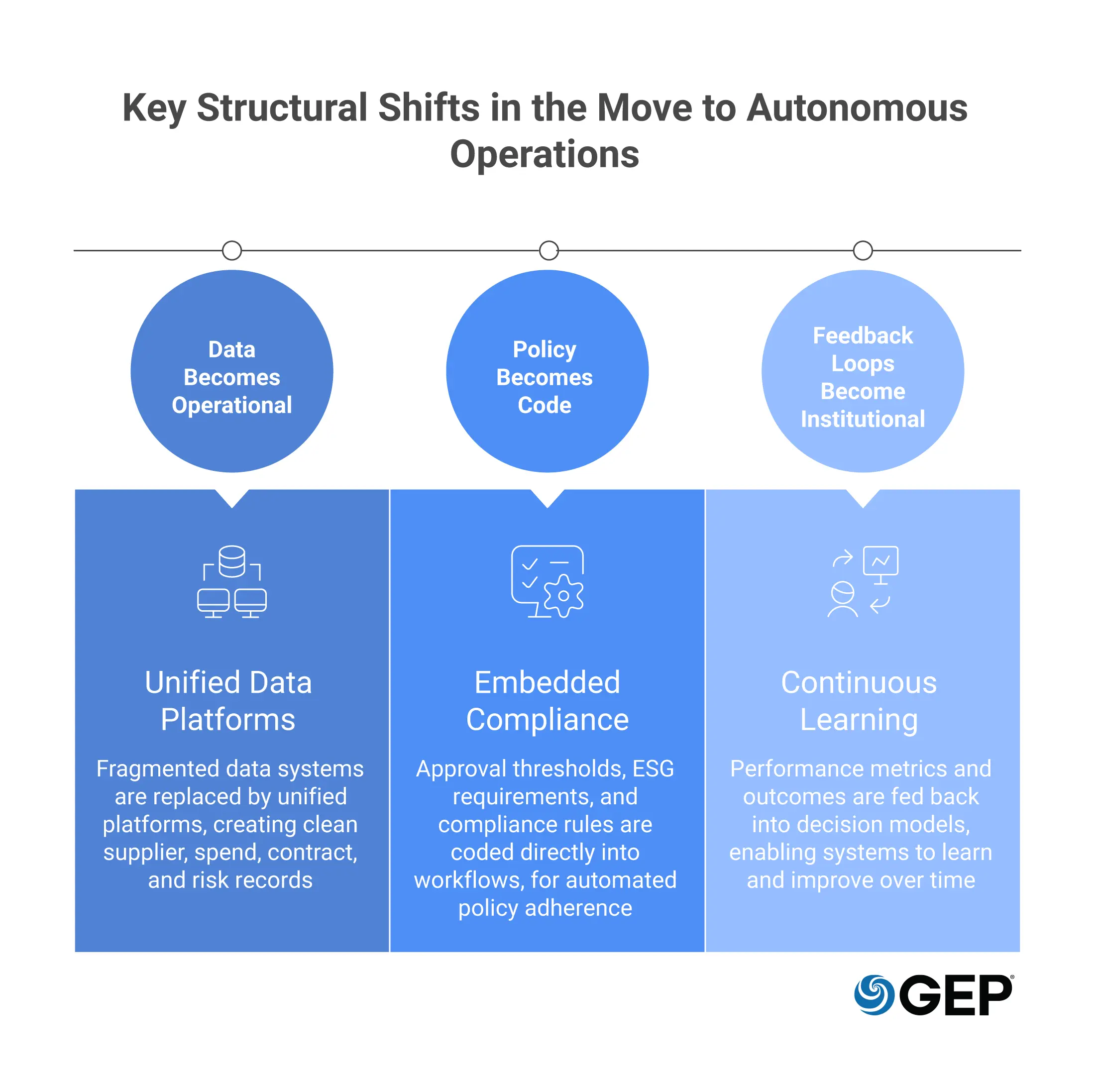
Three structural shifts define the move from digital to autonomous.
First, data becomes operational rather than observational. Unified data platforms replace fragmented systems. Clean supplier, spend, contract, and risk records form the foundation.
Second, policy becomes code. Approval thresholds, ESG requirements, segregation of duties, and regional compliance rules embed directly into workflows. The system checks every action against current policy before execution.
Third, feedback loops become institutional. Performance metrics such as cycle time, realized savings, supplier risk incidents, and compliance deviations feed back into decision models. Systems learn from outcomes.
Organizations that treat AI as a feature miss this redesign. Autonomy requires governance, data discipline, and executive sponsorship. It also requires patience. Large-scale transformation fatigue remains real. Many teams have spent a decade modernizing systems.
Incremental deployment works better than sweeping reinvention. Start with defined categories. Prove policy adherence. Measure impact. Expand deliberately.
Ready for Autonomous Procurement?
Discover how unified source-to-pay orchestrated by agentic AI turns procurement into a self-optimizing engine.
The Role of Procurement Software With AI Agents
Autonomy does not emerge from disconnected tools. It requires an integrated procurement software platform that supports agentic AI, unified data architecture, embedded analytics, and cross-functional orchestration.
AI agents inside such a platform can:
- Validate intake requests against contracts and catalogs
- Trigger sourcing events automatically within policy thresholds
- Continuously monitor supplier risk and sanctions exposure
- Record every action for audit and regulatory compliance
- Feed performance data back into future event design
That architecture moves procurement from reactive oversight to proactive execution.
GEP’s unified procurement and supply chain platforms combine source-to-pay capabilities with embedded AI agents designed for policy-safe execution. The result is shorter sourcing cycles, fewer compliance gaps, improved risk visibility, and broader spend coverage.
Autonomy becomes practical rather than theoretical.
The autonomous enterprise will not replace human judgment. It will reserve human judgment for high-impact decisions. Systems will handle the repeatable, data-intensive work that consumes most procurement capacity today.
Leaders who stop at dashboards will remain dependent on manual coordination. Leaders who embed AI agents into a unified operating model will move faster, respond earlier to disruption, and scale without proportional headcount growth.
Digital transformation digitized processes. The autonomous enterprise rewires execution itself. Procurement stands at the center of that shift.




FAQs
An autonomous enterprise uses AI agents and unified data platforms to execute routine decisions within policy guardrails. Systems sense changes, act across workflows, and improve through feedback loops while humans oversee exceptions and strategic calls.
Modern procurement software integrates source-to-pay processes, embeds AI agents for decision execution, and maintains unified supplier and spend data. This structure reduces manual intervention, shortens cycle times, strengthens compliance, and supports real-time risk management across the enterprise.