
The End of the Global Distribution System Era: How New Distribution Capability and AI Are Reshaping Corporate Air Travel Procurement
April 30, 2026 | Procurement Strategy 5 minutes read
- New Distribution Capability (NDC) is moving corporate buyers beyond legacy Global Distribution System (GDS) fare displays, offering richer content, bundled pricing and ancillaries that can deliver up to 16% savings per ticket.
- AI is transforming how those options are evaluated and booked, automating policy compliance, real-time price monitoring and disruption management at scale.
- Together, NDC and AI are helping procurement teams enable smarter contracting, stronger governance and a better traveler experience.
For decades, corporate air travel procurement ran on a simple, albeit increasingly creaky, foundation: the global distribution system. GDS platforms were the backbone of every booking, every fare comparison, and every negotiated rate.
However, the modern travel landscape has outgrown them. Business travelers expect the flexibility and personalization of consumer platforms. Finance leaders want real-time visibility and tighter policy control. And procurement teams need to squeeze more value from travel budgets that face constant pressure.
Two forces are filling that gap: New Distribution Capability (NDC) and Artificial Intelligence. Separately, each represents a meaningful upgrade. Together, they’re changing the equation on how procurement teams source, book and manage corporate air travel.
Is Your Travel Program Built for What’s Coming?
Talk to our experts about building a smarter, more resilient corporate travel strategy
What NDC Actually Changes
The Global Distribution System was built for an era where airline content was standardized, fares were fixed, and ancillaries barely existed. NDC breaks that mold. Developed by the International Air Transportation Association (IATA), it’s an API-driven standard that allows airlines to distribute rich, dynamic content directly to buyers, including bundled fares, seat selection, upgrade options and transparent ancillary pricing.
Early adopters of NDC report savings of up to 16% per ticket versus traditional GDS fares, according to Accelya and Garner. Some NDC-enabled systems are also handling approximately 99.5% of itinerary changes during disruptions without manual intervention.
Airlines are accelerating NDC-exclusive strategies. Lufthansa Group has expanded NDC-only fare categories across Swiss, Austrian, Brussels Airlines and Discover, making NDC adoption a prerequisite for their most competitive pricing.
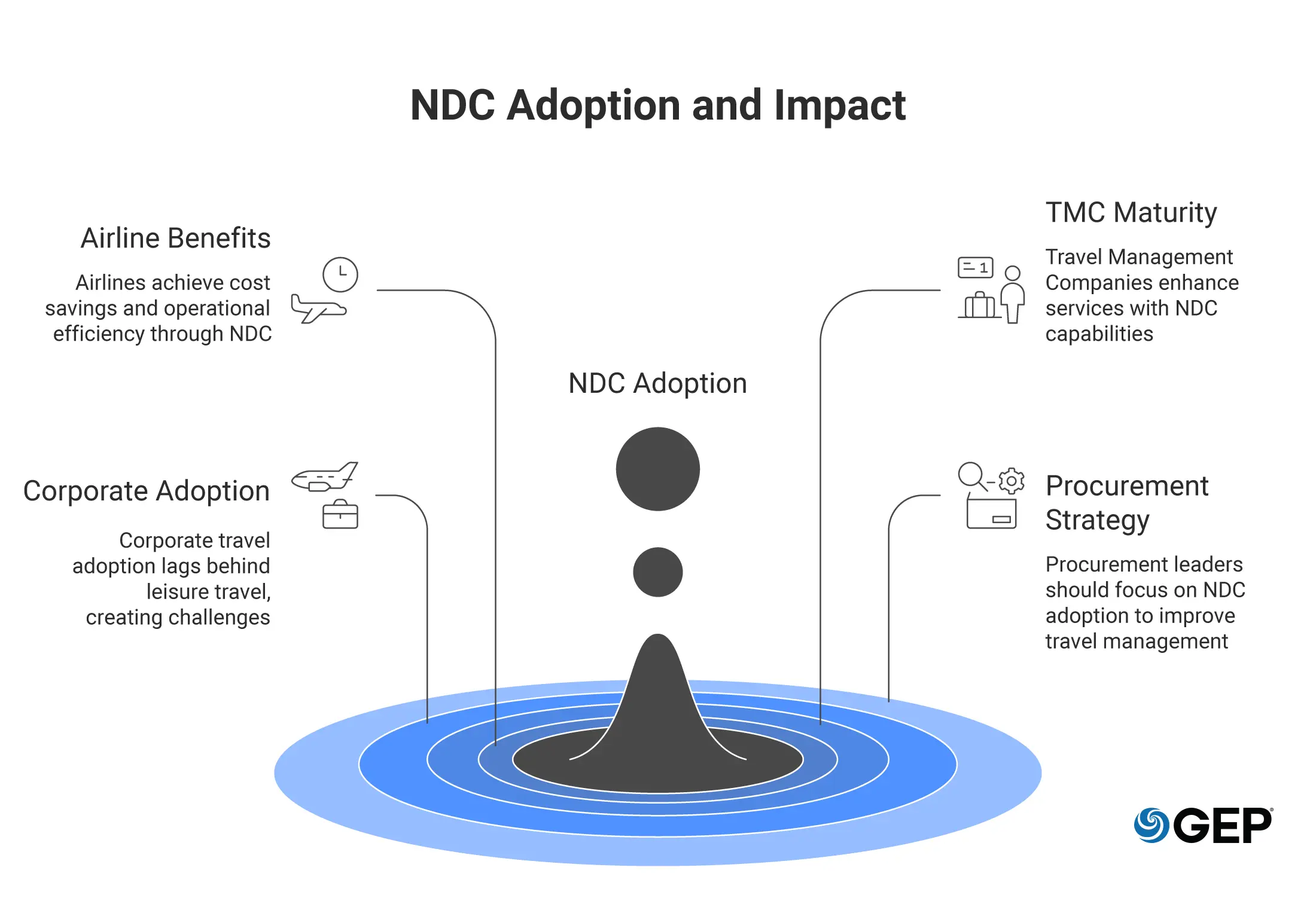
On the TMC side, FCM has achieved IATA NDC Level 4 certification, and BCD Travel has launched its NDC FastTrack program to accelerate content access for corporate clients — both signals that infrastructure maturity is catching up with ambition.
The gap between potential and reality remains real, however. Corporate NDC adoption sits at roughly 6%, compared to around 16% in leisure travel. Many TMCs and online booking tools (OBTs) still can’t surface NDC content consistently, and loyalty benefit access, exchange handling, and disruption servicing remain persistent friction points.
For procurement leaders, the direction is clear. NDC offers content, pricing flexibility and supplier relationships that legacy GDS channels cannot match. The question is no longer whether to adopt it, but how to do so without sacrificing operational continuity.
Where AI Takes Over
NDC tells you what’s available. AI determines what’s optimal.
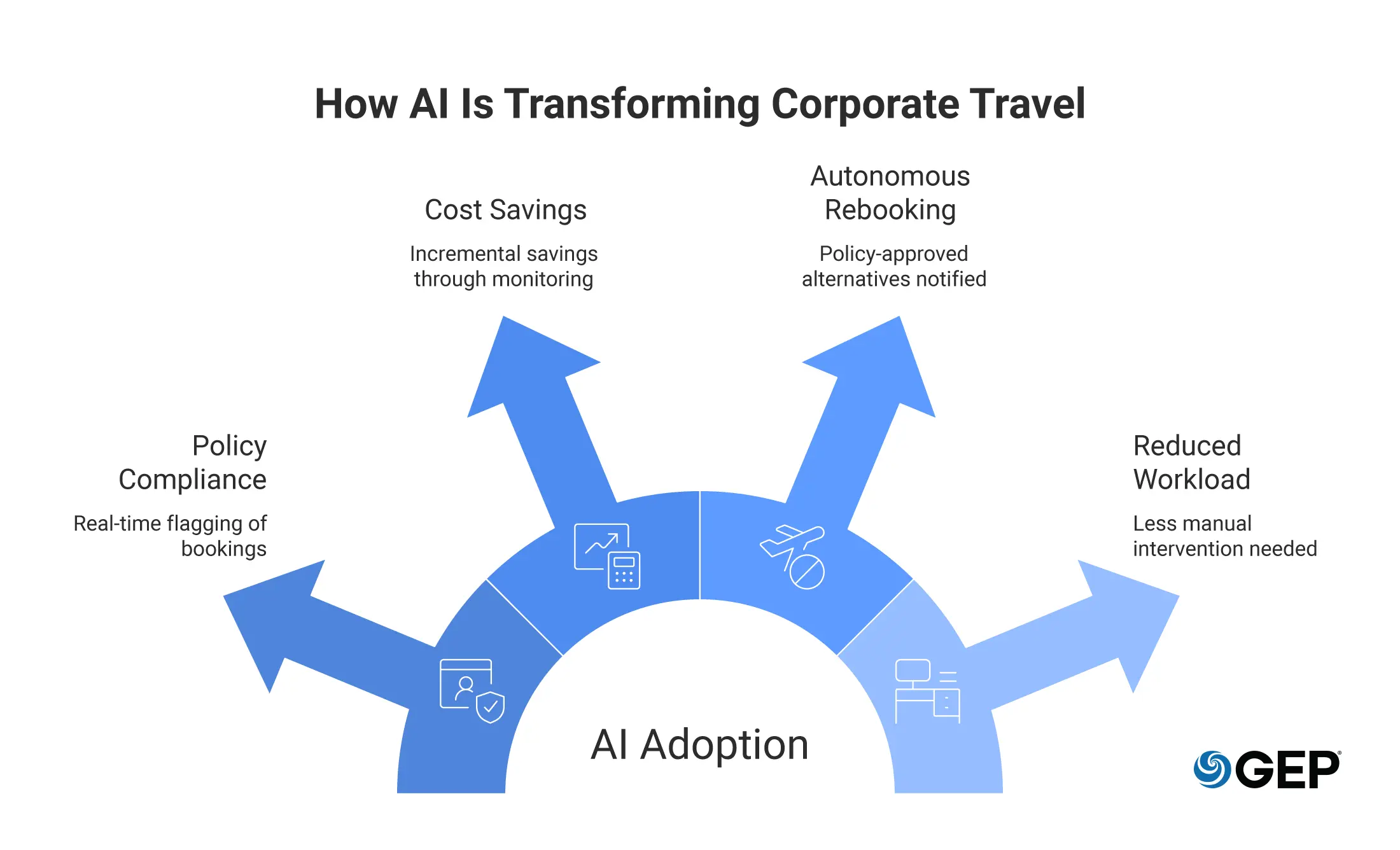
In 2025, AI adoption accelerated across every layer of the corporate travel stack. Booking platforms, TMCs and airlines are embedding machine learning into pricing, compliance and servicing workflows. Platforms like Navan surface policy-compliant flight recommendations and flag out-of-policy bookings in real time. BizTrip’s Agentic AI assistant delivers up to 8% incremental savings through continuous price monitoring and dynamic rebooking.
Airlines like Qatar Airways are using AI to manage rebooking autonomously, selecting policy-approved alternatives and notifying travelers without manual intervention from travel managers.
At the same time, there are real adoption challenges. Data privacy concerns, integration complexity, limited internal AI expertise and implementation costs are all genuine barriers. A recent GBTA study found that while 90% of business travel managers are using AI in some form, meaningful automation at scale remains aspirational for most programs.
For procurement teams, the payoffs are concrete: reduced manual workload, tighter policy enforcement, improved budget predictability and a better booking experience for employees. Those are outcomes CFOs and COOs understand and value.
What NDC + AI Looks Like at Scale
The near-term future is a full convergence of NDC and AI, where real-time airline retailing, intelligent booking and automated servicing operate as a single ecosystem. Three shifts will define this period.
Intelligent contracting will replace the static annual deal. NDC data feeding AI-native negotiation models will let procurement teams move from fixed-rate agreements to dynamic, performance-based contracts. Predictive savings forecasts, built on actual booking patterns and market pricing, will become a core input to supplier negotiations.
Infographic: How AI Is Transforming Corporate Travel
Additionally, disruption management will become fully automated. Today, a delayed flight still requires human intervention in most programs. Within a few years, AI-driven platforms will handle rebooking, policy checks, and traveler notifications end-to-end, cutting resolution times from hours to minutes.
The booking experience will look nothing like today. NDC’s visual fare displays combined with AI-native personalization will create a consumer-grade UX inside enterprise tools: bundled options, ancillaries and loyalty benefits in a single flow, with AI steering travelers toward policy-compliant choices.
What’s Your Tariff and Sourcing Risk Exposure?
Evaluate exposure and reduce risk across your procurement programs.
What Procurement Teams Should Do Now
The window for early-mover advantage won’t stay open indefinitely. Airlines are building NDC-first pricing strategies. TMCs are differentiating on AI capabilities. Programs that delay will find themselves locked into legacy content with less competitive fares and fewer options.
Start with an honest audit of your current travel stack. What percentage of bookings are NDC-enabled? Which TMCs or OBTs have achieved meaningful NDC certification? Where are the loyalty, servicing or refund gaps creating operational risk?
On AI, prioritize governance before automation. Define what tools are authorized to act autonomously — price monitoring, policy flagging, rebooking within parameters — and what requires human sign-off. That clarity protects your program’s integrity while capturing efficiency gains.
Finally, bring this to your C-suite. Travel procurement is one of the highest-spend, most data-rich categories in most organizations. NDC-driven fare savings combined with AI-powered compliance automation is a quantifiable ROI story: exactly the kind that earns budget and strategic attention.
The Competitive Advantage Is in the Stack
NDC and AI represent a fundamental redesign of how air travel is sourced, priced and serviced. The old GDS-driven model, static, opaque and increasingly expensive, is giving way to a dynamic, intelligent real-time alternative.
Companies that adopt early will shift procurement from reactive cost management to proactive value creation: smarter contracts, tighter compliance, fewer disruptions and a better experience for the people actually traveling. In a category this significant, that transformation is worth moving quickly for.
Want to understand how the leading themes reshaping procurement will play out in 2026? Download the full GEP Outlook 2026 report for detailed insights on the strategies procurement and supply chain leaders need to prioritize right now.