



Financial Services Procurement Guide for 2026
- Procurement in financial services carries regulatory weight that transforms vendor selection from cost optimization into compliance documentation.
- The sector faces a unique mix of data security needs, overlapping rules and audit requirements that affect every procurement decision.
- AI-native procurement systems are shifting from simple automation to intelligent agents that track regulatory changes and vendor risk in real time.
May 05, 2026 | Procurement Strategy 5 minutes read
In 2016, Morgan Stanley hired a third-party vendor to wipe customer data from old servers before disposal. The vendor failed to do so, however, and equipment with customer information ended up sold at auction. Regulators found Morgan Stanley "failed to adequately assess the risk of subcontracting the decommissioning work" and didn't maintain proper inventory of customer data.
The $60M penalty the bank paid shows the gap between standard procurement and what financial services actually needs. Banks and insurers work under rules where vendor choices create potential compliance issues, security gaps or reputation damage. The playbook that works elsewhere breaks down here.
What Is Financial Services Procurement?
Financial services procurement is acquiring goods and services in an industry where every vendor choice carries regulatory, security and reputation consequences beyond the purchase price.
The difference is fundamental. A consumer goods company evaluates vendors on price, delivery and quality. A bank evaluates those factors, and more: Can this vendor pass a regulatory audit? Does their data handling meet SEC and international banking standards? Will this relationship create risk if the vendor fails? Can we prove we did proper diligence if regulators ask about this decision in three years?
This applies to technology, professional services, facilities and operations. The common thread: procurement decisions create an evidence trail that must satisfy both business goals and regulatory review.
Key Aspects of Financial Services Procurement
High Regulatory Compliance
Every vendor deal must pass regulatory review from multiple jurisdictions at once. A bank can't just pick the cheapest cloud storage. They must verify the provider's data handling, encryption, residency requirements and continuity plans align with every applicable rule. The contract itself becomes a compliance document, not just a commercial agreement.
Risk Management
Vendor failures can trigger cascading problems. When a payment processor goes down, it can freeze liquidity for millions of customers and create headline risk that damages brand value. Third-party risk checks are mandatory. Teams must keep evaluating vendor financial health, operations, cybersecurity and continuity capabilities.
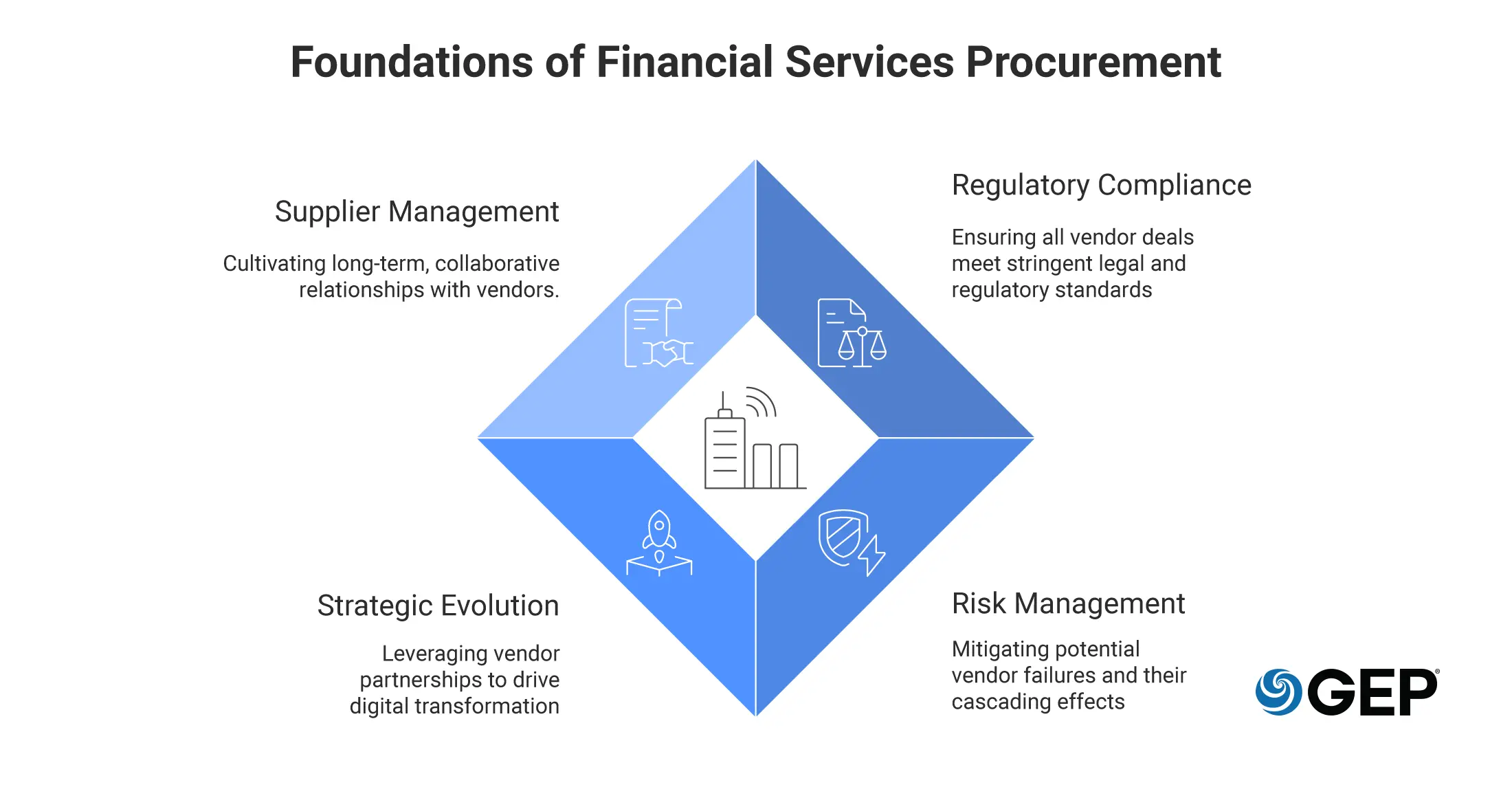
Strategic Evolution
Procurement has moved from back-office cost control to strategic partner. Vendors chosen today determine an institution's ability to deliver digital banking, process transactions and respond to market changes. A bank that picks the right payment tech partner can speed up digital transformation by years. But choose poorly, and you're stuck with legacy tech while competitors leap ahead.
Supplier Management
When the costs of switching vendors are high, long-term relationships matter more than one-time deals. This means ongoing collaboration beats one-time contract talks. A vendor approved three years ago may have changed ownership, altered data practices or experienced key staff turnover. Systems need to track these changes and flag issues before they create compliance gaps.
What Are the Challenges in Financial Services Procurement?
Increased Regulatory Framework
Overlapping rules across jurisdictions create complexity. A contract structure approved under New York financial rules may violate European banking directives. Teams must navigate this maze while still executing vendor agreements. The regulatory landscape shifts constantly. New privacy requirements, changing capital standards and evolving cybersecurity mandates all create ripple effects through vendor relationships.
Data Security Risks
Every vendor creates a potential entry point for cyberattacks. Financial institutions hold valuable, heavily regulated data, so when a third-party vendor gets breached, the institution faces regulatory and reputation consequences, even if the technical failure happened outside their control. Procurement must evaluate cybersecurity with the same rigor as pricing.
Increased Costs
Compliance can add 15% - 30% to procurement cycle times, what with the extra due diligence, legal review, security checks and regulatory approvals. But these costs are small compared to non-compliance expenses. A single violation can generate fines that dwarf years of procurement savings.
Need for Transparency in Financial Services
Regulators and auditors demand clear documentation of vendor selection reasons, ongoing monitoring and risk mitigation. Procurement decisions must be defensible years later when auditors ask why you picked this vendor and what due diligence you did. Paper trails must be complete and audit-ready at all times.
Financial Services Procurement Best Practices
Promote Socially Responsible Procurement
ESG criteria now factor into vendor selection as business considerations, not optional add-ons. Investors scrutinize third-party labor practices, environmental impacts and governance as indicators of risk management quality. Vendor relationships that conflict with ESG commitments create reputation risk.
Build Strategic Supplier Partnerships
When procurement and vendors work together on security protocols, integration and service delivery, both sides benefit. Strategic partnerships enable innovation in a way that purely transactional relationships don't.
Establish and Track Metrics
Move beyond cost savings as the main metric. Measure compliance rates, vendor stability scores, security assessment results, audit resolution times and contract risk levels. A dashboard tracking these indicators gives leadership a full view of procurement performance.
Embrace Data-driven Decision Making
Procurement analytics can predict vendor issues before they impact operations. By monitoring vendor financial reports, industry news and performance trends, teams can spot emerging risks while there's still time for contingency plans. This transforms reactive firefighting into proactive risk management.
Vet AI Like You Do Your Vendors
Evaluate Agentic AI With the Same Rigor Regulators Demand
Leverage AI: From Automation to "Agentic" Intelligence
Invoice matching, purchase order processing and contract renewals all benefit from rule-based automation. Agentic AI goes further. Instead of following set rules, these systems actively monitor for compliance drift and flag risks early. An agentic AI system can monitor regulatory updates and identify contracts that may be affected by new requirements. If the EU updates data residency rules, the agent can spot potential conflicts in agreements and recommend a fix. This shifts procurement from reactive compliance to predictive risk management.
Future Trends in Financial Services Procurement
Real-time regulatory monitoring will embed directly in procurement platforms. Systems will update requirements, flag affected contracts and suggest amendments automatically. The link between procurement and enterprise risk management will deepen, allowing chief risk officers to see vendor concentration risk and supply chain vulnerability alongside traditional risk metrics.
A Different Approach Makes Procurement a Competitive Advantage
For financial services procurement, oversight is tighter and error margins are smaller. But when it’s managed right, procurement can be a competitive advantage. Institutions that build strong procurement capabilities can move faster on strategic initiatives, maintain better vendor relationships and navigate regulatory changes more efficiently than competitors using traditional approaches.
Streamline your procurement process with our expert procurement services – Get started today.




FAQs
Financial services procurement must satisfy regulatory compliance, security requirements and audit readiness on top of traditional cost and quality metrics. Every vendor decision creates potential regulatory exposure that teams must document and defend.
Procurement platforms with built-in audit trail capabilities, vendor risk modules and compliance documentation features help manage audit requirements by maintaining evidence of due diligence and decision rationale.
Automation ensures consistent application of compliance requirements, maintains complete audit trails automatically and flags potential issues before they become violations. Advanced AI systems monitor regulatory changes and identify affected contracts.