



Sustainability Report or ESG Report: Do You Know Which One Your Business Actually Needs?
- Sustainability and ESG reports serve different audiences. Mixing them up creates gaps that regulators and investors will notice.
- Procurement teams hold most of the data both reports need. Getting that data right is the real challenge.
- Companies that build one shared data system to feed both reports save time, reduce errors, and are better prepared for audits.
April 17, 2026 | Sustainability 6 minutes read
More businesses than ever before are required to submit reports on their social and environmental performance. What was formerly a voluntary activity is rapidly turning into a legal duty due to new regulations in the US, Europe, and other major markets. The EU's Corporate Sustainability Reporting Directive (CSRD) already covers over 50,000 businesses, and 17 additional nations are expanding their climate disclosure regulations.
However, many companies continue to treat the sustainability report and the ESG report as the same. Both are important. Both rely on comparable data. However, they provide distinct services and respond to various enquiries. If you do that incorrectly, you may fail compliance tests, mislead investors, or duplicate work that your team is currently performing.
This blog discusses how the two reports differ from one another, why procurement is important in both, and how to create a straightforward system that covers both without needless additional labor.
What is a Sustainability Report?
A sustainability report describes a company's impact on the environment. It covers things like how much energy and water the company uses, how it treats its employees and local communities, and its efforts to lessen its environmental impact.
Employees, clients, community organizations, non-governmental organizations, and increasingly other companies considering whether to collaborate with you are the people who read it. When discussing programs, advancements, and long-term objectives, the tone is frequently narrative and explanatory.
The Global Reporting Initiative (GRI), which has formed the foundation of sustainability disclosure since 1997 and is currently utilized by over 10,000 businesses worldwide, is the most extensively used standard for sustainability reports. The CDP questionnaire and the UN Sustainable Development Goals (SDGs) are two more often cited sources.
In its most basic form, a sustainability report poses the question, "How does our company affect the world?"
What is an ESG Report?
An ESG report answers a very different question: "How do environmental, social, and governance issues affect the financial health of our company?"
Investors, banks, analysts, and regulators are the main audience members. These readers like statistics over stories. They want to know which climate risks could have an impact on the company's future profits, how well the board manages those risks, and how the company's operations stack up against those of other companies in the same sector.
ESG reporting is more structured, regulated, and investor-facing in comparison to traditional sustainability reporting. The frameworks used include SASB (which sets industry-specific metrics), TCFD (which focuses on climate-related financial risk), and the newer ISSB standards (IFRS S1 and S2), which are fast becoming the global benchmark for investor-facing disclosure.
To put it simply, an ESG report poses the question, "How does the world affect our company's value?"
Key Differences Between Sustainability Reports and ESG Reports
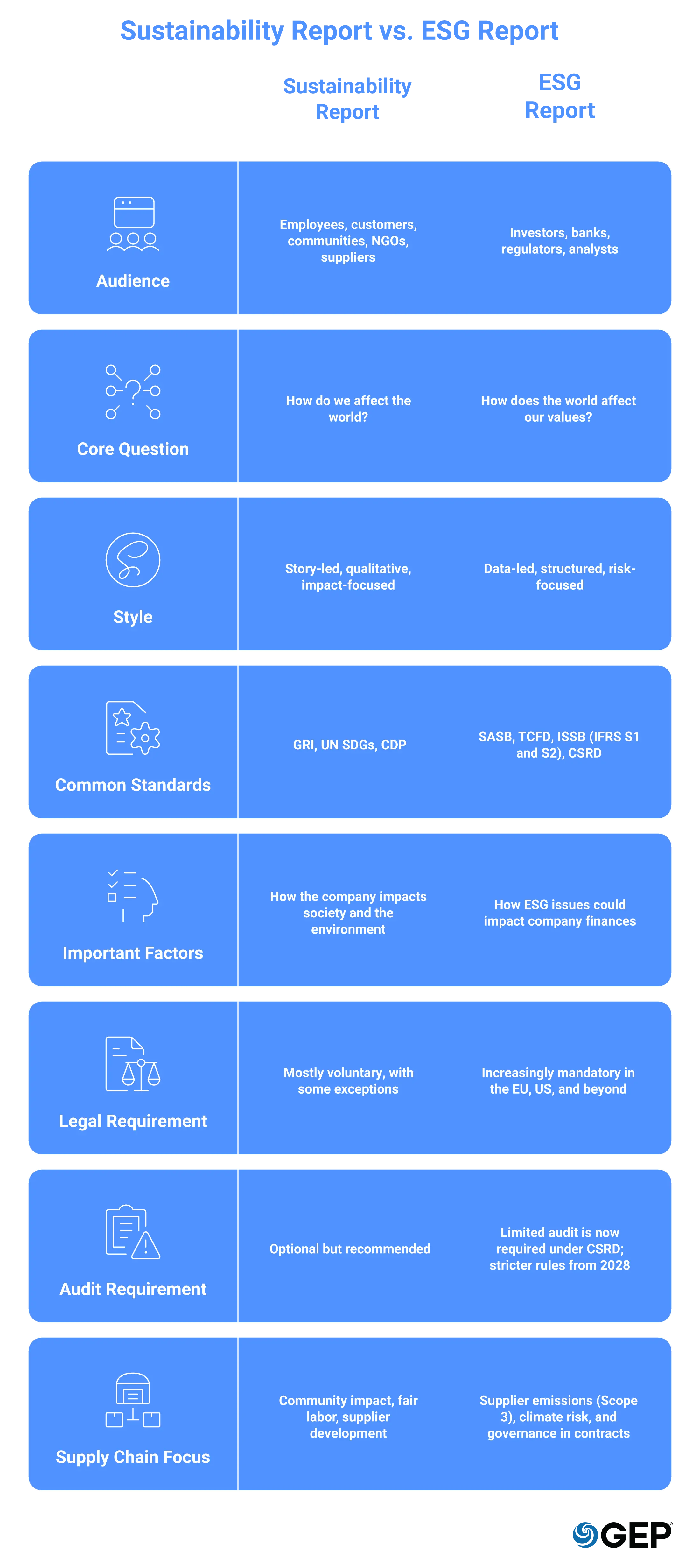
Although the data included in both reports is identical, they are designed for different audiences, goals, and increasingly different regulatory requirements. A side-by-side comparison is shown here:
Where Businesses Go Wrong
The most common mistake is thinking that everything is covered in a single yearly sustainability report. It rarely does.
Investors require structured, auditable data, which cannot be found in a report created for employees and community stakeholders. Additionally, the supplier-level emissions data that is now essential to both report types is hardly ever included.
Three issues keep coming up:
1. Data is scattered across teams
Procurement, finance, operations, and sustainability each hold different pieces of the picture. These components never come together to provide a comprehensive report in the absence of a shared system.
2. The wrong standards are used for the wrong audience
When investors require SASB-structured data, teams generate a report in the GRI format. In the end, the work is completed twice using disparate data sources and an inconsistent technique.
3. There is a lack of supply chain data
Many businesses have little insight into the real emissions and environmental practices of their suppliers. Supplier emissions (often referred to as Scope 3) account for most of the carbon footprint of many businesses. Both reports are lacking if procurement does not have access to quality supplier data.
How Companies Benefit from Producing Both Reports
The business case for completing both reports effectively is no longer abstract. Businesses that integrate procurement and operational data into their reporting processes reap significant benefits.
1. Better access to finance
Sustainability-linked lending is progressively increasing, and a company's eligibility for financing and access to investment funds is directly impacted by structured, auditable ESG disclosure. ESG performance is becoming a more important consideration for lenders and institutional investors.
2. Staying on the right side of the rules
Major economies are adopting more ESG disclosure regulations, and every year, more nations conform to international standards. Non-compliance is increasingly not just a fine risk but a procurement access risk, as buyers require verified ESG data before awarding contracts.
3. Avoiding reputational damage
Businesses that make public statements that are not supported by their data are increasingly at risk from regulations and damage to their brand. Large organizations have recently faced severe financial penalties as a result of greenwashing instances. This danger is greatly decreased by a reliable sustainability report based on the same validated data that drives ESG disclosure.
4. Less duplicated work
When procurement systems are linked to sustainability and ESG reporting procedures, organizations find that both reports become more accurate, easier to defend during an audit, and more efficient to create.
5. Stronger supplier relationships
When procurement procedures explicitly incorporate ESG requirements, suppliers are aware of what is expected of them. As a result, there are fewer back-and-forths, longer-term partnerships are formed, and it becomes simpler to collaborate on common sustainability objectives over time.
The 2026 Annual ProcureCon CPO Report
Emerging insights about the evolving role of the chief procurement officer
The Bottom Line
An ESG report and a sustainability report are two different documents created for different audiences. They provide distinct answers, fulfil distinct purposes, and increasingly have distinct legal obligations. Auditors, investors, and regulators will discover gaps if they are treated as interchangeable.
The businesses that are succeeding are those that have developed a shared data system that automatically renders both reports accurate and audit-ready, rather than considering these as distinct yearly tasks. Since most of the data is there, procurement is the function that makes this possible.
If you want to explore how to set this up at your organization, talk to a GEP expert.



FAQs
Yes, for big companies with international operations or exposure to the EU. The sustainability report fosters trust among communities, workers, and consumers. The standardized, comparable data that investors and regulators require is provided by the ESG report. The good news is that your workload won't necessarily double because both can use the same data system.
The most effective reports start with clean, reliable data, and that data largely lives in procurement. It is much easier to create both reports when you control your contract governance, spend data, and supplier information. The key is to refrain from viewing reporting as an annual task. Businesses that consistently gather and manage ESG data throughout the year provide reports that are easier to audit, more accurate, and more trustworthy to readers.
In both, it is often the most important data you have. Supplier emissions, contract-level governance, and third-party audit results are central to ESG investor disclosure and sustainability narrative reporting. Procurement teams that do not systematically collect and manage this data create gaps in both reports.