


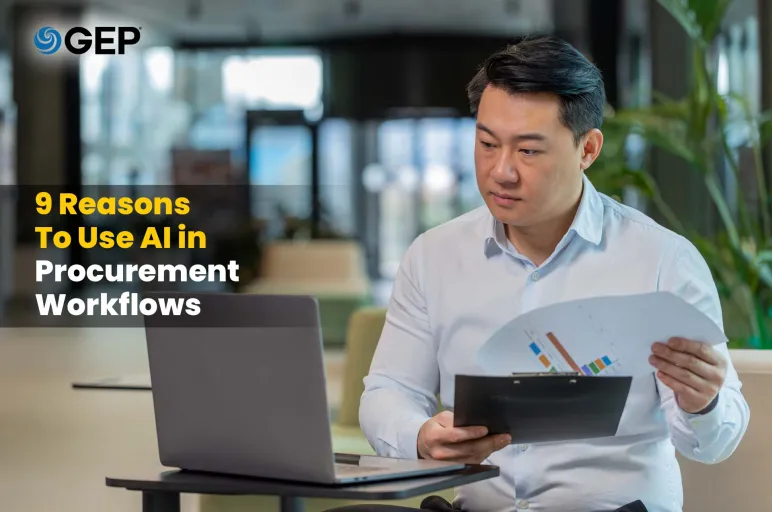
9 Top Benefits of Using AI in Procurement Workflows
- AI moves procurement from reacting to the past to shaping what happens next.
- Faster workflows matter, but better decisions are where the real value lies.
- AI frees procurement from routine work so it can focus on strategy and impact.
May 06, 2026 | Procurement Strategy 6 minutes read
If you have spent a decade or more in procurement, you have probably seen every wave of transformation. ERP. Outsourcing. Digital procurement. Analytics.
Now AI is here. And this time, it is not just another layer. It is changing how decisions get made.
The real question is not what AI can do. The real question is what you should stop doing manually.
Because right now, a large part of your procurement workflows is still dependent on human effort. Chasing approvals. Cleaning data. Comparing suppliers. Reviewing contracts line by line.
AI changes that equation.
It compresses time. It expands visibility. And most importantly, it gives you leverage.
Teams using AI in procurement are already seeing 60 to 80 percent faster contract cycles and the ability to handle 2 to 3 times more workload without adding headcount.
So, this is not about incremental efficiency. This is about redefining your role.
Understanding Procurement Workflows using AI
Let’s make this real.
A typical procurement workflow looks clean on paper. Requisition. Sourcing. Evaluation. Contracting. Purchase. Payment.
In reality, it is messy.
Unlock smarter procurement with AI
Make faster, sharper decisions across your procurement workflows.
Data sits in different systems. Supplier information is inconsistent. Approvals get stuck. Insights come too late.
AI does not just automate steps. It fixes the underlying fragmentation.
Here is what changes when you embed AI technology into procurement workflows:
- Spend data is automatically classified and normalized across systems
- Supplier performance is continuously tracked and scored
- Contracts are analyzed instantly with key risks flagged
- Approvals are dynamically routed based on risk and value
- Insights are generated in real time instead of monthly reports
This is why leading procurement systems are shifting from workflow engines to decision engines.
And this is where most teams underestimate AI.
It is not just about saving time. It is about changing the speed and quality of decisions.
For example, AI powered contract tools can automatically review agreements, extract key clauses, and reduce manual review effort by up to 80 percent.
That is not automation. That is augmentation.
Key Benefits of using AI in Procurement Workflows
1. Decision intelligence replaces manual analysis
For years, procurement decisions have leaned heavily on looking backward. You review past spend, check supplier performance, and then try to make the best call for what comes next.
AI changes that rhythm.
Instead of spending time piecing together insights, you start with them. AI pulls together large volumes of data, both structured and messy, and turns it into something you can actually use. You begin to see where prices are likely heading, where supply risks are building, and where your sourcing strategy needs to shift.
It is a subtle but powerful change. You are no longer reacting to what has already happened. You are making decisions with a clearer view of what is likely to happen next.
2. Cycle time compression becomes systemic
Every procurement team has tried to reduce cycle times. Usually, it comes down to pushing harder, setting stricter SLAs, or chasing approvals more aggressively.
That only gets you so far.
AI improves cycle time in a more structural way. Approvals move automatically based on logic, not follow ups. Documents flow through the process without getting stuck in inboxes. Repetitive steps simply disappear.
What you notice is not just speed, but consistency. Timelines become more predictable, which matters a lot in sourcing events and contract negotiations where delays tend to ripple across the business.
3. Data integrity and accuracy improve at scale
If you have worked in procurement long enough, you know how unreliable data can be. Supplier records do not match across systems. Spend is misclassified. Contracts sit in different formats and locations.
AI helps clean this up quietly in the background.
It standardizes data, flags inconsistencies, and keeps things aligned across systems. Over time, you start trusting your data more because it holds up under scrutiny.
That has a direct impact on decision-making. When the data is solid, you spend less time questioning it and more time acting on it.
4. Spend visibility becomes actionable
Most organizations believe they have spend visibility. In reality, they have partial visibility spread across multiple tools.
AI connects the dots.
It classifies spend automatically, surfaces patterns you would not catch manually, and highlights where money is leaking. You begin to see things like off-contract buying, fragmented supplier bases, or missed consolidation opportunities.
The difference is that insights are not buried in reports. They are clear, timely, and usable. That is what makes procurement strategies sharper and more effective.
5. Supplier management evolves into continuous evaluation
Supplier management has traditionally relied on periodic reviews and a fair amount of judgment.
AI brings more structure to it.
You get a continuous view of supplier performance across delivery, quality, pricing, and risk signals. Instead of waiting for a quarterly review to spot an issue, you see it as it develops.
This changes how you manage relationships. Conversations become more fact based. Decisions become easier to justify. And when it comes to negotiations, you walk in with data that is hard to challenge.
6. Procurement capacity expands without proportional cost increase
One of the biggest constraints in procurement is capacity. There is always more work than the team can realistically handle.
AI helps rebalance that.
By taking over routine tasks and supporting decision-making, it allows your team to handle more without feeling stretched. More suppliers, more contracts, more categories can be managed with the same core team.
This is where procurement starts to scale without becoming heavier or more expensive. It becomes more efficient, but also more impactful.
7. Risk management becomes proactive and continuous
Risk in supply chains does not follow a schedule. Yet, many organizations still review it periodically.
AI shifts this to a continuous model.
It monitors supplier performance, external signals, and market developments in real time. When something starts to change, you know early enough to respond.
This is especially important now, where disruptions are not rare events. They are part of the operating environment. Staying ahead of them is what separates stable operations from constant firefighting.
8. User experience improves across the procurement function
Adoption has always been a sticking point for procurement systems. If tools feel complicated, people find ways around them.
AI is starting to change that experience.
With generative AI in procurement, systems are becoming easier to interact with. You can search, ask questions, generate documents, and move workflows forward without navigating complex interfaces.
This reduces friction for everyone involved, not just procurement teams but also stakeholders across the business. And when the experience improves, compliance tends to follow naturally.
Also Read: Our Whitepaper - Next-Gen Procurement Using Gen AI
9. Procurement transitions into a strategic business partner
When you step back and look at all of this together, the bigger shift becomes clear.
Procurement moves beyond executing transactions.
With better visibility, faster decisions, and stronger insights, it starts influencing outcomes. Cost structures improve. Risks are managed earlier. The business responds faster to change.
That is when procurement becomes a true strategic partner rather than a support function.
If you are looking to move in that direction, exploring Procurement Services can help you understand how to bring AI into your procurement workflows in a structured and scalable way.
Stay ahead of shifting spend dynamics across key categories.
Explore the GEP Spend Category Outlook to inform data driven decisions.
Conclusion
AI in procurement is not about doing the same things faster.
It is about doing different things.
Less manual work. Better decisions. Higher impact.
If you approach it correctly, AI does not replace your role.
It elevates it.
And the teams that figure this out early will not just be more efficient.
They will be more influential.



FAQs
How does AI improve procurement accuracy?
AI improves accuracy by validating and standardizing data automatically, detecting anomalies, and reducing manual errors across procurement workflows.
How does AI reduce cycle time in procurement workflows?
AI reduces cycle time by automating approvals, streamlining workflows, and eliminating manual bottlenecks in procurement operations.
What procurement workflow stages can be automated using AI?
Sourcing, supplier evaluation, contract management, purchase order processing, and invoice matching can all be automated using AI.
How does AI use data to improve procurement workflow efficiency?
AI analyzes large volumes of structured and unstructured data to generate real time insights, predict outcomes, and optimize procurement decisions.