



How Can Green Consulting Help Companies Reduce Their Environmental Impact?
- Sustainability works best when it is tied to spend and supplier decisions.
- Focus on a few high-impact areas instead of trying to fix everything.
- Data and supplier collaboration are what make progress stick.
April 07, 2026 | Procurement Strategy 5 minutes read
Procurement leaders already know this: sustainability is no longer a side conversation. It sits alongside cost, risk and resilience.
What is changing now is the level of expectation. Boards want measurable progress, regulators want transparency and customers want proof. This is where green consulting steps in. Not as theory; but as a structured, practical way to reduce your environmental footprint while still hitting commercial targets.
What is Green Consulting and its Role in Businesses?
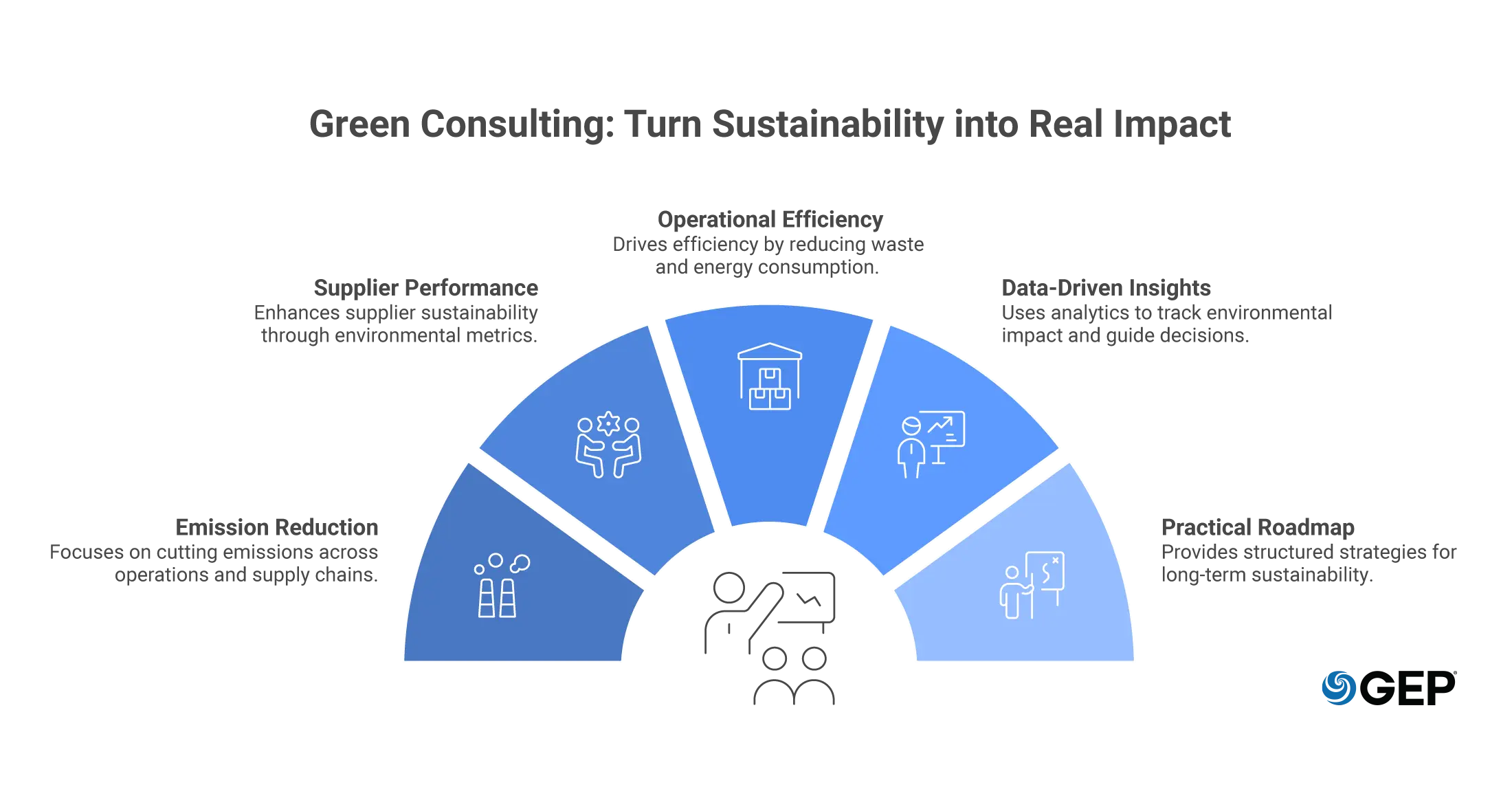
Let’s simplify what is often overcomplicated. Green consulting is a specialized form of sustainability consulting that helps organizations design and execute initiatives to reduce environmental impact. It combines environmental consulting services with operational know-how, which is exactly why it resonates with procurement leaders.
At its core, green consulting answers a very practical question: where are we today and what should we fix first?
A good consultant typically starts with an environmental impact assessment for businesses. That means mapping emissions across Scope 1, 2 and 3, understanding supplier practices; and identifying energy, waste and logistics inefficiencies. From there, you build what is often called a corporate sustainability roadmap. Not a glossy deck but a prioritized plan with timelines, owners and measurable outcomes.
What makes this powerful in a procurement context is the connection to spend. Sustainability becomes tangible; tied directly to sourcing decisions, supplier selection and contract design. That is where you begin to see real traction.
Start reducing your environmental impact without slowing the business down.
Turn sustainability into a measurable advantage.
Key Strategies Green Consulting Uses to Reduce Environmental Impact for Companies
Here is where things get actionable. Green consulting is not about one big initiative; it is about a set of coordinated moves across operations and supply chain.
1. Carbon footprint mapping and reduction
The first step is clarity. You cannot reduce what you cannot measure. Consultants help you calculate your baseline emissions and then identify reduction levers, energy efficiency, supplier shifts, logistics optimization and product redesign.
For example, switching to lower emission suppliers in key categories or redesigning packaging can significantly reduce your corporate carbon footprint without major disruption.
2. Building a sustainable supply chain
This is where your role becomes central. A sustainable supply chain is not just about compliance, it is about collaboration. Green consulting helps define supplier standards, integrate sustainability into RFPs and create scorecards that go beyond price.
You start asking better questions: what is the supplier’s energy mix? How do they manage waste? Can they commit to science-based targets?
3. Energy and resource optimization
This is often the quickest win. Consultants identify inefficiencies in energy usage, water consumption and material waste. Think of it as lean applied to sustainability.
You will see initiatives like facility upgrades, smarter energy sourcing and process optimization. These are not only good for the environment; they reduce operating costs. That dual benefit is what gets leadership buy-in.
4. Circular economy practices
Instead of the traditional take make dispose model, green consulting pushes companies toward reuse, recycling and remanufacturing.
For procurement, this means sourcing materials that are recyclable or designing contracts that enable take back programs. Over time, this reduces dependency on virgin materials and lowers environmental impact.
5. Data and digital enablement
Sustainability without data becomes guesswork. Consultants help implement tools that track emissions, supplier performance and compliance in real time.
Platforms like GEP GREEN support this by embedding sustainability into procurement workflows; so you are not managing it as a separate initiative but as part of daily decision-making.
Key Benefits of Green Consulting for Companies
Now the obvious question: does this actually move the needle for the business?
Short answer – yes, and in more ways than you might expect.
1. Cost optimization with purpose
Energy savings, waste reduction and efficient logistics directly reduce costs. At the same time, you are advancing sustainable business practices.
2. Stronger supplier ecosystem
When you embed sustainability into sourcing, you elevate your supplier base. You attract partners who are future ready and reduce exposure to regulatory or reputational risks.
3. Regulatory readiness
Regulations are only getting stricter. Green consulting ensures you are not reacting at the last minute. You build processes that are compliant by design.
4. Brand and stakeholder trust
Customers and investors are paying attention. Demonstrating a clear corporate sustainability roadmap builds credibility not just externally but internally as well.
5. Better decision-making
With the right data and frameworks, sustainability becomes part of everyday decisions. You are no longer debating whether to act, you are choosing how fast to move.
Stay ahead of shifting spend dynamics across key categories.
Explore the GEP Spend Category Outlook to inform data driven decisions.
Steps to Get Started with Green Consulting
If you are thinking this sounds good but where do I begin, here is a practical path.
Step | What you actually do | Why it matters |
|---|---|---|
| Step 1: Assess your current state | Get a clear baseline. Look at your emissions, energy use, waste and supplier footprint. No need to overcomplicate it. Just get a truthful starting point. | You cannot improve what you cannot see. This gives you clarity and direction. |
| Step 2: Define priorities | Don’t try to fix everything. Pick the areas that move the needle. Usually high spend categories or suppliers with heavy emissions. | Focus keeps things realistic and helps you show early results. |
| Step 3: Build a roadmap | Turn ideas into a plan. Define what gets done, by when, and who owns it. Plug this into procurement and operations so it is not sitting on the side. | Execution is everything. This is where strategy becomes real work. |
| Step 4: Engage suppliers | Have honest conversations with suppliers. Set expectations, share goals and support them where needed. Make sustainability part of how you evaluate them. | Most of your impact sits in the supply chain. You cannot do this alone. |
| Step 5: Leverage technology and expertise | Invest in technology to make sustainability part of everyday workflows. | This keeps things scalable and avoids manual tracking chaos. |
| Step 6: Track and refine | Keep measuring. See what is working and what is not, then adjust. Small improvements over time beat big one-time efforts. | Momentum builds credibility and keeps leadership bought in. |
Green consulting works because it connects sustainability with real business levers: cost, risk and supplier performance. It gives you a structured way to reduce impact without slowing the business down.
Unlock GEP’s Sustainability consulting services



FAQs
Green consulting identifies where energy is being wasted across operations and supply chains. It recommends practical fixes like process optimization, efficient equipment and smarter sourcing. Over time, these changes reduce overall consumption, lower costs and make energy performance more predictable and easier to manage.