



How Does the Order-to-Cash Cycle Impact a Company’s Cash Flow?
- The order-to-cash cycle controls how quickly a business converts sales into usable cash, making it one of the most consequential financial processes in any organization.
- Delays at any stage of the O2C process, from order fulfillment to invoicing to collections, create gaps that constrain growth and erode working capital efficiency.
- Optimizing the O2C process through automation, clear governance and real-time visibility can dramatically improve Days Sales Outstanding (DSO) and overall liquidity.
April 09, 2026 | Procurement Strategy 4 minutes read
Revenue is a vanity metric. Cash flow is reality.
A company can post record sales and still struggle to make payroll if the cash from those sales takes too long to arrive. This is the central paradox of growth-stage businesses and large enterprises alike, and it’s exactly why the impact of the order-to-cash cycle on cash flow deserves more attention.
Today, with working capital under pressure and interest rates still elevated, finance and operations leaders can’t afford to treat the order-to-cash process as back-office housekeeping. It’s a differentiator between a business that scales confidently and one that’s perpetually cash-constrained.
What Is the Order-to-Cash Cycle?
The order-to-cash cycle (O2C) is the sequence of business processes that govern how a company receives, fulfills and collects payment for customer orders. It spans order management and credit checks, through order fulfillment, invoicing, accounts receivable, collections and final cash application.
Every step is a potential friction point: an invoicing error delays payment, a slow credit check delays fulfillment, a manual collections process lets overdue balances sit longer than they should.
The cumulative impact of those delays is captured in one critical KPI: Days Sales Outstanding (DSO), the average time between sending an invoice and receiving payment. Every unnecessary day of DSO is working capital locked in the system rather than available to the business.
Why the O2C Cycle Matters for a Company’s Cash Flow
The longer it takes to complete the O2C cycle, the longer cash remains tied up in receivables instead of funding operations, investment or debt service.
Consider the scale of the compounding effect. In a business processing 10,000 invoices per month at an average of $5,000 each, a single-day DSO reduction frees $50 million in working capital. That’s capital that can fund hiring, inventory, R&D or debt repayment, without touching a credit facility.
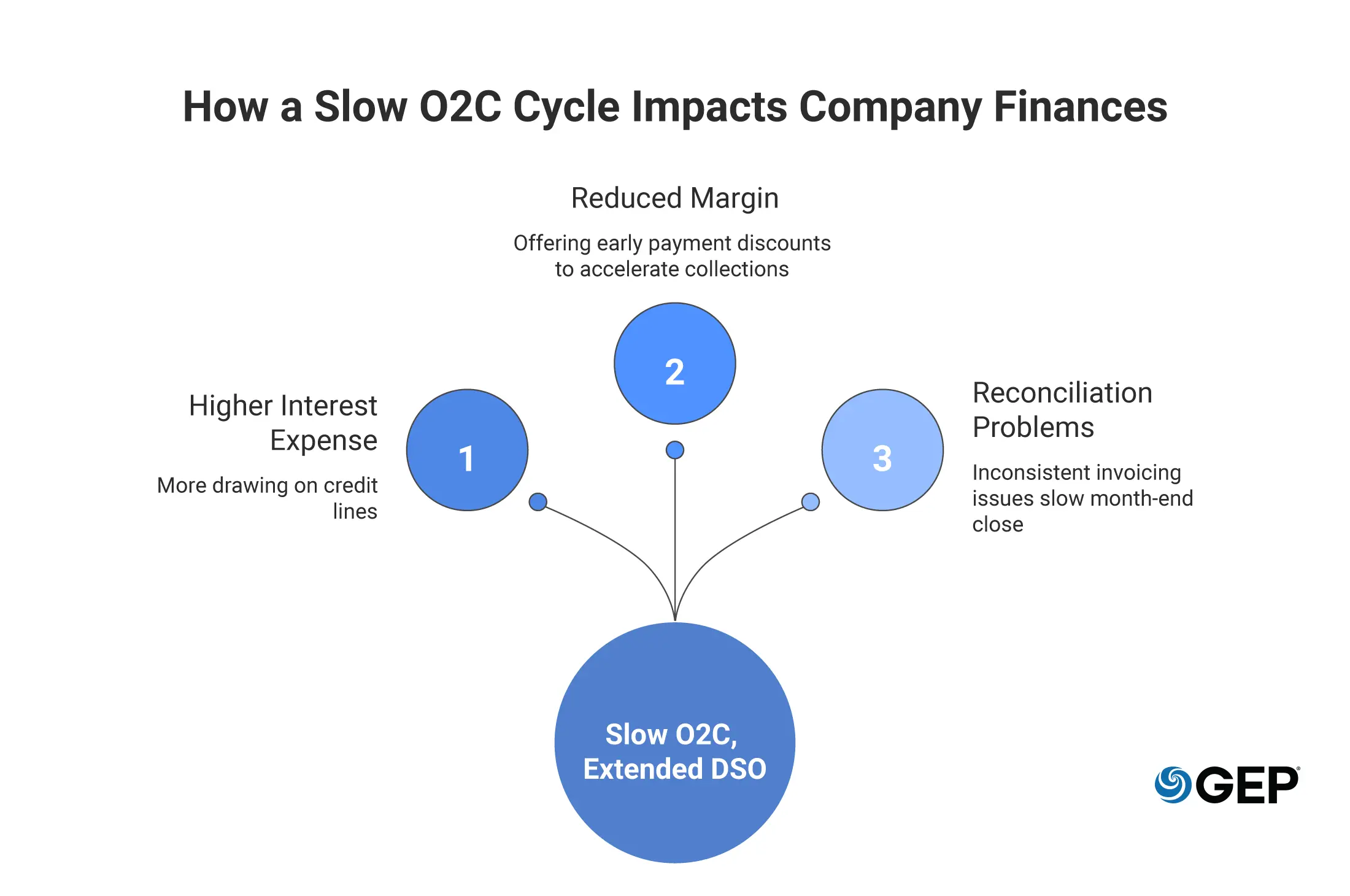
A slow O2C cycle also creates secondary costs. Companies with extended DSO often draw on credit lines to fund operations, adding interest expense. They may offer early payment discounts to accelerate collections, reducing margin. And inconsistent invoicing creates reconciliation problems that slow month-end close and introduce revenue recognition risk.
Measuring Strategic Impact: How Efficiently a Company Converts Cash Outflows into Inflows
DSO alone doesn’t tell the full story. The Cash Conversion Cycle (CCC) provides a more complete picture by measuring the total time between paying suppliers and collecting from customers. A company optimizing O2C while leaving its procure-to-pay cycle unaddressed will still carry a bloated CCC.
Other metrics worth tracking include invoice accuracy rate, first-pass match rate (the percentage of invoices automatically matched to POs without manual intervention) and collection effectiveness index (CEI). These metrics are leading indicators of financial health that CFOs use to stress-test liquidity forecasts and communicate cash conversion efficiency to boards and investors.
Best Practices for Enhancing the Order-to-Cash Cycle
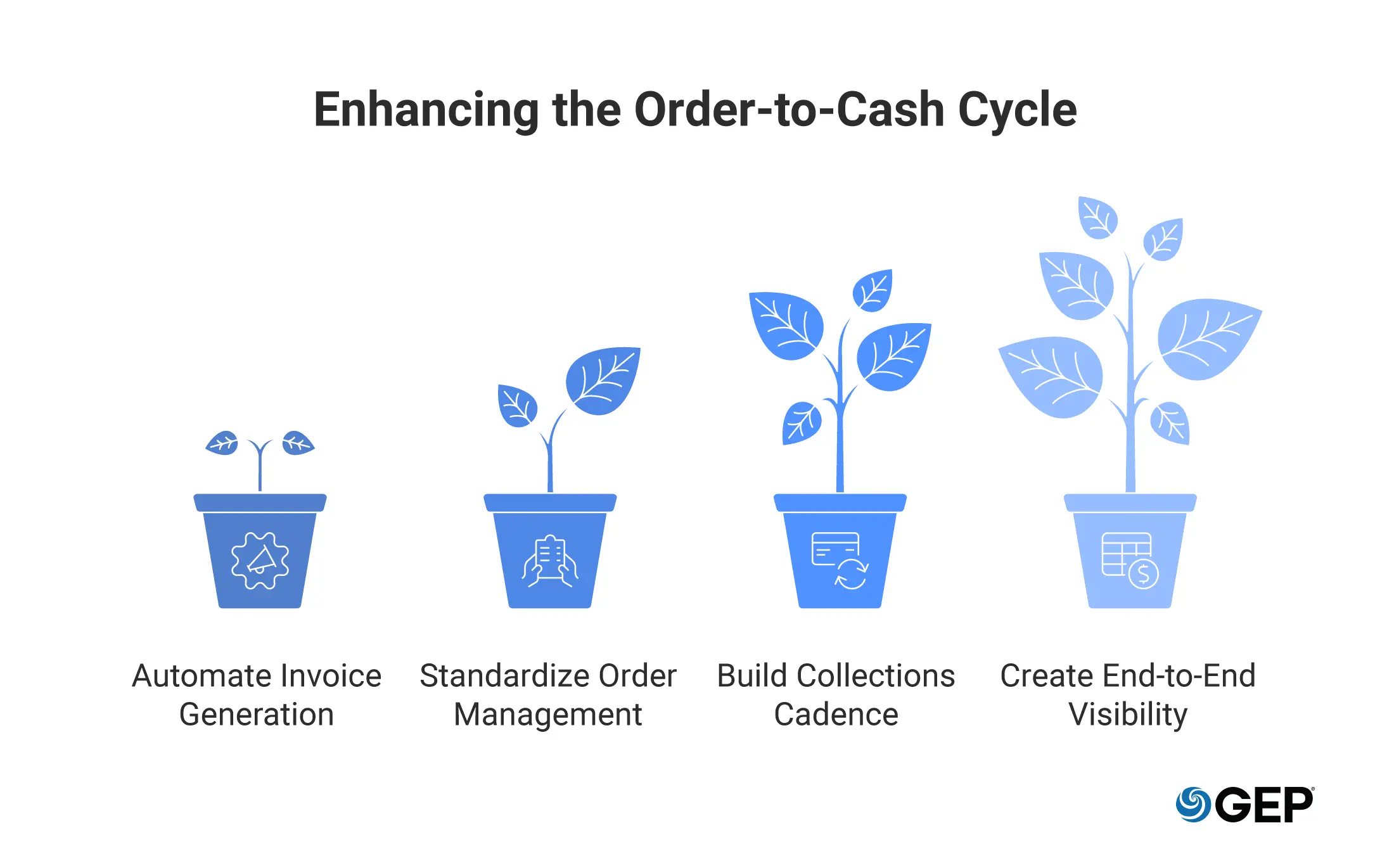
Automate the invoice-to-cash workflow
Intelligent automation platforms generate invoices upon fulfillment confirmation, route them through preferred delivery channels and match payments to open receivables without human intervention. The reduction in processing time and error rate is immediate and measurable.
Standardize order management
Organizations still accepting orders through email or spreadsheets carry structural inefficiency into every downstream step. A standardized digital order capture process integrated with inventory and ERP systems creates clean data from the start of the cycle.
Build a structured collections cadence
Automated reminders before and after due dates, escalation protocols for aging receivables and clear dispute resolution workflows dramatically reduce the percentage of invoices requiring intensive manual follow-up.
Create end-to-end O2C visibility
Siloed systems mean no one has a complete picture of where cash is stuck. Modern source-to-pay platforms that connect order management, fulfillment and finance functions give leaders real-time visibility across the cycle, enabling faster intervention when bottlenecks emerge.
Optimizing Your Order-to-Cash Cycle for Better Cash Flow Management
The order-to-cash cycle is one of the most tangible expressions of how well an organization converts commercial activity into financial reality. The companies getting this cycle right are building the financial agility to compete in an environment where liquidity is a strategic advantage.
Converting sales to cash faster than competitors isn’t just good treasury management. It’s a source of competitive differentiation. See how an integrated procure-to-pay platform can help streamline your financial operations end-to-end.




FAQs
What tools and technologies help improve the order-to-cash process?
ERP-integrated order management, automated invoice processing, cash application tools and live DSO dashboards all help — but only when they're connected. Disconnected point solutions tend to trade one bottleneck for another.
How can companies reduce delays in the order-to-cash process?
Focus on the two ends of the cycle: order capture accuracy at the front and fast cash application at the back. Automating invoice generation at the point of fulfillment and following up on invoices before they go overdue move the needle fastest.
How does the order-to-cash process vary across different industries?
In manufacturing, a delayed shipment means a delayed invoice. In services, revenue timing hinges on milestone tracking; in distribution, the challenge is volume — even a small invoice error rate creates a large manual workload.
What are the common challenges that cause inefficiencies in the order-to-cash cycle?
Invoice errors are the most common culprit — a wrong price or missing PO reference stops the clock on payment. Manual handoffs, disconnected systems, weak credit vetting and reactive collections usually compound the problem from there.