The Return of Investigative Tariffs: What U.S. Trade Probes Mean as Middle East War Reshapes Global Supply Chains
- Investigative tariffs now target strategic dependencies, reshaping sourcing decisions beyond traditional cost or trade considerations.
- Cost increases are immediate, but supply instability and supplier reliability create deeper long-term procurement challenges.
- Procurement must shift from cost control to real-time risk visibility and faster decision-making.
March 26, 2026 | Risk Management 5 minutes read
Tariffs are returning. But this time, they are not leading the disruption, they are amplifying it.
The ongoing U.S.–Israel–Iran War has turned the Middle East into a supply chain stress zone. Energy infrastructure is being targeted, shipping routes are breaking down, and critical trade corridors are under threat.
In this specific context and environment, the resurgence of Section 301 investigations is not just about trade enforcement. It is about control over supply chains that are now visibly fragile.
Don’t Wait To Be Disrupted
Explore how autonomous AI agents are driving procurement transformation
War First, Tariffs Second: Understanding the Sequence
Supply chains do not break because of tariffs alone. They weaken earlier.
Conflict changes the operating environment in ways policy might not be able to fully predict. Shipping insurance costs spike. Lead times stretch. Suppliers struggle to commit to delivery schedules. Energy price volatility ripples through manufacturing costs.
Only after these cracks appear do tariffs step in.
This sequence creates compounding pressure. A supplier already dealing with disrupted logistics suddenly becomes more expensive due to tariffs. A region already unstable becomes commercially unviable.
Procurement teams often plan for one disruption at a time. That assumption no longer holds.
Recent examples show how quickly costs escalate. A U.S. manufacturer dependent on imported raw materials can see input costs double when tariffs hit, forcing immediate sourcing decisions under pressure.
The timeline compresses. Decisions that once took quarters now take weeks.
Why Investigative Tariffs Matter More in a War Scenario
Investigative tariffs carry a different weight during conflict.
They do not just increase costs. They signal intent. Governments use them to reshape supply dependencies in real time. Categories under investigation often align with strategic vulnerabilities such as semiconductors, energy components, or critical minerals.
That creates a ripple effect across supplier networks.
Suppliers outside the immediate tariff scope still feel the impact. Demand shifts suddenly. Capacity tightens. Pricing becomes unstable. Contracts lose relevance faster than expected.
The challenge is not limited to cost modeling. Visibility becomes the real constraint.
Many organizations still lack integrated data across procurement and supply chain functions.
This gap slows response times and increases exposure during disruptions.
War conditions amplify that weakness. Teams cannot react to tariffs if they cannot see supplier dependencies in real time.
Check Out GEP’s - AI Powered Supply Chain Management Software
What the War is Exposing (and Tariffs are Targeting)
The current environment is stripping away long-held assumptions.
Single-region sourcing still exists in critical categories. Supplier risk data remains incomplete. Contract structures rarely account for rapid policy shifts. These gaps were manageable in stable conditions. They are now liabilities.
Tariffs are being applied where these weaknesses are most visible.
Energy-linked supply chains offer a clear example. When infrastructure is under threat, upstream disruptions cascade quickly. Tariffs layered on top of that disruption make recovery harder.
Another exposed area is coordination. Procurement, logistics, and finance often operate with partial alignment. That disconnect slows decision-making and increases costs during disruption cycles.
Execution gaps show up in three ways. Higher costs, longer cycle times, and reduced resilience. Those outcomes are already visible in current conditions.
Tariffs do not create these issues. They highlight them.
The Illusion of Safe Alternatives — Now Completely Broken
Diversification once offered a sense of safety.
“China-plus-one” strategies, nearshoring, and regional sourcing appeared to reduce exposure. That logic assumed disruptions would remain localized.
Current conditions challenge that assumption.
Alternative regions face their own risks. Capacity constraints limit how quickly suppliers can scale. Regulatory environments shift without warning. Logistics networks remain interconnected, so disruption in one region affects others.
Even local production carries hidden dependencies. Components, raw materials, and sub-tier suppliers often trace back to the same global sources.
Examples from high-tariff environments show how companies try to adapt. Some move production closer to end markets. Others build regional supplier bases. These shifts reduce tariff exposure but increase operational complexity.
That complexity creates new risks. More nodes in the network mean more points of failure.
The idea of a “safe” supply chain no longer holds. Trade-offs define every decision.
The Path to Autonomous Procurement
Explore how AI-native S2P platforms enable orchestration and agentic execution for 1.5–2.5x higher ROI over time
What This Means for Procurement and Supply Chain Leaders
Procurement cannot treat tariffs as isolated events anymore.
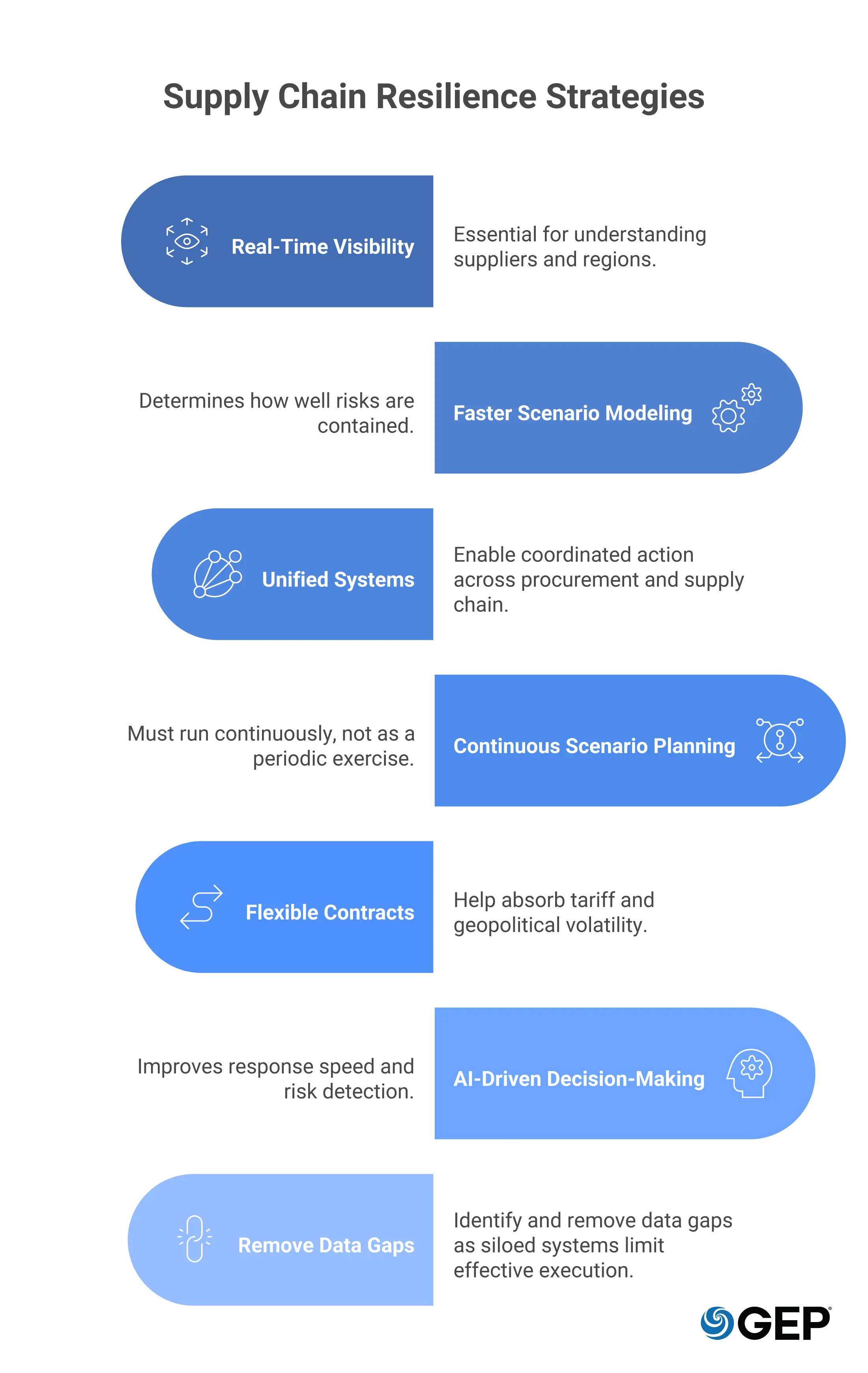
The focus shifts from cost control to risk positioning. Leaders must understand exposure across suppliers, regions, and categories in real time. Static reports do not help in fast-moving conditions.
Speed becomes critical. Organizations need the ability to model scenarios quickly and act without delay. Waiting for full clarity often leads to missed windows for mitigation.
Unified systems play a central role here. Without end-to-end supply chain visibility, teams cannot identify which suppliers or categories face tariff exposure. They also struggle to coordinate responses across functions.
Scenario planning moves from a periodic exercise to a continuous process. Teams must evaluate multiple outcomes at once. Best case, worst case, and everything in between.
Supplier relationships also change. Flexibility in contracts becomes essential. Fixed pricing models fail under volatile conditions. Procurement must build clauses that allow adjustments as tariffs and geopolitical risks evolve.
Another shift involves decision-making structure. Manual processes slow response times. Autonomous and AI-driven systems offer a way to monitor risks continuously, adjust sourcing strategies, and flag disruptions before they escalate.
Adoption remains uneven. Many organizations still struggle with data integration and internal expertise. More than half lack unified procurement data systems, limiting their ability to use advanced tools effectively.
That gap creates a divide. Some organizations respond in near real time. Others react after disruption has already hit.
Conclusion
Investigative tariffs now operate in a different landscape. They follow disruption rather than trigger it.
War conditions expose supply chain fragility at speed. Tariffs then reinforce those fault lines, forcing rapid structural changes. The combination creates sustained pressure on sourcing strategies, supplier networks, and operational models.
Procurement leaders face a narrower margin for error.
Control over supply chains depends on visibility, coordination, and the ability to act quickly. Systems that connect data across procurement, supply chain, and finance provide that foundation. AI-driven orchestration adds another layer by sensing risk, modeling scenarios, and guiding decisions as conditions shift.
This is no longer about reacting to tariffs.
It is about operating in a world where disruption arrives first and policy follows close behind.Top of Form
FAQs
How can procurement teams respond quickly to tariff changes during geopolitical disruptions?
Use agentic AI-orchestrated, unified source-to-pay platform to gain real-time visibility into suppliers and contracts. Such platforms can help you identify impacted categories quickly, run scenario models, and collaborate with suppliers to adjust pricing and delivery without delays. Faster, coordinated action reduces both cost spikes and supply disruptions.
What practical steps can organizations take to reduce supply chain risk from investigative tariffs?
Map supplier dependencies, build validated alternatives, and update contracts with flexible pricing clauses. Use continuous scenario planning and agentic AI tools to track risks and act early. This approach strengthens resilience while keeping sourcing decisions controlled under uncertainty.