



Margin Protection in Volatile Markets: Executive Playbook for Cost Leadership
- Organizations that track cost drivers across suppliers, commodities, and logistics can respond to volatility before it hits the bottom line.
- Diversified sourcing and collaborative cost engineering help reduce exposure to sudden cost spikes.
- Procurement becomes a strategic margin lever when finance, data, and supplier insights work together to anticipate and manage cost risks.
March 24, 2026 | Procurement Strategy 5 minutes read
If the last few years have taught business leaders anything, it’s this: volatility is no longer the exception—it’s the operating environment.
Commodity prices spike unexpectedly. Shipping lanes get disrupted. Interest rates shift. Currency swings eat into margins overnight. For procurement and finance leaders, protecting margins in this kind of environment can feel like trying to hold water in your hands.
Yet some organizations manage to do it consistently. They protect margins even when markets are turbulent. They don’t just react to cost pressure—they build systems that anticipate it.
The difference usually isn’t luck. It’s discipline, visibility, and smarter procurement strategies.
Let’s walk through the executive playbooks that leading organizations are using to protect margins in volatile markets.
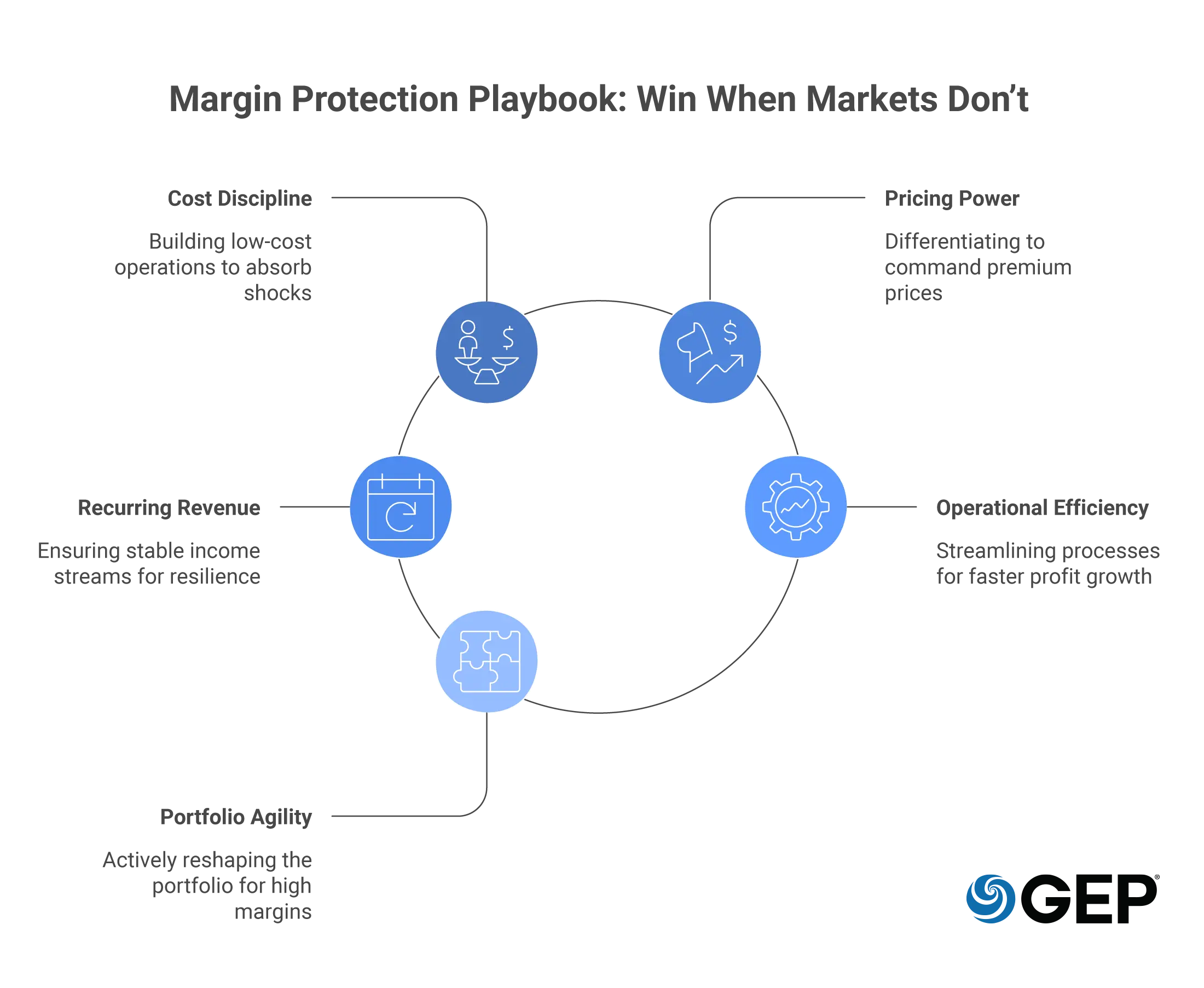
Turn Volatility into Advantage
Use smarter procurement and cost intelligence to protect margins.
First: Stop Treating Cost Management as a Short-Term Exercise
When margins come under pressure, the first instinct in many companies is to launch cost-cutting initiatives: renegotiate contracts, freeze hiring, reduce discretionary spending.
Those tactics can help in the short term. But they rarely create sustainable cost leadership.
Leading organizations treat cost management as a continuous capability, not a one-off response to market shocks.
This means building structured cost intelligence across categories like:
- Direct materials
- Logistics and freight
- Energy
- Packaging
- Indirect procurement
Instead of reacting to supplier price increases, procurement teams track should-cost models, commodity indices, and supplier cost structures. That visibility allows them to challenge price increases intelligently rather than simply accepting them.
In volatile markets, information becomes one of the most powerful margin protection tools.
Build Real-Time Cost Visibility Across the Supply Chain
A surprising number of companies still make cost decisions using outdated or fragmented data.
Procurement sees supplier invoices. Finance sees budgets. Operations sees production costs. But these views are rarely unified.
When volatility hits, that fragmentation becomes dangerous.
Cost leaders build real-time cost visibility across the entire supply chain.
This includes:
- Commodity price tracking
- Supplier performance analytics
- Freight cost monitoring
- Demand and inventory visibility
With the right digital infrastructure, procurement leaders can see cost movements early—sometimes weeks or months before they appear in financial results.
That early warning system allows organizations to act before margins are impacted.
For example:
- Switching sourcing regions
- Locking in prices before commodity spikes
- Adjusting order volumes
- Rebalancing supplier portfolios
Without visibility, companies react late. With visibility, they can move first.
Diversify Supplier Risk Before It Becomes a Margin Problem
Supplier concentration is one of the hidden drivers of margin volatility.
If a company depends too heavily on a single supplier, region, or logistics corridor, any disruption quickly translates into cost escalation.
We saw this during pandemic-era supply chain disruptions and again during geopolitical trade tensions.
Cost leaders build intentional supplier diversification strategies.
This does not necessarily mean doubling the number of suppliers. Instead, it means balancing sourcing across:
- Geographic regions
- Supplier tiers
- Contract structures
For example, some companies combine long-term strategic suppliers with flexible regional partners who can ramp up production during disruptions.
Others maintain “shadow suppliers” that are pre-qualified but used only when primary suppliers face constraints.
The goal is resilience without sacrificing efficiency.
In volatile markets, supplier optionality becomes a margin protection lever.
Stay ahead of shifting spend dynamics across key categories.
Explore the GEP Spend Category Outlook to inform data driven decisions.
Shift Procurement from Price Negotiation to Cost Engineering
Traditional procurement often focuses on negotiating better prices.
But in volatile markets, price negotiation alone has limits. If raw material costs rise dramatically, suppliers simply cannot absorb the increase.
This is where cost engineering becomes powerful.
Cost engineering means working collaboratively with suppliers to redesign products, materials, and processes in ways that reduce overall cost structures.
Examples include:
- Material substitution
- Packaging redesign
- Component standardization
- Manufacturing process improvements
Rather than arguing over price, procurement and suppliers work together to reduce underlying costs.
This approach strengthens supplier relationships while protecting margins.
It also shifts procurement’s role from transactional negotiation to strategic value creation.
Use Long-Term Contracts Strategically
Many organizations rely too heavily on spot buying during volatile markets. While spot buying offers flexibility, it can also expose companies to sudden cost spikes.
Strategic organizations balance long-term contracts with dynamic sourcing strategies.
Long-term agreements can lock in favorable pricing during periods of stability. They can also include mechanisms such as:
- Commodity index linking
- Volume-based pricing adjustments
- Risk-sharing clauses
These structures help both buyers and suppliers manage uncertainty.
The key is not simply locking prices—it’s designing contracts that flex with market conditions without destroying margins.
Bring Finance and Procurement Closer Together
One of the biggest organizational barriers to margin protection is the disconnect between finance and procurement.
Finance teams track financial performance. Procurement teams manage supplier relationships. But these functions often operate with different data sets and priorities.
Leading organizations are changing this dynamic.
They are integrating procurement analytics directly into financial planning and forecasting processes.
This collaboration enables:
- Better cost forecasting
- More accurate margin projections
- Faster response to supply shocks
When procurement insights feed directly into financial planning, organizations gain a much clearer view of cost risk.
That alignment turns procurement into a strategic partner in margin management.
Leverage AI and Advanced Analytics for Cost Intelligence
The complexity of modern supply chains makes manual cost tracking almost impossible.
Thousands of suppliers. Dozens of commodities. Multiple logistics routes. Currency fluctuations. Regulatory changes.
This is where AI-driven procurement platforms are transforming margin protection strategies.
Advanced analytics can now:
- Detect early cost anomalies
- Predict supplier risk exposure
- Track commodity trends
- Identify savings opportunities across categories
Instead of spending weeks analyzing spreadsheets, procurement teams receive automated insights that highlight potential cost risks.
This dramatically shortens response times.
In volatile markets, speed matters.
Organizations that identify cost threats first have the best chance of protecting margins.
Build a Culture of Continuous Cost Discipline
Finally, margin protection is not just a procurement strategy—it’s an organizational mindset.
Companies that consistently outperform peers tend to embed cost discipline into their operating culture.
That means:
- Leaders regularly reviewing cost drivers
- Cross-functional teams collaborating on savings initiatives
- Procurement involved early in product design decisions
- Digital tools providing transparent cost data
When cost management becomes everyone’s responsibility—not just procurement’s—organizations build structural resilience.
And resilience is what ultimately protects margins.
Explore about GEP’s Cost Data & Analytics Platform
The Bottom Line
Volatility isn’t going away anytime soon. Markets will keep shifting, costs will keep moving, and supply chains will keep throwing surprises.
The companies that handle this best aren’t the ones scrambling to cut costs when things go wrong. They’re the ones that build smarter procurement strategies, stronger supplier networks, and better cost visibility from the start.
In other words, margin protection isn’t a last-minute fix. It’s something you design into how the business runs every day.
And when that discipline is in place, even volatile markets become a lot more manageable.




FAQs
Companies can protect margins by improving cost visibility, diversifying suppliers, using strategic contracts, and leveraging analytics to anticipate cost fluctuations early.
Procurement helps manage supplier relationships, track cost drivers, negotiate strategic contracts, and collaborate with suppliers to reduce underlying cost structures.
Supply chain visibility allows organizations to identify cost changes early, adjust sourcing strategies quickly, and prevent unexpected price increases from impacting margins.