



Agentic AI Is Simplifying ESG Materiality Assessment
- Agentic AI is redefining ESG materiality assessments by shifting the focus from retrospective reporting to real-time risk discovery.
- Procurement leaders are increasingly utilizing autonomous systems to navigate the gap between historical data and the volatile reality of global supply chains.
- The transition to agentic workflows allows organizations to automate data normalization, providing decisional clarity that manual processes cannot replicate.
March 05, 2026 | Procurement Software 5 minutes read
Most procurement and sustainability leaders struggle to identify environmental, social, and governance (ESG) issues that are material to their business. This typically involves a cycle of static surveys, intermittent stakeholder interviews, and a heavy reliance on historical data.
This approach is increasingly insufficient for a global marketplace defined by rapid regulatory shifts and sudden environmental disruptions.
Agentic AI marks a departure from the limitations of traditional automation. These are systems capable of reasoning, planning and executing complex data-gathering tasks with a high degree of independence.
For a modern enterprise, this shift allows materiality assessment to move from a static document, updated once a year, to a dynamic, live feed of a company’s operational risks and impacts.
Understanding ESG Materiality Assessment in Modern Business
Materiality is how a company views its own survival and impact. It is the process of identifying specific ESG factors, such as carbon emissions, supply chain labor conditions or board diversity, which have a "material" impact on the company’s financial health or its stakeholders' interests. It dictates where a company should direct its resources and where it must mitigate risks.
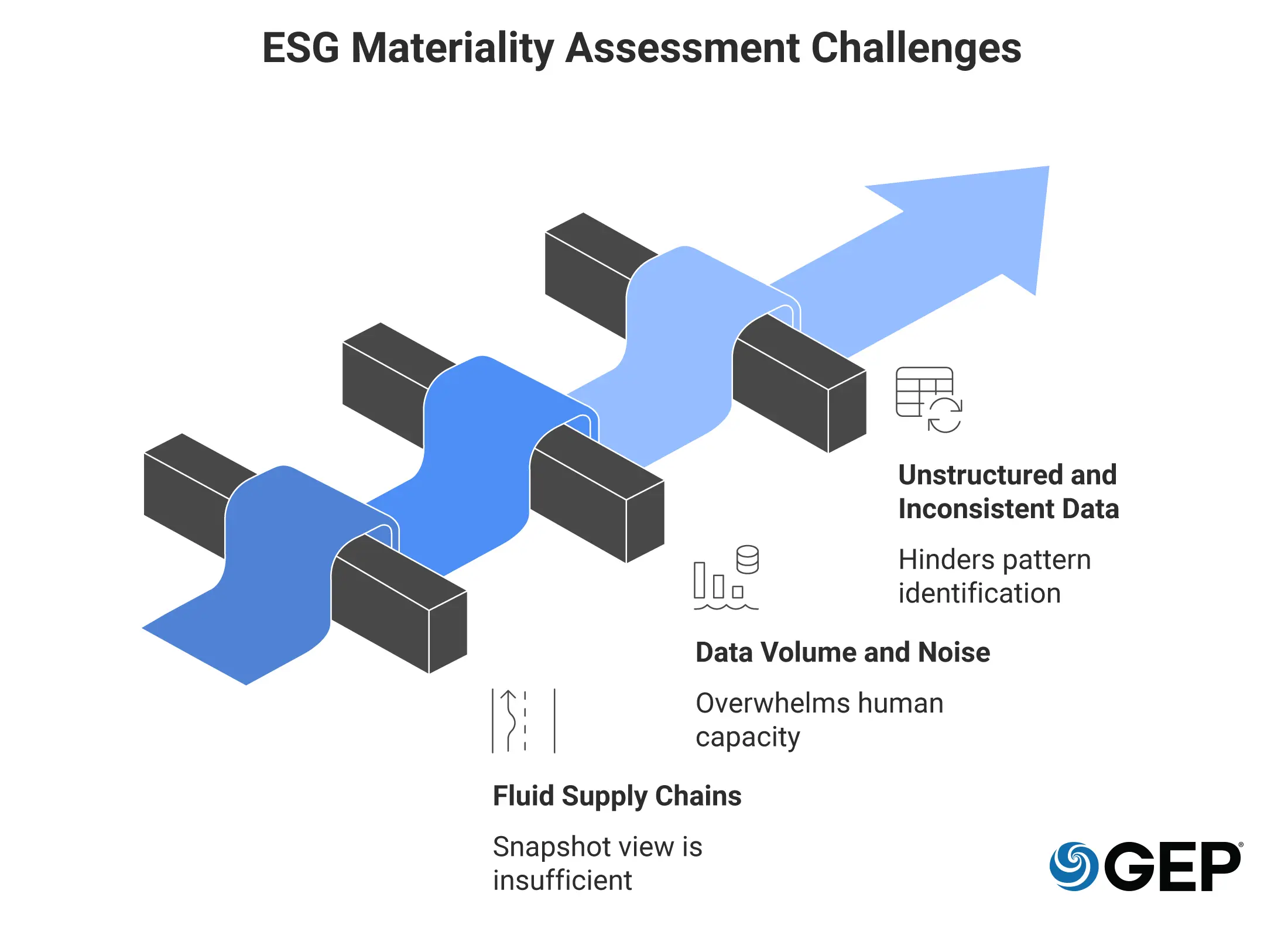
Historically, companies would look back at the previous year's performance, gather what data was available and produce a report. However, modern supply chains are too fluid for a snapshot view to capture the full picture. A climate-driven water shortage in a specific manufacturing hub or a sudden shift in local labor laws can transform a minor ESG footnote into a catastrophic operational failure in a matter of weeks.
The primary obstacle to a more frequent assessment has always been the sheer volume and "noise" of the data involved. Every tier of a global supply chain generates a mountain of information, much of it unstructured and inconsistent. Identifying meaningful patterns within this data is a task that has historically outpaced human capacity.
The Role of Agentic AI in ESG Materiality Assessment
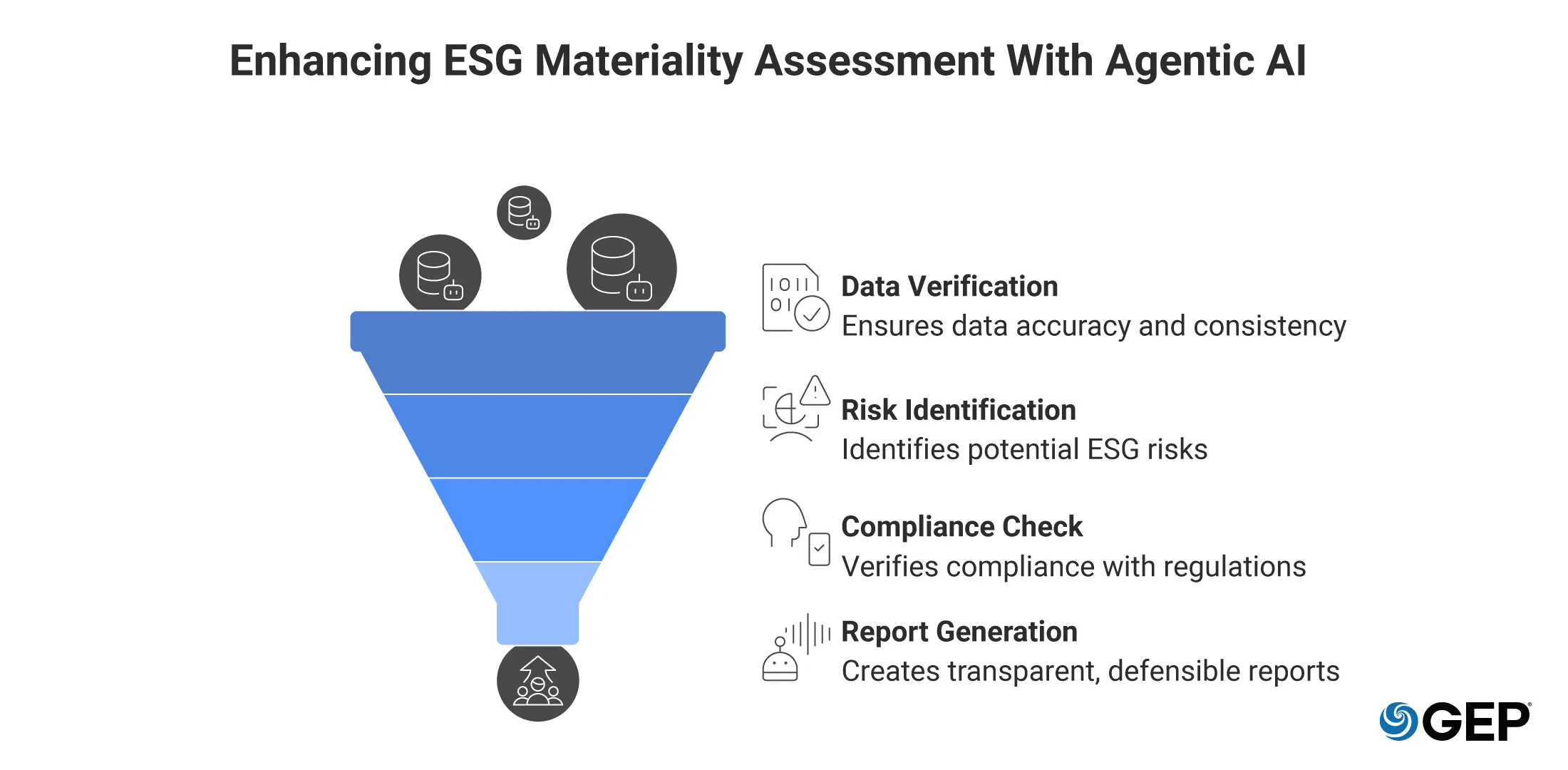
Agentic AI differs from standard automation in its ability to manage "intent" rather than just "instruction." While a standard AI tool might be able to search a database for a specific keyword, an agentic system acts as a digital analyst tasked with a broader objective.
If instructed to assess the impact of new biodiversity regulations on a company’s agricultural suppliers, the agent doesn’t just wait for a structured spreadsheet. It develops a multi-step plan and synthesizes findings into a risk profile.
This autonomy is critical because ESG data is rarely found in a neat, organized format. It is buried in news reports, local social audits and fragmented shipping manifests. Agentic systems excel at handling this data. They can ingest unstructured information and normalize it into a coherent narrative. This helps to discover risks that traditional software would miss.
Furthermore, the continuous nature of these agents ensures that the materiality assessment is never truly finished. The system remains in a state of constant observation, flagging the moment a change in carbon tax policy or a localized labor strike requires executive attention. In this model, materiality is a live component of the corporate workflow.
How Autonomous ESG Materiality Assessments with Agentic AI Improves Decision-Making
A unified workflow creates a single source of truth. Procurement, finance, legal and sustainability teams work from the same verified data. This eliminates data silos that lead to conflicting strategies across the organization.
Consider the practical challenge of conflict mineral compliance. Manual verification of five hundred suppliers typically requires months of documentation review and supplier outreach. By the time a compliance gap is discovered, the company may already be in breach of new regulations.
An agentic system operates differently: it ingests new regulatory requirements immediately and maps those requirements against your existing supplier base within hours. This speed allows you to address risks before they escalate into legal or reputational crises.
It also provides transparency and defensibility. As ESG greenwashing becomes a financial and legal risk, audit trails matter. Agentic AI maintains clear records of how data was gathered and why issues were deemed material. This creates robust, data-driven reports that withstand auditor and investor scrutiny.
Stop Fighting Silos. Start Operating Intelligently.
See How Top Organizations Are Scaling Agentic AI Across Procurement
Read Now
Key Benefits of Autonomous ESG Materiality Assessment With Agentic AI
Autonomous systems free your team from mechanical data work, letting procurement and sustainability pros move away from data cleaning and normalization. Instead, they can focus on high-level strategy and supplier relationship management. While they apply their judgment and expertise, technology handles the foundational work.
Speed is another critical advantage. Access to capital is increasingly tied to ESG performance, making it essential to have verified data on demand. Finance teams no longer wait for quarterly audit cycles to understand ESG risk exposure. Real-time data availability enables faster decision-making and greater business agility. This represents the evolution of sustainability from a compliance function into a core component of business strategy.
Turn Data into Decisions
Autonomous ESG materiality assessment is the next step of corporate governance in an increasingly complex world. As the amount of data grows and demands for transparency grow more urgent, manual methods will be even more limited. Agentic AI provides the bridge between raw information and strategic action, turning data into decisions.
For organizations that adopt this approach, the benefits extend beyond compliance. They build supply chains that are more ethical, more transparent and more resilient to shocks. In the current era, the companies that thrive will be those that recognize that materiality as a continuous, vital part of their operational intelligence.
Learn more about how GEP’s ESG consulting services help organizations translate ESG materiality insights into defensible priorities, credible disclosures and ongoing risk governance.




FAQs
It moves the organization from a reactive stance to a proactive one. Instead of reporting on risks after they have occurred, companies can identify and mitigate environmental and social issues as they emerge, leading to more impactful and timely sustainability outcomes.
Yes. These systems are designed to be framework-agnostic, meaning they can map data to established standards like GRI, SASB, or the CSRD. This ensures that the insights generated are immediately useful for formal reporting and regulatory compliance.
The system utilizes autonomous agents to monitor a vast array of internal and external data sources. It then uses reasoning models to analyze this information against the company’s specific business context, determining which ESG factors are truly material and updating these findings continuously as the data changes.