



Hidden Manufacturing Costs Are Draining Your Margins. Here is How Procurement Software Fixes That
- Identify cost leaks that are hidden by unreliable suppliers, bad processes, and poor data integration before they cause a loss of profit.
- Use procurement software to automate cost benchmarking, integrate visibility of spending, and compare real costs to should-cost models right now.
- Help procurement professionals go from reporting costs after the fact to managing costs proactively across the whole industrial supply chain.
May 12, 2026 | Procurement Software 7 minutes read
There has never been greater exposure to manufacturing margins. Cost management has evolved from a finance function to a boardroom priority due to raw material volatility, logistics interruptions, and escalating regulatory requirements. However, many procurement teams continue to operate with limited data, basing their judgments on contracted unit prices while a much bigger pool of costs builds up unnoticed throughout their supply base.
A lack of data is not the issue. The incorrect information is disseminated over manual spreadsheets, supplier portals, ERP systems, and invoicing platforms. The harm to margins and working capital is already done by the time hidden costs, such as invoice mismatches, rework, premium freight charges, or non-compliance penalties, come to light.
This blog explains the true nature of hidden manufacturing costs, how they are revealed by contemporary procurement software, and why should-cost modeling is the crucial component that transforms visibility into control.
What Are Hidden Manufacturing Costs?
Hidden manufacturing expenses are costs that don't show up on a regular purchase order or line-item invoice. Instead, they build up over time in the supplier relationship, the production process, and the internal workflow. They are not random; they are built into the system.
Common categories include:
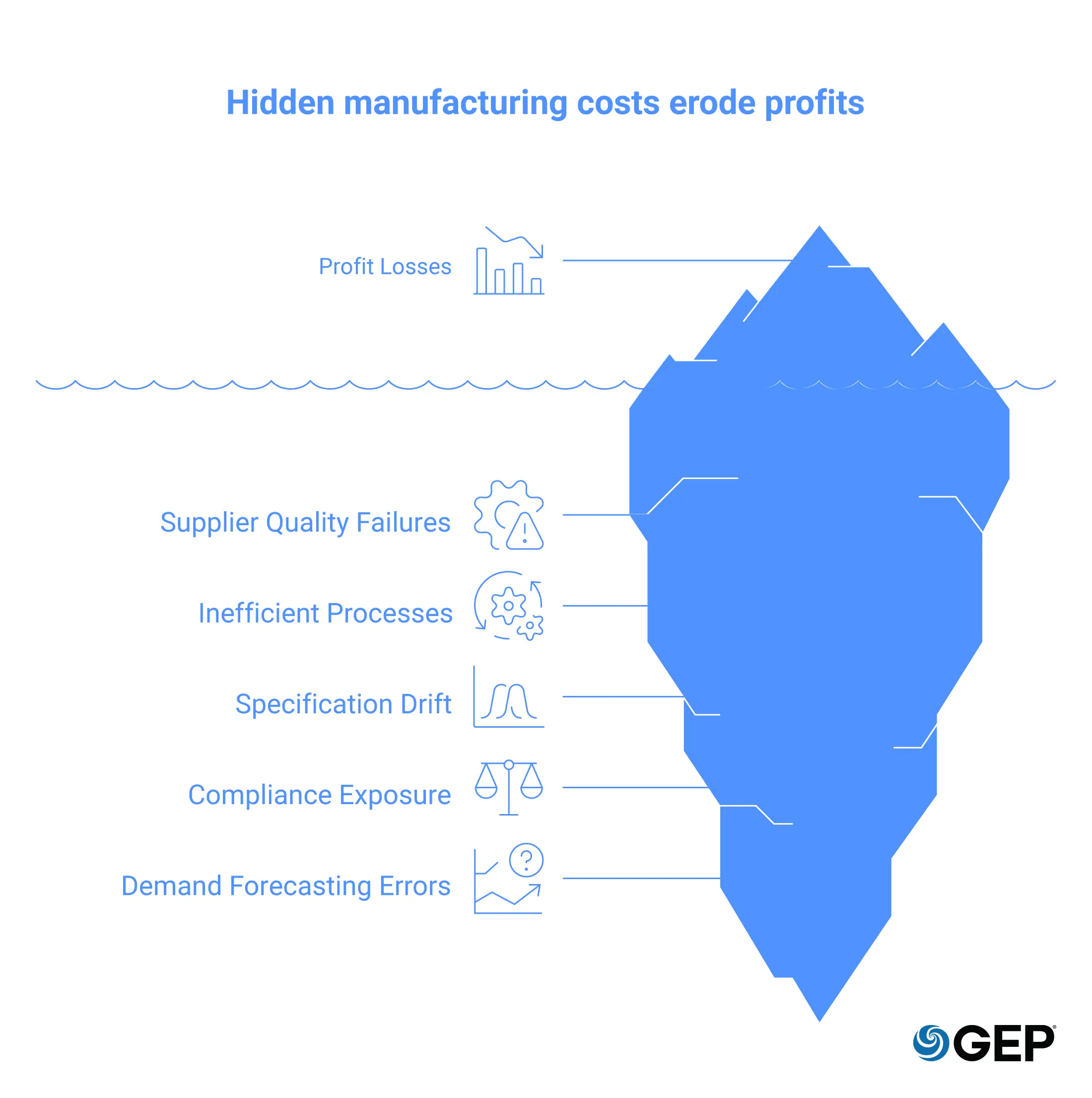
- Problems with supplier quality: Examples of problems with supplier quality include rework, scrap, and returns that lower margins but don't show up in procurement records.
- Inefficient processes: These include having to manually approve purchases, paying late fees, and having to pay more for shipping charges that come up unexpectedly because of reactive buying.
- Specification drift: Costs incurred when materials or parts arrive outside of acceptable ranges, which leads to design changes or line stoppages.
- Compliance and audit exposure: Costs that come up when a supplier doesn't follow the rules, there are gaps in carbon reporting, or there isn't enough ESG paperwork.
- Mistakes in demand forecasting: Mistakes in demand forecasting can lead to overstock write-offs and emergency sourcing surcharges because planning and procurement data are not connected.
When looked at separately, these costs might make sense. When aggregated throughout a complicated manufacturing supply chain, they can lead to big losses of profit. The difficulty is that people don't know these costs exist. The infrastructure is being constructed so that they can be caught before they do.
How Procurement Software Tracks Hidden Costs
Modern procurement software does more than merely keep track of spending. It links spending data, supplier performance data, contract obligations, and operational outcomes so that differences are noticed right away instead of weeks later in a financial review.
The core tracking mechanisms include:
Unified spend intelligence:
Putting transactional data from P-cards, ERP systems, and direct procurement channels on one screen to show supplier concentration risk, category leakage, and maverick spending.
Supplier performance monitoring:
By comparing quality measurements, delivery performance, and invoice accuracy to agreed-upon SLAs, the operational consequences of poor performance that weren't considered when the initial sourcing option was made become clear.
Automated invoice matching:
Finding three-way differences between purchase orders, goods receipts, and invoices in real time, halting payment leaks, and settling conflicts before they affect working capital cycles or relationships with suppliers.
Contract compliance:
This means finding differences between what was billed and what was agreed upon, as well as exposing purchases that go against the agreed-upon rates.
Predictive cost alerts:
These leverage AI-native analytics to find unusual changes in the cost trajectory, such as spikes in materials, longer lead times, or changes in freight costs, before they show up as line-item shocks.
GEP Quantum Intelligence is designed to bring together this capability and ensure that the information needed to uncover hidden costs is never spread across disconnected systems. By combining sourcing, contract management, supplier performance, and procure-to-pay into a single environment, it helps manufacturers move from fragmented data to full cost visibility.
Leveraging Should-Cost Solutions Alongside Procurement Software to Track Hidden Costs
Spend visibility reveals the amount paid. What should have been paid is revealed via should-cost modeling. The hidden cost is in that gap.
A should-cost model uses labor rates, raw material inputs, overhead distribution, tooling amortization, and supplier margin assumptions to create a bottom-up estimate of what a part, assembly, or service should cost. It becomes a live benchmark when combined with procurement software. Each invoice and supplier estimate can be compared to a cost objective that is independently determined. In practice, this combination enables procurement teams to:
- Enter negotiations with a defensible cost position rather than relying on supplier-provided breakdowns.
- Determine which supplier margins have grown over time above contracted projections.
- Divide the supply base into cost-efficient segments, focusing development funds on high-value suppliers and rationalizing the tail.
- Evaluate the actual cost impact before design or specification changes are put into production.
- Validate that suppliers’ efforts to reduce costs are reflected in the actual invoice results.
Procurement is transformed from a price-taker to a cost-architect using should-cost modeling. That shift is only sustainable when the underlying data infrastructure covering spend intelligence, supplier performance, and contract compliance is already in place.
Features of Procurement Software That Help Identify Hidden Manufacturing Costs
Not every procurement platform is designed to handle complex manufacturing costs. The most important skills are:
AI-native spend analytics:
Automatically tagging and classifying spend across cost centers, suppliers, and categories, with anomaly detection that identifies trends before they become issues.
Real-time supplier scorecards:
By combining quality, delivery, and compliance data, the full cost of supplier relationships can be seen beyond the purchase price.
Configurable cost models:
Category teams may make and use should-cost templates right in the sourcing process, so they don't need to use any outside technologies.
Three-way match automation:
Automating the process of matching purchase orders, goods receipts, and invoices removes the danger of overpayment and delays in processing invoices.
ERP and systems integration:
Making sure that cost information flows seamlessly between the platforms for demand planning, manufacturing execution, finance, and procurement so that hidden costs don't get shifted to another system.
ESG cost tracking:
Instead of being a separate reporting assignment, this method collects data on the financial effects of emissions, compliance, and supplier sustainability performance as part of the procurement cycle.
Step-By-Step Guide to Leveraging Procurement Software for Tracking Hidden Costs
Setting up cost visibility is not something that can be done once and for all. It requires a planned way to build skills:
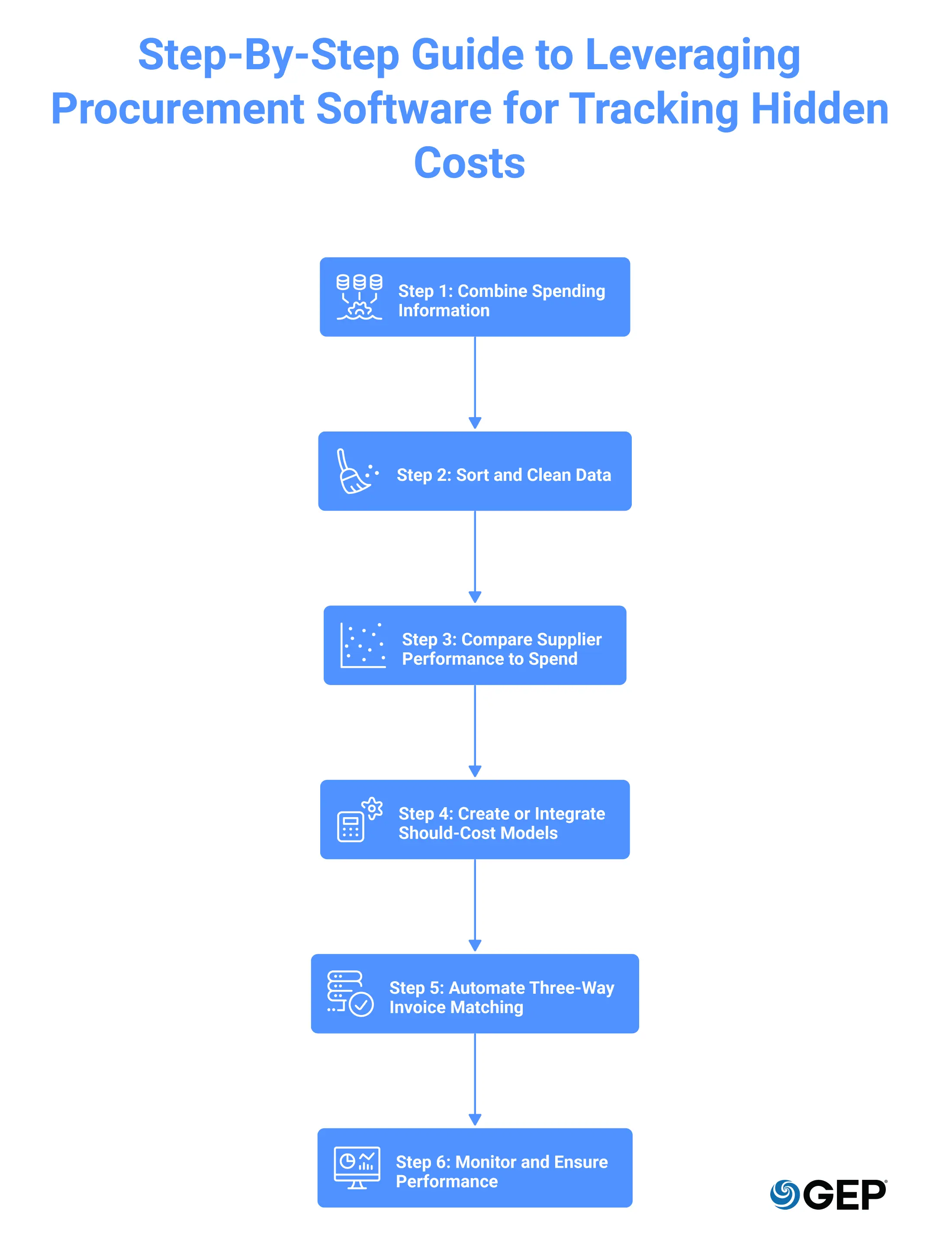
Step 1: Put all of your spending information together
Combine all your transactional sources, such as ERP, P-cards, and indirect spend platforms, into one layer of spending intelligence. Without this base, everything downstream is missing something.
Step 2: Sort and clean
Use AI to find duplicate or rogue spending, assign category codes, and make sure that supplier names are all the same. Dirty data is the key reason why cost leakage is hidden.
Step 3: Compare how well suppliers do their jobs to how much you spend
Include information on delivery, quality, and compliance in your spending view. This shows how much it costs to run a business when suppliers don't do their jobs well, something the PO system can't track.
Step 4: Make or bring in should-cost models
Make category-level cost models that include your actual bill of materials, labor costs from the area, and estimates of overhead. Add these to the list of standards for sourcing.
Step 5: Automate three-way invoice matching
For every type of direct spending, turn on three-way matching. Set tolerance criteria and exception routines to make sure that mismatches are rectified right away instead of at the end of the month.
Step 6: Keep an eye on things and make sure they are working
Make dashboards that show working capital data, contract compliance rates, and actual costs compared to should-cost targets on a regular basis. You should look at these dashboards at the level of the category, the supplier, and the business unit.
Digital Should-Cost Analysis
How Technology Can Help Optimize Sourcing and Unlock Value
From Cost Visibility to Cost Leadership
There is no data issue with hidden production costs. Procurement is in a unique position to address these systems and governance issues. Cost leakage becomes controllable when spend intelligence, supplier performance, contract compliance, and should-cost benchmarking function as a cohesive system.
The companies making the biggest cuts are not the ones that will set the standard for manufacturing cost performance over the next two years. They are the ones who can see most clearly where value is being made and lost. To get to that point of view, the right platform, data architecture, and analytical models must all work together. Talk to the GEP team if you want to learn how to put cost governance into action on a large scale in your manufacturing procurement operations.




FAQs
Yes, and it does so in ways that go well beyond what traditional finance reporting captures. Procurement software improves cost transparency by consolidating spend data from ERP systems, P-cards, and supplier portals into a single view, making it possible to see not just what was spent but where, with whom, and against what contract terms. It helps in identifying supplier quality failures, invoice mismatches, and off-contract purchases that would otherwise go unnoticed until they show up as margin erosion. When paired with should-cost models, it also gives procurement teams a benchmark to evaluate whether what they are paying reflects what they should be paying. The result is a shift from reactive cost reporting to proactive cost governance across the full supply chain.
The features that matter most for manufacturing cost tracking are AI-native spend analytics that automatically classify and flag anomalies, real-time supplier scorecards that connect quality and delivery performance to actual spend, and three-way match automation that reconciles purchase orders, goods receipts, and invoices in real time. Configurable should-cost models allow category teams to build independent cost benchmarks directly within the sourcing workflow, while contract compliance tracking identifies gaps between agreed pricing and what is actually being billed. ERP and systems integration ensure cost data flows across procurement, finance, and manufacturing execution without creating new silos. Together, these features give procurement teams the visibility to catch hidden costs before they reach the bottom line.