From Visibility to Orchestration: The Next Evolution of Spend Management
- Visibility shows where money goes but does not shape decisions across sourcing, contracts and suppliers.
- Disconnected tools slow action and reduce the impact of analytics investments.
- Spend orchestration connects workflows, thereby improving speed, control and cost outcomes.
April 30, 2026 | Spend Management 4 minutes read
Dashboards show category-level spend, along with supplier data. Reports break down costs by region, business unit, and vendor. This looks like a clear improvement over fragmented systems.
Yet the results fall short.
Savings don’t scale and maverick spend continues. Decision cycles too remain slow despite better information. Visibility explains what happened. It doesn’t influence what happens next. That gap defines current spend management.
Even when procurement and supply chain align on priorities, execution gaps increase costs and slow response times.
The bottom line — visibility addressed the data problem; execution remains unresolved.
Lead with Agentic AI
Drive smarter procurement and resilient supply chains through enterprise-proven technology
How Latest AI Tools Could Still Fall Short
The next logical step for many organizations has been adding intelligence on top of visibility.
They invested in analytics, predictive models, and AI tools to extract more insight from spend data. The assumption was straightforward. Better insight would improve decisions.
That rarely happens in practice.
AI depends on structured, consistent data. But most organizations still operate with fragmented procurement data. Supplier records vary across systems. Contracts sit outside sourcing tools. Spend classification needs manual correction.
Teams fill the gaps manually. They clean data before analysis, reconcile inconsistencies, build temporary datasets, and so on. Output improves, but the process does not.
A deeper issue remains. Insights and execution are still separate.
Spend analytics tools can highlight opportunities. They point to savings, supplier consolidation, risk exposure, and so on. But acting on those insights requires switching systems, launching sourcing events, updating contracts, and coordinating approvals.
Each step slows progress. Each handoff introduces friction. And when disruptions come (but they often don't come knocking), these problems become apparent. Be it tariff shifts or supply constraints, procurement teams have to act fast. They must identify exposure, evaluate options, and execute decisions quickly. Without integrated systems, responses come late or rely on partial data.
AI tools expose the problem. They don’t fix it. There is also a structural issue.
Most organizations run multiple systems:
- One for analytics
- One for sourcing
- Another for contracts
- Additional tools for suppliers and payments
Each system works on its own. None manage the full spend lifecycle. This creates hidden costs.
Teams move between systems. Data duplicates and drifts out of sync. Approvals slow down. IT maintains complex integrations that grow over time.
The pattern repeats — better visibility, better insight, the same execution issues.
So, investment increases, but outcomes stay largely unchanged.
How AI-Native Procurement Software Makes the Real Difference
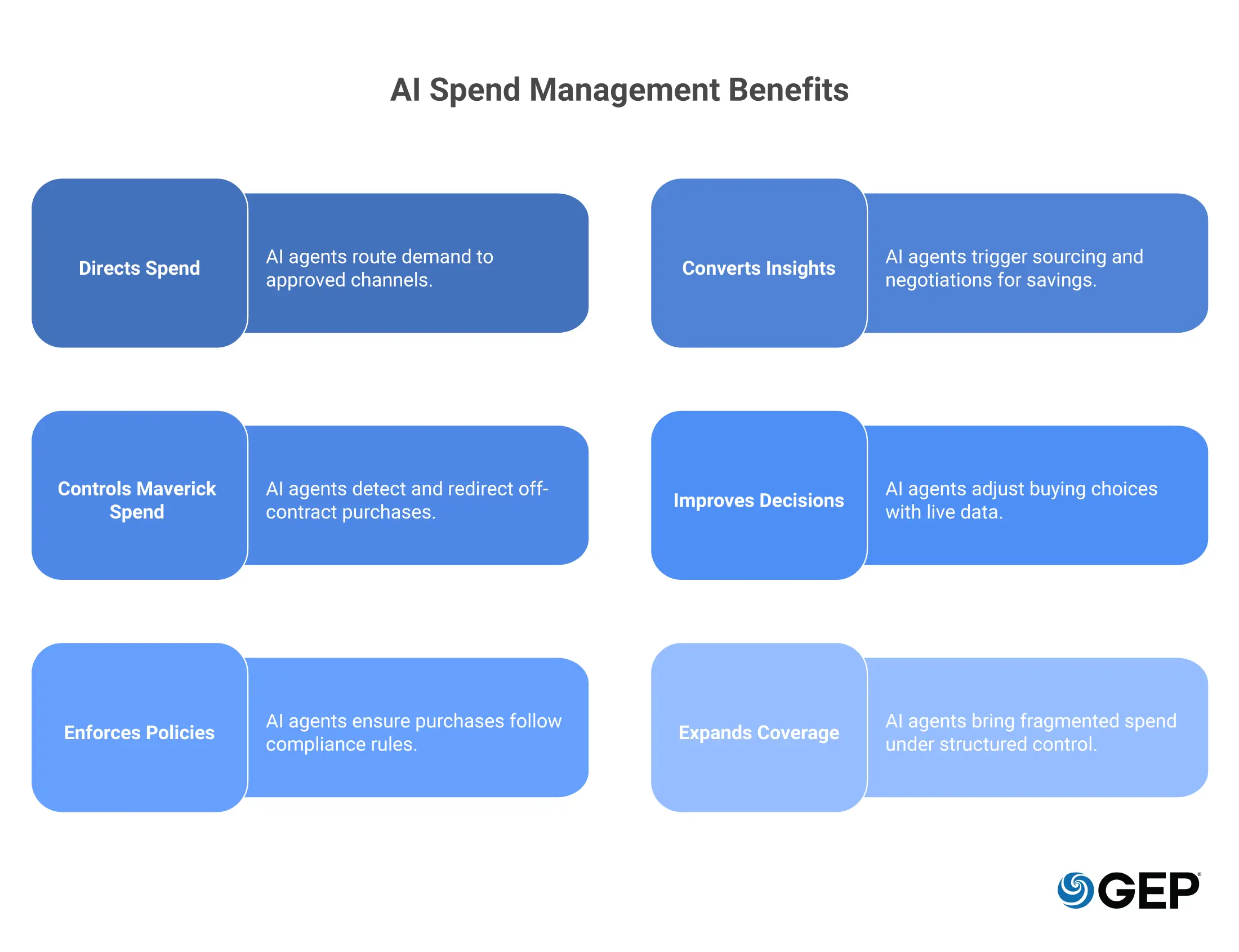
The next phase of spend management is not about seeing more. It is about acting with consistency and speed.
That shift moves procurement from visibility to orchestration.
Orchestration (best enabled by AI-native platforms) connects intake, sourcing, contracts, suppliers, and payments into one process. Data stays consistent. Actions follow without manual handoffs. This changes how work flows.
A request enters the system. It gets evaluated against demand, existing contracts, supplier options, and policy. The system determines the next step and moves it forward. That continuity removes delays.
Cycle times shorten because processes stay connected. Approvals move faster. Supplier decisions improve because risk and performance data are built into the workflow.
The impact is clearer in volatile conditions.
When tariffs change or supply risks increase, orchestrated systems allow teams to identify exposure, evaluate alternatives, and act without delay.
Speed improves. Accuracy improves. The cost structure changes as well.
Manual effort drops because data does not need repeated cleanup. Integration overhead reduces because systems are unified. Teams spend less time managing tools and more time managing outcomes. Some gains come from areas visibility never reached.
Tail and mid-value spend move under control. Supplier collaboration improves because everyone works from the same data. Procurement, supply chain, and finance align more easily.
AI-native platforms play a different role here. In such a system, AI operates within the workflow instead of outside it. It evaluates options, initiates actions, and adjusts based on results. Organizations are already moving in this direction as they invest in agent-based capabilities. This is where traditional spend management reaches its limit.
Visibility shows what is happening. Spend orchestration determines what happens next. The difference shows up in execution.
AI-Driven Spend Analytics Often Falls Short in Procurement. Why?
Explore what it takes to operationalize spend intelligence across procurement
Conclusion: The Next Phase of Spend Management
Spend visibility was an important step. It brought clarity to procurement data and improved understanding of spend patterns. But that’s no longer enough.
The next phase requires systems that connect insight to action. Organizations that adopt orchestrated spend management will move faster, respond earlier to risk, and capture opportunities that visibility alone cannot deliver.
Others will continue relying on dashboards while struggling to act on what they see.
Procurement teams that move from visibility to orchestration will set the pace for how spend is managed going forward.
The shift is already happening.