




Executive Summary
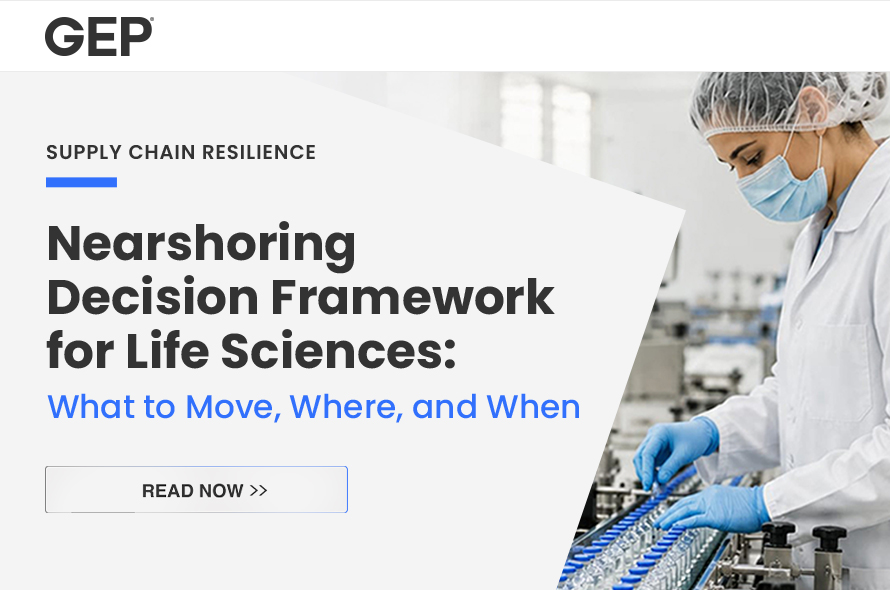
Tariffs and geopolitical volatility have turned life sciences manufacturing networks into financial-risk systems, not just supply chains. Nearshoring is often treated as the default fix. But in regulated manufacturing, relocating production can simply shift concentration from one region to another while adding new qualification and compliance burdens.
Roughly 80% of API sourcing for critical generics is concentrated in India and China, and tariff actions can take effect within 18 to 24 hours. Qualifying a new supplier, meanwhile, takes 18 to 24 months. That gap between how fast policy moves and how slowly supply chains respond is the real problem, which means the qualification plan has to be part of the strategy from day one, not an afterthought.
GEP's bulletin lays out a three-layer model: true total landed cost, disruption scenario modeling and option comparison across partial nearshoring, dual-region sourcing and a reinforced status quo. Options that look cheaper on unit cost often lose that advantage once tariff exposure and qualification drag are priced in.
Nearshoring redistributes where inventory needs to sit; it doesn't eliminate the need to hold it. Postponement strategies can reduce exposure to demand and disruption without compromising service levels.
For procurement and supply chain leaders, the stakes are clear: nearshoring decisions made without this analysis risk solving for geography while leaving the real exposure unchanged.
Frequently Asked Questions
It weighs total landed cost, disruption scenarios and sourcing options together to determine whether nearshoring actually improves resilience without adding cost or compliance risk.
Moving production closer to market can introduce new regulatory, qualification and concentration risks. Nearshoring needs to be measured against alternatives using the same risk and cost lens.
New supplier qualification can take 18 to 24 months, so sourcing decisions must align with qualification capacity to ensure risk reduction happens within the required window.
Resilience depends on where inventory sits and how postponement strategies balance flexibility with service levels, not just on where manufacturing happens.
Total landed cost, tariff and geopolitical exposure, supplier qualification feasibility, inventory strategy and single points of failure all need assessment before deciding what to nearshore.