




Enterprises have spent two decades digitizing source-to-pay. The result, in most organizations, is a chain of workflow tools that still depends on people to keep it moving. Buyers chase approvals. Analysts rebuild the same reports. Accounts payable teams spend their days resolving invoice exceptions one ticket at a time.
The AI-first source-to-pay process starts from a different assumption. Instead of software that waits for human input at every step, intelligence runs the process and people supervise it. Requests arrive in plain language. Agents classify spend, draft sourcing events, match invoices and flag only the exceptions that genuinely need judgment. The shift is less about adding a feature and more about redesigning how procurement work gets done.
This guide explains what an AI-first source-to-pay process is, how it differs from the traditional model, where the value shows up and how to implement it in a way that survives contact with real enterprise data. Here is all you need to know:
AI-Native or Bolt-On Procurement Platform?
Find out what separates AI-powered tools from AI-native procurement platforms.
What is AI-First Source-to-Pay Process?
An AI-first source-to-pay process is a procurement operating model in which artificial intelligence acts as the primary engine of every S2P stage, from intake and sourcing through contracting, purchasing, invoicing and payment, while people set strategy, approve consequential decisions and handle true exceptions. AI is not a layer added on top of the process. It is the process.
The distinction matters because most source-to-pay software on the market today is AI-added rather than AI-first. A chatbot sits beside the requisition form. A summarizer sits beside the contract repository. Useful, but the underlying workflow is unchanged: humans still push each transaction from step to step.
In an AI-first design, the default flow is touchless. An employee types what they need in ordinary language. The system interprets the request, finds the right contract or catalog item, builds the requisition, predicts the approval path and routes it. A compliant order can go from request to purchase order without anyone opening a workflow screen. Humans enter the loop where the stakes justify it: a supplier award, an unusual contract term, an invoice that fails tolerance checks.
How Is AI-First S2P Process Different from Traditional Source to Pay Process?
Traditional S2P platforms digitized paperwork. They replaced fax machines and spreadsheets with forms, approval chains and dashboards, which was real progress. What they never changed was the operating assumption: a person initiates, a person decides, a person reconciles. The software records what people do.
An AI-first process inverts that. The system initiates, proposes and executes; people govern. Data flows through one intelligence layer rather than sitting in module silos, so a sourcing decision knows about contract terms, supplier risk scores and live budget positions without anyone exporting anything. The practical differences look like this:
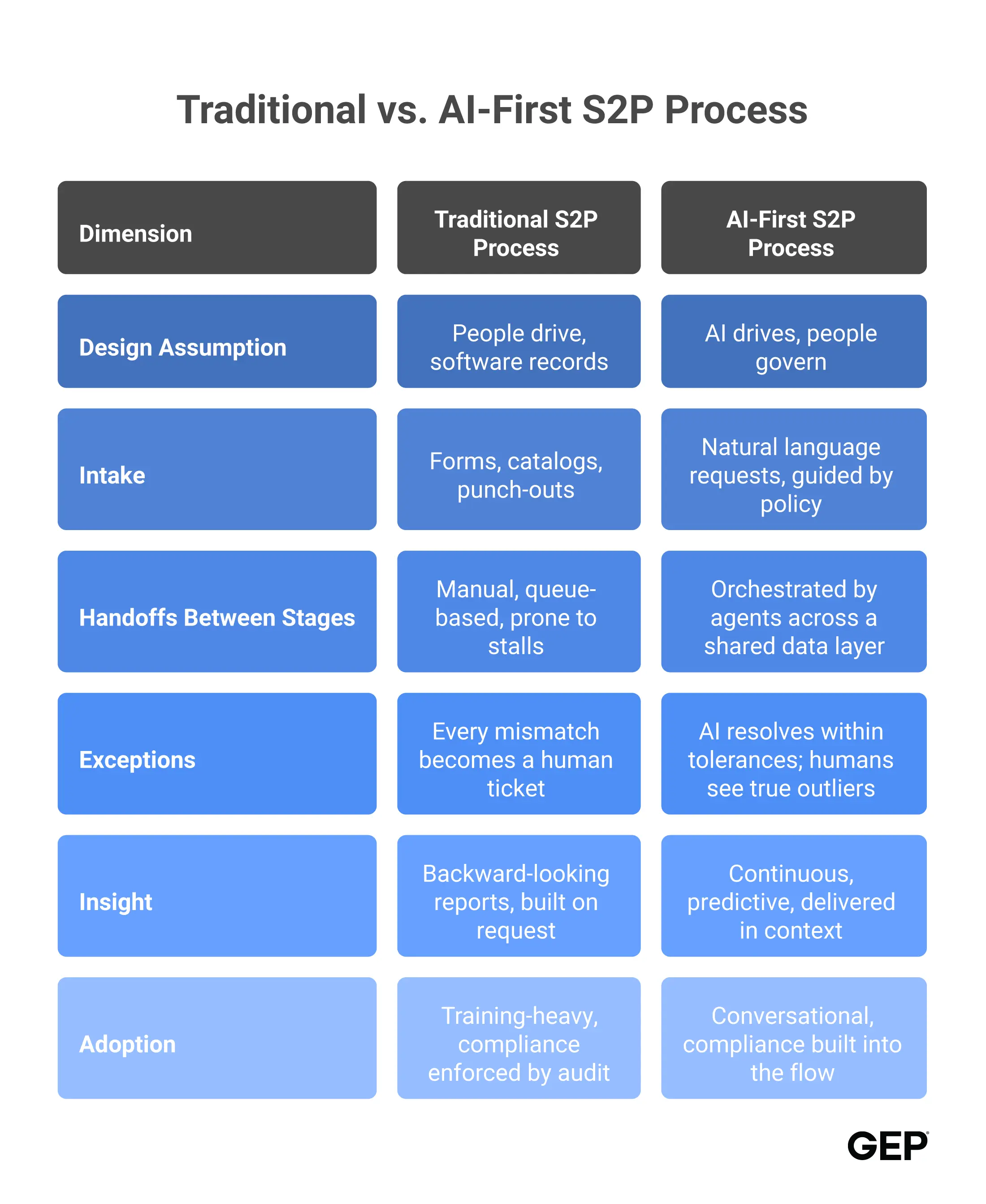
Neither model eliminates the other overnight. Most enterprises will run hybrid processes for years. The point is the direction: every capability added to an AI-first process reduces manual touches, while every capability added to a traditional one tends to add another screen.
Why Are Enterprises Adopting an AI-First Source-to-Pay Process?
Because the old math stopped working. Procurement teams are asked to deliver more savings, more risk coverage and more supplier innovation with flat or shrinking headcount. There are only so many hours a category manager can spend on requisition triage before the strategic work simply does not happen.
Several pressures are converging at once. Cost volatility and tariff uncertainty demand faster sourcing cycles. Regulatory scrutiny of supply chains keeps expanding, from ESG disclosure to sanctions exposure. Experienced procurement talent is scarce and expensive. And employee expectations have changed: people who use conversational AI at home have little patience for a nine-field requisition form at work.
At the same time, the barrier to adoption has dropped. AI capability that once required a data science team now ships embedded in procurement platforms. In a survey by Foundry and GEP, 65% of senior technology decision-makers said AI and ML tools can significantly augment or even revolutionize decision-making in procurement and supply chain. Conviction at that level, combined with tooling that finally matches it, explains why AI-first has moved from experiment to roadmap in most large enterprises.
Lead with Agentic AI
Drive smarter procurement and resilient supply chains through enterprise-proven technology
How AI Powers Each Steps of the Source-to-Pay Process
Walk the process end to end and the pattern repeats: AI removes the manual work inside each step, then improves the connections between steps.
Spend Analysis
Classification is continuous instead of quarterly. AI cleanses, deduplicates and categorizes transactions as they land, so spend analysis becomes a live view rather than a periodic project. Category managers ask questions in plain language and get answers with the underlying records attached.
Sourcing
AI drafts RFx documents from a short brief and prior events, identifies qualified suppliers against technical requirements, scores bids side by side and writes the award recommendation with its reasoning shown. Sourcing managers spend their time on negotiation strategy, not document assembly.
Contract Management
Models draft agreements from approved clause libraries, compare supplier paper against your standards, extract obligations and renewal dates from legacy contracts and monitor compliance after signature. Contract management shifts from filing documents to enforcing what they say.
Supplier Management
Onboarding questionnaires arrive pre-filled from public data. Supplier records from five systems resolve into one profile. Risk monitoring runs around the clock, blending financials, sanctions lists, cyber ratings and news into an early warning rather than a post-mortem.
Requisitioning and Ordering
Guided buying interprets a plain-language request, steers it to preferred suppliers and negotiated rates, checks budget in real time and predicts the approval path. Compliant requests become purchase orders without a manual touch.
Invoicing and Payments
Invoice data is captured and validated automatically, matched n-ways against orders and receipts, and reconciled within set tolerances. Exceptions that once queued for accounts payable get resolved by agents inside procure-to-pay orchestration, while payment timing is optimized for working capital and early-payment discounts.
What are Core Stages of the AI-First Source-to-Pay Process?
Seen from above, the AI-first S2P process organizes into four connected stages. The names will look familiar; what changes is how they hand off to each other.
Intelligent intake
One front door for every request, in natural language, with policy and budget awareness applied at the moment of asking rather than three approvals later.
Upstream
Source to contract. Opportunity identification, sourcing events, negotiation support and contracting, run as one flow in which the winning bid becomes the contract and the contract terms flow forward automatically.
Downstream
Procure to pay. Ordering, receiving, invoicing and payment, executed touchlessly wherever transactions stay within tolerance, with exceptions routed to people alongside the context needed to decide.
The intelligence layer
A shared data and AI foundation underneath all of it: classified spend, unified supplier records, contract intelligence and market signals feeding every stage and learning from every transaction.
The fourth stage is the one traditional S2P never had, and it is what makes the loop close. Payment data sharpens the next forecast. Contract outcomes tune the next sourcing event. In a modular world, those lessons died in separate databases; in an AI-first process, they compound.
Benefits of an AI-First Source-to-Pay Process
Cycle Times Measured in Days, Not Weeks
Sourcing events, contract turnarounds and requisition-to-order times all compress when drafting, scoring and routing happen automatically. Speed is often the first benefit stakeholders actually feel.
Touchless Transaction Rates
The share of orders and invoices processed with zero human touches becomes a managed KPI. Every point of improvement releases hours back to strategic work and removes a chance for error.
More Savings, Captured Faster
Continuous spend visibility surfaces opportunities that quarterly analysis misses: price creep against contract, unmanaged tail spend, demand that should be consolidated. Savings tracking in real time also keeps negotiated value from leaking during implementation.
Compliance Built Into the Flow
When the easiest way to buy is also the compliant way, maverick spend falls without a single stern email. Policy checks run inside every transaction instead of in the annual audit.
Risk Caught Earlier
Continuous supplier monitoring turns risk management proactive. A deteriorating financial signal at a key supplier prompts a sourcing contingency months before it would have surfaced in a business review.
Adoption People Do Not Resist
A conversational interface needs almost no training. That sounds like a soft benefit until you remember how many procurement transformations have died of low adoption.
Challenges in the AI-First Source-to-Pay Process (and How to Solve Them)
The obstacles are real, and they are consistent across enterprises. So are the remedies.
Data That Is Not Ready
Unclassified spend, duplicate supplier records and contracts scattered across shared drives will starve any AI initiative. Solve it in parallel, not in advance: modern platforms use AI itself to classify spend and cleanse master data, so the foundation improves as the process runs. Waiting for perfect data is how programs stall for two years.
Trust and Change Management
People will not hand transactions to a system they do not trust, and they should not. Build trust deliberately: start with AI recommending rather than acting, show its reasoning, publish accuracy rates and widen autonomy only as the evidence accumulates. Involve accounts payable and category teams in setting the tolerances.
Integration With ERP and Legacy Systems
An AI-first process that cannot see the ERP is theater. Insist on proven connectors to your ERP, finance and planning systems, and on APIs for whatever is homegrown. This is also an argument for platforms where AI is native to the S2P suite rather than a bolt-on that needs its own integration project.
Governing Autonomous Decisions
Which decisions may run touchless, and which need a signature? Answer that question in policy before scale, with audit trails on every automated action, defined escalation paths and periodic reviews of model performance. Good governance is what lets you expand autonomy safely; without it, one bad automated decision can set the program back a year.
Proving the Business Case
AI programs attract scrutiny, and vague productivity claims will not survive a CFO review. Baseline the metrics before you begin, attribute results per use case and separate hard savings from capacity gains.
How to Implement the AI-First Source-to-Pay Process, Step by Step
Step 1: Baseline the Current Process
Measure today's cycle times, touchless rates, exception volumes, compliance levels and cost per transaction. Every later ROI claim depends on this snapshot.
Step 2: Fix the Data Foundation, Using AI to Do It
Classify spend, unify supplier master and centralize contracts. Let AI-driven cleansing carry the load, with your team validating rather than keying.
Step 3: Select the Platform
Evaluate whether AI is native to the suite or added to it, how deep the ERP connectors go and how the vendor handles data security and model governance. AI-native platforms such as GEP Quantum Intelligence embed intelligence in the workflow itself, which shortens everything that follows.
Step 4: Pilot Two or Three High-Value Use Cases
Guided intake, invoice exception handling and contract analysis are common first wins: high volume, measurable, low regret. Keep humans in the loop and instrument everything.
Step 5: Set Governance Before Scaling
Codify decision rights, tolerances, audit requirements and escalation paths while the footprint is still small. Retrofitting governance onto a scaled process is far more expensive.
Step 6: Expand Autonomy Deliberately
Widen the touchless envelope as accuracy proves out: higher value thresholds, more categories, more stages. Publish the metrics as you go; internal proof recruits the skeptics.
Step 7: Retrain the Team for the New Work
Buyers become category strategists. AP specialists become exception managers and auditors of the machine. Invest in prompting skill, output verification and process redesign, because the people change is the part that determines whether the technology change pays.
Technologies that Enable the AI-First Source-to-Pay Process
Six building blocks come up in every serious evaluation.
Large Language Models and NLP
The conversational layer: interpreting requests, drafting documents, summarizing supplier responses and answering questions in ordinary language.
Machine Learning and Predictive Analytics
The quantitative engines behind demand forecasts, price predictions, approval-path prediction and anomaly detection in invoices and spend.
AI Agents and Orchestration
Agents execute multi-step work: running a sourcing event, resolving an invoice exception, chasing a confirmation. An orchestration layer sequences them, manages handoffs and enforces the guardrails, which is what turns individual features into a process.
Retrieval-Augmented Generation and Knowledge Graphs
RAG grounds every answer in your actual contracts, policies and records, with citations. Knowledge graphs map supplier-to-part-to-product relationships so reasoning reflects your supply base, not a generic one.
Intelligent Document Processing and Master Data Management
Extraction and validation of invoices, certificates and supplier paper, plus the deduplication and enrichment that keep the data layer trustworthy.
Low-Code Platforms, APIs and Connectors
The plumbing: prebuilt ERP connectors, open APIs and low-code tooling that lets procurement compose new AI-driven workflows without waiting on scarce engineering capacity.
Conclusion: The Future of the AI-First Source-to-Pay Process
The trajectory from here is visible. Copilots that assist are giving way to agentic AI that acts: autonomous agents running sourcing events, negotiating within mandates and resolving exceptions end to end, with humans setting strategy and approving what matters. Orchestration engines will coordinate those agents across the full S2P lifecycle so the process runs continuously instead of in queued steps.
Underneath sits a deeper convergence. AI-native platforms are combining predictive models, language models and optimization engines into multi-intelligence systems, coordinated stacks in which the orchestration layer decides which form of intelligence a given decision needs. Forecasting feeds sourcing. Sourcing outcomes tune the forecast. The process learns.
For procurement leaders, the takeaway is plain: the AI-first source-to-pay process is not a distant destination, it is a capability being switched on in stages, and the enterprises that start now will compound advantages the late movers cannot buy back. To see what a fully agentic S2P process looks like in practice, explore GEP's agentic AI source-to-pay platform, GEP Quantum Intelligence.
Frequently Asked Questions
Sooner than it feels comfortable, but in stages. The signals that you are ready: transaction volumes your team cannot triage, exception queues that keep growing, savings leaking between negotiation and realization, or a platform refresh already on the roadmap. You do not need perfect data or a finished AI strategy to begin; a two-use-case pilot with baselined metrics is the right first move for most enterprises.
Four datasets do most of the work: classified spend data, a unified supplier master, a centralized and searchable contract repository, and transactional history from your ERP and P2P systems (orders, receipts, invoices, payments). Market and risk feeds strengthen sourcing and supplier monitoring on top of that base. None of it has to be perfect on day one, because modern platforms use AI to classify and cleanse as the process runs.
Baseline first, then track the delta per use case. Hard measures include cycle times, touchless transaction rates, cost per order and per invoice, savings captured, early-payment discounts earned and working capital effects. Add adoption and quality measures, such as active usage, exception rates and override rates, since a tool nobody trusts returns nothing. Attributing ROI use case by use case keeps the business case honest and makes each expansion decision easier.
Any industry with high transaction volumes, complex supply bases or heavy compliance obligations sees outsized returns. Manufacturing and CPG gain from direct-material sourcing and multitier supplier visibility. Life sciences and financial services value the audit trails and embedded compliance. Retail benefits from speed and tail spend control, while energy and utilities lean on risk monitoring and contract intelligence. The common thread is volume plus complexity, not any single vertical.