




Every enterprise procurement organization depends on accurate, complete, and current supplier information. Yet for many companies, the process of registering new suppliers and keeping their profiles up to date remains one of the most fragmented, manual, and risk-prone activities in the entire source-to-pay cycle. Emails carrying W-9 forms, spreadsheets tracking insurance certificates, phone calls to verify bank details, and duplicate vendor records scattered across multiple ERP instances are still the daily reality for far too many procurement and accounts payable teams.
This guide explains what supplier registration and profile maintenance involve, why traditional approaches create operational bottlenecks and fraud exposure, and how modern supplier registration portals with easy registration and updates functionality transform the process. It also walks through the key steps for managing supplier registration and shows how enterprises can automate the entire workflow from intake to ERP synchronization.
What is Supplier Registration and Profile Maintenance?
Supplier registration is the structured process by which an enterprise collects, verifies, and records the information it needs to do business with a new supplier. It typically begins when a business stakeholder identifies a need for a new vendor, and it ends when that supplier is approved, assigned a vendor number, and activated in the company's procurement and financial systems. Along the way, the enterprise gathers legal entity details, tax identifiers, banking information, contact records, compliance certifications, insurance documentation, diversity classifications, and any category-specific credentials the supplier must hold.
Profile maintenance is the ongoing counterpart to registration. Supplier data is not static. Companies merge, relocate, change legal names, switch banks, renew or let lapse their insurance policies, gain or lose certifications, and update their remittance details. Profile maintenance covers all the processes through which this changing information is captured, validated, approved, and propagated to every downstream system that relies on it, from the ERP vendor master to contract repositories, payment platforms, and risk monitoring tools.
Together, registration and maintenance form the foundation of supplier master data management. When they work well, purchase orders reach the right entity, invoices match without exceptions, payments arrive in legitimate bank accounts, and compliance teams can trust the certifications on file. When they work poorly, the consequences ripple across the enterprise: blocked invoices, duplicate payments, failed audits, fraud losses, and strained supplier relationships.
It helps to think of supplier registration as a gate and profile maintenance as a guardrail. The gate determines who enters the supply base and under what conditions. The guardrail keeps the relationship within safe and compliant boundaries over its entire lifespan. Enterprises that invest only in the gate, treating onboarding as a one-time event, quickly discover that data decays.
Sub-Tier Visibility Is Just the Start
Discover the 4 strategic imperatives every procurement and supply chain leader must act on in 2026
Common Operational Bottlenecks in Traditional Supplier Registration
Traditional supplier registration, built on email exchanges, PDF forms, shared drives, and manual data entry, creates predictable and costly bottlenecks. Four of these deserve particular attention because they appear in nearly every enterprise that has not yet modernized the process.
Manual Document Vetting and High Invoice Exception Rates
In a manual environment, procurement or AP staff receive supplier documents as email attachments: tax forms, bank letters, certificates of insurance, quality certifications, and signed agreements. Someone must open each file, check that it is the right document type, confirm it is legible and current, extract the relevant fields, and key them into one or more systems. Each of these steps invites error. A transposed digit in a tax ID, an outdated remit-to address, or a missing payment term does not usually surface at registration. It surfaces weeks later when the first invoice arrives and fails to match.
The result is a high invoice exception rate. Invoices land in exception queues because the supplier name on the invoice does not match the vendor master, because the purchase order references an inactive vendor record, or because banking or currency details conflict. Every exception requires human investigation, back-and-forth emails with the supplier, and often a correction to the vendor record itself. AP teams end up spending a disproportionate share of their time firefighting data quality problems that originated during registration.
Disconnected ERP Master Data Leading to Duplicate Supplier Records
Large enterprises rarely run a single system of record. Mergers, regional operations, and best-of-breed application strategies leave companies with multiple ERP instances, each holding its own vendor master. When supplier registration happens locally that first engages, through whichever team that needs the supplier first, the same legal entity frequently gets created several times: once in the North American ERP, again in the European instance, and perhaps a third time under a slightly different name in a subsidiary's system.
Duplicate records are more than a housekeeping nuisance. They fragment spend visibility, making it impossible to see the true total spent with a supplier and weakening negotiating leverage. They create payment risk, because a credit memo issued against one record may never offset invoices posted to another. They complicate compliance, since a supplier blocked for sanctions or performance reasons in one system may continue receiving orders through its duplicate in another.
Vulnerability to Fraud: Unverified Bank Account and Payee Changes
Perhaps the most dangerous weakness of traditional registration and maintenance processes is their exposure to payment fraud. Business email compromise schemes routinely target the supplier update process: a fraudster impersonates a known supplier, emails AP with a convincing request to change bank account details, and waits for the next legitimate invoice to be paid into the fraudulent account. When bank changes are processed based on an email and a PDF letterhead, with no callback verification, no account ownership validation, and no segregation of duties, the enterprise is effectively trusting whoever controls an email inbox.
Losses from this type of fraud regularly run into six and seven figures per incident, and recovery is difficult once funds move. The same vulnerability exists at initial registration. Without independent verification that a bank account actually belongs to the registering legal entity, a company may onboard a supplier whose payment details were manipulated from the start.
Portal Fatigue and Low Supplier Adoption
Even when enterprises deploy technology, they often encounter a different bottleneck: suppliers who will not engage with it. A typical mid-sized supplier may sell to dozens or hundreds of enterprise customers, each with its own onboarding portal, its own login, its own form structure, and its own document requirements. Suppliers understandably experience portal fatigue. They abandon half-completed registrations, ignore reminder emails, or route everything back through their salesperson, defeating the purpose of self-service.
Low adoption has a compounding effect. If only a fraction of suppliers complete registration through the portal, internal teams must maintain parallel manual processes for everyone else, which means the enterprise pays for technology without retiring the old workload. Clunky user experiences make this worse: forms that ask for the same information twice, requirements that are unclear until a submission is rejected, portals that do not work well on mobile devices, and registration flows offered only in one language for a global supply base. Ease of use is not a cosmetic concern in supplier registration. It is the single biggest determinant of whether the process works at all.
Explore GEP’s - AI-Native Supplier Master Data Management Software
What are Supplier Registration Portals?
A supplier registration portal is a secure, web-based platform through which suppliers submit and maintain their own business information for a buying organization. Instead of exchanging documents over email and having internal staff key data into the vendor master, the enterprise invites the supplier to a branded portal where the supplier creates a profile, completes structured forms, uploads required documents, certifies the accuracy of the information, and submits it for review. Once approved, the data flows into the enterprise's procurement and ERP systems, and the supplier retains access to the portal to make updates whenever something changes.
Modern portals are typically one component of a broader supplier management or source-to-pay suite. They connect intake with qualification, risk assessment, contract management, performance tracking, and payment processes, so that the profile created at registration becomes a living record used throughout the relationship. The portal serves both sides of the relationship. For the enterprise, it is a controlled front door: every supplier enters through the same process, provides the same baseline data, and passes the same checks. For the supplier, it is a single place to see what the customer requires, track approval status, respond to information requests, and manage credentials such as insurance certificates or diversity classifications.
It is worth distinguishing a true registration portal from a simple online form. A web form merely digitizes data capture. A registration portal manages an entire lifecycle: it authenticates supplier users, applies conditional logic to determine what each supplier must provide, validates entries against external data sources, routes submissions through configurable approval workflows, maintains an auditable history of every change, and synchronizes approved records with downstream systems. The difference matters because most of the value of a portal comes from what happens after the supplier clicks submit, not from the form itself.
Portals also vary in their deployment model. Some enterprises run buyer-specific portals in which every supplier profile exists only for that customer. Others participate in network models where suppliers maintain a single profile shared across multiple buying organizations, reducing duplicate effort for the supplier. Many advanced platforms blend the two, letting suppliers reuse common data such as legal entity details and certifications while still answering buyer-specific questions.
Are fragmented systems and blind spots affecting your supplier monitoring?
See how procurement software with embedded AI agents can result in stronger supplier performance
Core Capabilities of Advanced Supplier Registration Portals
Basic portals capture data. Advanced portals actively improve data quality, reduce internal workload, and lower risk. Four capabilities in particular separate advanced supplier registration portals from standard ones.
Self-Service Onboarding
Self-service onboarding shifts responsibility for data entry and document submission to the party that knows the information best: the supplier. An advanced portal supports the full journey without human hand-holding. Suppliers receive an invitation, register their user accounts, and are guided step by step through a dynamic questionnaire. Progress indicators show how much remains, contextual help explains why each item is required, and the supplier can save a partial submission and return later. Multi-language support, mobile-friendly design, and accessible interfaces remove friction for global supply bases.
Crucially, self-service extends beyond initial onboarding to ongoing updates. A supplier that changes its address, adds a new contact, or renews an insurance policy can log in at any time and submit the change through the same governed workflow, with the enterprise approving before anything reaches the vendor master. This is the "easy updates" half of easy registration and updates functionality, and it is what keeps supplier data fresh year after year.
Real-time Data Validation and Enrichment
Advanced portals validate data at the moment of entry rather than after submission. As a supplier types its tax identification number, the portal checks the format and, where integrations exist, verifies it against government registries such as tax authority databases. Address fields are standardized against postal databases. Bank account details are checked for valid formats, and in mature implementations verified against bank account ownership services that confirm the account actually belongs to the named legal entity. Duplicate detection runs in real time, comparing the new registration against existing vendor records using fuzzy matching on names, tax IDs, addresses, and bank details, and flagging potential matches before a duplicate is ever created.
Enrichment complements validation. Rather than asking suppliers to type everything, the portal can pull firmographic data from third-party providers using a business identifier such as a DUNS number or a national registration number: legal name, corporate hierarchy, industry codes, financial health indicators, and sanctions or watchlist status. Enrichment shortens forms, improves accuracy, and gives the enterprise risk context it would never obtain from self-reported data alone. The combined effect is that data enters the vendor master already clean, verified, and de-duplicated, which is far cheaper than cleansing it later.
Automated Certificate Expiration Tracking and Renewal Alerts
Certificates of insurance, quality certifications such as ISO 9001, safety credentials, licenses, and regulatory registrations all share one property: they expire. In manual environments, tracking expirations means spreadsheets and calendar reminders, and lapses are usually discovered during audits or, worse, after an incident reveals that a supplier's liability coverage ended months earlier.
Advanced portals treat every uploaded certificate as a structured record with metadata: document type, issuer, coverage amounts or scope, effective date, and expiration date. Some platforms extract these fields automatically from the uploaded document using intelligent document processing, reducing manual review. The system then monitors expiration dates continuously and triggers escalating reminders to the supplier ahead of expiry, for example at 90, 60, and 30 days. Suppliers upload renewals through the portal, the new document is validated, and the compliance record updates without any internal chasing. If a certificate lapses, the platform can flag the supplier, alert category managers, restrict new purchase orders, or trigger a review, depending on configured policy. This converts certificate management from a periodic scramble into a continuous, automated control.
Tier-1 and Tier-2 Supplier Diversity Self-Reporting
Many enterprises carry supplier diversity commitments, whether driven by corporate responsibility goals, customer contract requirements, or government reporting obligations. Meeting those commitments requires reliable data on which suppliers qualify as diverse businesses, such as minority-owned, women-owned, veteran-owned, or small disadvantaged businesses, along with valid certification evidence.
Advanced portals build diversity data collection directly into registration. Suppliers self-report their diversity classifications, upload certificates from recognized certifying bodies, and keep those credentials current through the same expiration tracking used for insurance and quality documents. This covers Tier-1 diversity, meaning the enterprise's direct suppliers. Leading platforms go further and support Tier-2 reporting, in which prime suppliers periodically report the diverse spend they themselves direct to their own subcontractors and suppliers on the enterprise's behalf. The portal provides prime suppliers with structured reporting forms and deadlines, aggregates their submissions, and feeds enterprise-level diversity reporting.
Key Steps for Managing Supplier Registration
Whatever technology an enterprise uses, a well-managed supplier registration process moves through five essential stages. Understanding these stages helps organizations design workflows, assign ownership, and identify where automation adds the most value.
Risk Tiering and Intake
Registration should begin with a deliberate intake decision, not with a form. When a stakeholder requests a new supplier, the first questions are whether a suitable supplier already exists in the approved base, whether the spend justifies a new relationship, and what level of risk the proposed supplier represents. Risk tiering classifies suppliers by criteria such as spend magnitude, category criticality, geographic exposure, data access, and regulatory sensitivity. A one-time caterer and a contract manufacturer handling proprietary designs should not travel the same onboarding path.
The tier assigned at intake determines everything downstream: which questionnaire the supplier receives, which documents are mandatory, which screenings run, and who must approve. Proportionality is the goal. Low-risk suppliers move through a light process measured in days, preserving business agility, while high-risk suppliers receive rigorous due diligence. Enterprises that skip tiering tend to either over-burden every supplier, causing delays and portal fatigue, or under-scrutinize risky ones.
Self-Service Data Collection
Once intake approves the request, the supplier is invited to the portal to complete data collection. The enterprise defines the data model: core identity fields such as legal name, registered address, tax identifiers, and ownership structure; financial details including banking information and payment preferences; operational information such as contacts, capabilities, and service locations; and compliance content such as certifications, policies, and questionnaire responses on topics like anti-bribery, data protection, and sustainability.
Effective data collection follows a few design principles. Ask only for what the supplier's risk tier and category require. Use conditional logic so questions appear only when relevant. Prefer structured fields over free text so responses can be validated and reported on. Allow document upload with clear specifications of acceptable formats and issuers. And communicate expectations up front, including how long the process would take and what would happen next.
Compliance and Validation
After submission, the enterprise validates what it received. This stage has two threads. Data validation confirms that the information is accurate and internally consistent: tax IDs verified against registries, addresses standardized, bank accounts checked through penny tests, ownership verification services, or documented callback procedures, and the whole record screened against existing vendors for duplicates.
Compliance screening confirms that the enterprise may and should do business with the supplier. Typical checks include sanctions and watchlist screening across relevant jurisdictions, politically exposed persons (PEP) checks where appropriate, adverse media review, financial health assessment, and category-specific requirements such as environmental permits or industry licenses. For higher tiers, this stage may extend to full due diligence questionnaires, cybersecurity assessments, or on-site audits. Findings are documented against the supplier record, and unresolved issues either return to the supplier for remediation or halt the process. The discipline to stop a registration at this stage is what makes the process a genuine risk gate rather than a formality.
Internal Review and Approval
Validated submissions then route to the internal stakeholders whose sign-off the policy requires. Approval matrices vary, but common participants include the requesting business owner confirming the need, procurement confirming sourcing policy compliance, finance or AP confirming payment terms and banking controls, and specialist functions such as legal, information security, quality, or trade compliance for suppliers that trigger their thresholds.
Good approval design balances control with speed. Sequential approvals suit dependencies, parallel approvals shorten cycle time, and delegation and escalation rules prevent submissions from stalling in someone's inbox during vacation. Every approval or rejection should be captured with identity, timestamp, and rationale, forming an audit trail that supports internal audit, external audit, and regulatory inquiries. Sensitive changes deserve special treatment: a bank account change, for example, should require independent verification and a second approver regardless of how routine the supplier relationship is, because this is precisely where fraudsters strike.
System Integration
The final stage moves the approved record into the systems where it will be used. At minimum, this means creating or updating the vendor master in the ERP, with the correct company codes, purchasing organizations, payment terms, and withholding tax settings. In multi-ERP environments, integration logic determines which instances receive the record and keeps identifiers cross-referenced. Beyond the ERP, the supplier record may need to reach procurement applications, contract management systems, risk monitoring platforms, and payment providers.
Integration should be bidirectional and continuous, not a one-time export. When a supplier later updates its profile through the portal and the change is approved, the update must propagate automatically to every connected system, and status changes originating in the ERP, such as blocks or payment holds, should reflect back into the portal. Closing this loop is what finally eliminates the swivel-chair data entry and version conflicts that plague manual processes, and it is what makes the portal, rather than a dozen spreadsheets, the single source of truth for supplier information.
The 2026 Procurement Executive Insight Report
Explore the factors driving procurement transformation in the next five years
How to Automate Supplier Registration Workflows
Automating supplier registration means connecting the five aforementioned stages into a single digital workflow in which software performs the repetitive work and humans intervene only where judgment is required. Six building blocks make this possible.
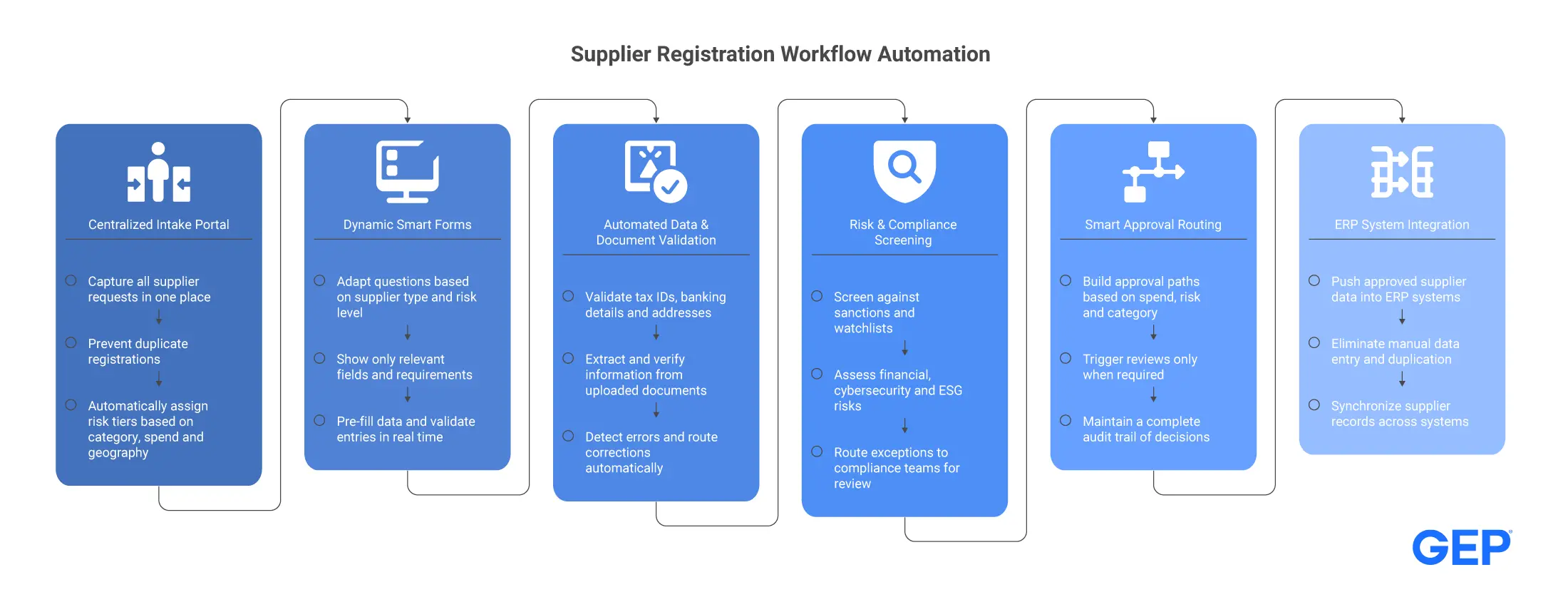
Centralized Intake Portal
Automation starts by giving every registration request one front door. A centralized intake portal receives all new supplier requests, whether raised by internal stakeholders or by suppliers responding to invitations, and applies consistent logic before anything else happens. The portal checks the request against the existing supplier base to prevent duplicates, captures the business justification, and applies risk tiering rules automatically based on category, spend, and geography. Because every request enters the same funnel, procurement gains complete visibility into the onboarding pipeline (and shadow registrations through side channels disappear).
Dynamic Smart Forms
Static forms treat every supplier identically and collect either too much or too little. Dynamic smart forms adapt in real time to the supplier's answers and risk tier. A domestic services supplier sees a short questionnaire; a foreign manufacturer handling regulated goods sees additional sections on trade compliance, quality certifications, and site details. Fields pre-populate from enrichment sources, validation happens inline, and conditional logic hides everything irrelevant. The supplier's effort shrinks, completion rates rise, and the enterprise still collects the full depth of information where the risk warrants it.
Automated Data and Document Validation
Once information is submitted, automation takes over verification. Tax identifiers are checked against government registries, addresses standardized, and bank details validated through format checks and account ownership verification services. Intelligent document processing reads uploaded certificates, extracts issuer, scope, and expiration dates, and compares them against requirements. Duplicate detection algorithms compare the submission against all existing vendor records. Anything that passes moves forward without human touch; anything that fails returns to the supplier automatically with a clear explanation of what to correct.
Risk and Compliance Screening
Automated screening engines run the supplier against sanctions lists, watchlists, politically exposed persons databases, and adverse media sources the moment validated data is available, and they continue monitoring after onboarding so that a supplier who becomes sanctioned next year is flagged immediately. Financial risk scores, cybersecurity ratings, and ESG indicators can be pulled from specialist providers and attached to the profile. Screening results feed rules: clean results proceed automatically, potential matches route to a compliance analyst for adjudication, and confirmed issues stop the workflow.
Smart Approval Routing
Instead of emailing forms around, smart approval routing reads the attributes of each submission and assembles the correct approval chain automatically. Spend thresholds, risk tier, category, region, and the nature of the change all influence who must sign off. Low-risk registrations may auto-approve after validation, while a bank account change always demands independent verification and dual approval. Approvers initiate actions from web or mobile interfaces, reminders and escalations keep submissions moving, and the system records every decision with full context, producing an audit trail without any extra effort.
ERP System Integration
The final building block is machine-to-machine integration with the ERP and other downstream systems. Pre-built connectors or APIs create the vendor record automatically upon final approval, populating company codes, payment terms, and tax settings according to mapping rules, and return the ERP vendor number to the portal. Subsequent profile updates flow through the same pipeline, so approved changes synchronize everywhere within minutes. Bidirectional sync keeps statuses aligned in both directions. With integration in place, the registration workflow becomes genuinely touchless from supplier submission to a payment-ready vendor record.
Conclusion: Turning Supplier Registration into a Secure Risk Gate
Supplier registration is often dismissed as administrative plumbing, but it is better understood as the enterprise's most important risk gate. Every fraud scheme that exploits a fake bank change, every compliance failure traced to an unvetted vendor, every duplicate payment, and every invoice exception has its roots in how supplier information was collected, verified, and maintained. Enterprises that modernize this process with an easy supplier registration and updates capability gain far more than convenience.
They gain clean master data that keeps invoices matching and spend analytics trustworthy. They gain fraud resistance through verified banking details, controlled change workflows, and complete audit trails. They gain compliance assurance through automated screening, certificate tracking, and diversity reporting. And they gain supplier goodwill, because a fast, transparent, self-service experience signals that the enterprise is easy to do business with. The formula is consistent: centralize intake, tier by risk, let suppliers own their data through self-service, validate automatically, route approvals intelligently, and integrate tightly with the ERP. Organizations that follow it turn a historically painful process into a durable competitive control, one that protects the enterprise on day one of a supplier relationship and every day after.
Frequently Asked Questions
Mandatory fields typically include the supplier's legal entity name and any trade names, registered address, country of incorporation, tax identification numbers, banking details with account ownership evidence, a primary contact with verified email, payment currency and terms, and the goods or services category. Depending on risk tier and industry, enterprises also mandate insurance certificates, quality or safety certifications, diversity classifications, and responses to compliance questionnaires covering topics such as anti-bribery and data protection.
It improves accuracy at the source. Suppliers enter their own information through validated, structured forms, which eliminates transcription errors from manual rekeying. Real-time checks against tax registries, address databases, and bank verification services catch mistakes before submission, while duplicate detection prevents redundant records. Because suppliers can easily submit updates through a governed workflow, changes such as new addresses or renewed certificates reach the vendor master promptly instead of decaying quietly, keeping data accurate over the full relationship rather than only at onboarding.
A standard portal digitizes forms; an automated self-service portal manages outcomes. Distinguishing features include dynamic questionnaires that adapt to risk tier, real-time data validation and third-party enrichment, intelligent document processing that reads and tracks certificates, automated sanctions and risk screening with continuous monitoring, certificate expiration alerts with supplier-driven renewals, smart approval routing with full audit trails, Tier-1 and Tier-2 diversity reporting, and bidirectional ERP integration that synchronizes approved data automatically rather than relying on exports and manual entry.
Automation removes the waiting that dominates manual onboarding. Suppliers complete adaptive forms in one sitting instead of exchanging emails over weeks, validation and screening run in minutes rather than sitting in queues, incomplete submissions bounce back instantly with clear correction guidance, and approvals route in parallel with automatic reminders and escalations. ERP records are created automatically upon approval rather than waiting for data entry. Organizations commonly compress onboarding cycles from several weeks to a few days, and low-risk suppliers can be activated in hours.
Yes. Modern portals are designed for ERP integration through pre-built connectors and open APIs, supporting platforms such as SAP, Oracle, Microsoft Dynamics, and others, including multi-ERP landscapes. Integration is typically bidirectional: approved registrations and profile updates flow into the vendor master automatically with correct company codes and payment settings, while vendor numbers, blocks, and status changes flow back to the portal. Middleware or integration platforms can also be used where enterprises prefer to route data through an existing integration layer.