
Caught Between Cost and Growth: How CPOs Are Rewriting the Efficiency Playbook in 2026
- According to the 2026 ProcureCon CPO Report, 52% of procurement leaders cite balancing cost reduction with growth investment as a top challenge.
- Tariffs, supply network disruption and persistent inflation have made traditional cost-cutting levers less effective.
- The procurement leaders pulling ahead are using intelligent automation to compress cycle times, recover hidden savings and fund transformation from within.
May 19, 2026 | Procurement Strategy 4 minutes read
The CFO wants 10% cost reduction. The board wants AI investment. The supply base is repricing everything because of tariffs. And the CPO is expected to deliver all three simultaneously.
This is a strategy problem, not a resource problem. The rules of cost management have changed, and the CPOs navigating 2026 successfully aren’t squeezing harder, they’re thinking differently and reframing the narrative.
The Cost Pressure CPOs Are Feeling Today Is Different
The 2026 ProcureCon CPO Report makes the shift in priorities unmistakable. Last year, procurement leaders said their biggest challenges were digital transformation and supply chain risk. This year, 52% cite balancing cost reduction with growth investment as a top concern, a direct reflection of the macro environment CPOs are operating in right now.
Tariffs are a significant driver. According to the Budget Lab at Yale, 2025 tariff policies pushed the overall U.S. average effective tariff rate to roughly 14% to 17% by year-end after import patterns adjusted, the highest level in nearly nine decades. Those costs don’t stay with importers, they flow downstream through supply chains, showing up as higher input costs, repriced contracts and margin pressure at every tier.
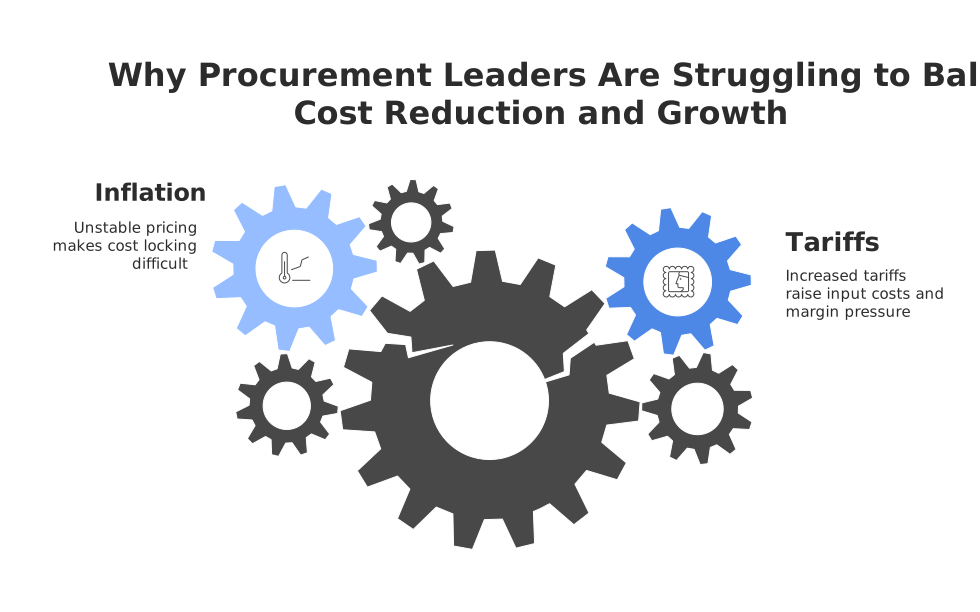
Inflation compounds the picture. Procurement teams are negotiating in an environment where supplier pricing assumptions from 2024 no longer hold, and where locking in costs today means betting on a trade policy landscape that has shifted repeatedly.
Why the Old Playbook Is Breaking Down
In previous cycles of cost pressure, procurement had a reliable set of levers. Consolidate to fewer suppliers for volume leverage. Push harder on price. Trim inventory to free up working capital.
Each of those moves carries new risk in 2026. Consolidating to fewer suppliers increases concentration exposure, exactly what the past few years have taught organizations to avoid. Pushing suppliers on price when they are already absorbing tariff and input cost increases creates fragility, not savings. And trimming inventory buffers leaves organizations with no cushion when the next disruption arrives.
The companies still running the 2015 playbook are discovering that every dollar saved in one column is generating liability in another. A cheaper supplier in a tariff-exposed region can quickly become the more expensive option when landed cost, disruption risk and compliance exposure are fully priced in.
The Real Squeeze: Funding Transformation While Delivering Savings
Here is where the tension becomes genuinely difficult. The same ProcureCon survey that flags cost pressure as a top challenge also shows that 45% of CPOs rank AI-driven automation as a top strategic priority. Those two objectives aren’t in conflict in theory, but in practice, building the data quality, talent and platform capabilities that AI requires demands investment at the exact moment CFOs are asking for cuts.
The talent dimension compounds this further. 54% of CPOs identify securing digital and analytical skills as their biggest challenge. You cannot automate your way to savings without people who can configure, supervise and improve the systems doing the work. Organizations that treat AI as a budget line item without building the human capability around it are investing in shelf-ware.
The Leaders Solving Both Problems at Once
The CPOs pulling ahead share a common insight: technology investment and cost reduction do not have to be sequential. Deployed correctly, one funds the other.
Intelligent automation applied to accounts payable and tail spend recovers value that manual processes routinely miss: duplicate invoices, missed early-payment discounts, pricing variances that slip through on high-volume transactions. Automated sourcing tools surface market pricing benchmarks that give procurement teams a stronger position in supplier negotiations. Faster cycle times mean organizations can act on savings opportunities before market conditions shift.
The ProcureCon data supports this. 55% of CPOs report that the speed and efficiency of procurement processes have significantly improved due to their team's recent efforts. That improvement is the foundation for recovering savings, funding further investment and building the credibility to make the case for both.
Cost Pressure. AI Ambition. Talent Gaps.
New research reveals where procurement leaders are focusing and where they're falling behind
Reframing the Conversation With the CFO
The CPO who walks into the budget conversation with cost reduction and transformation investment as two separate line items will lose. The CFO will cut the transformation line. The CPO who walks in with a unified narrative: “Here’s how our capability investment generates savings that fund itself” has a fundamentally stronger position.
That requires procurement leaders to become fluent in a language beyond spend metrics. It means building investment cases that show how automation reduces exception handling costs, how better supplier data reduces risk exposure and how faster cycle times unlock working capital. Cost and growth are not opposing forces in this framing. One enables the other.
The 2026 ProcureCon CPO Report notes that future procurement leaders will need strong narrative and storytelling capabilities for boardrooms and executive teams. That skill starts with the cost-versus-growth conversation. CPOs who can tell that story compellingly will have the organizational backing to execute on both sides of it.
The Forcing Function
The cost pressure CPOs face in 2026 is real, but also clarifying. It’s forcing the profession past blunt-force efficiency and toward something more durable: procurement that generates savings intelligently, funds its own transformation and builds resilience without sacrificing competitiveness.
The leaders who treat this moment as a forcing function rather than a threat will come out the other side with procurement organizations that are structurally stronger. It’s the result of rethinking what efficiency actually means when the world keeps changing the rules.