What the 2026 Middle East Crisis Means for Global Chemical Supply Chains
- The partial closure of the Strait of Hormuz is impacting global chemical supply chains, driving energy price volatility, longer transit times and trade flow disruptions.
- Exposure varies significantly by buyer type, with those dependent on Middle East feedstocks facing the highest risk and the greatest urgency to act.
- Procurement leaders should sequence response across three phases: immediate stabilization, short-term flexibility and long-term structural resilience to protect supply continuity.
May 19, 2026 | Supply Chain Strategy 5 minutes read
The global chemical industry is undergoing a structural disruption. The partial closure of the Strait of Hormuz, through which nearly one-third of global oil and 20% of liquefied natural gas (LNG) flows, has led to a sharp escalation in oil prices, and the risk premium has shifted from cyclical to structural.
Based on GEP’s engagement with clients across chemical value chains, this is not just a pricing event. But it is a test for supply reliability, lead times, inventory management and sourcing economics, with direct implications for key chemicals such as methanol, polyethylene, polypropylene and ammonia.
For procurement leaders, the question is no longer - what or where is the problem? But how to act. Organizations can no longer treat supply risk as a routine operational matter—crises like COVID-19 and regional conflicts demand a different posture./
Three Channels of Disruption
The current situation differs in both scale and impact from previous Middle East disruptions, which fall into three disrupting channels:
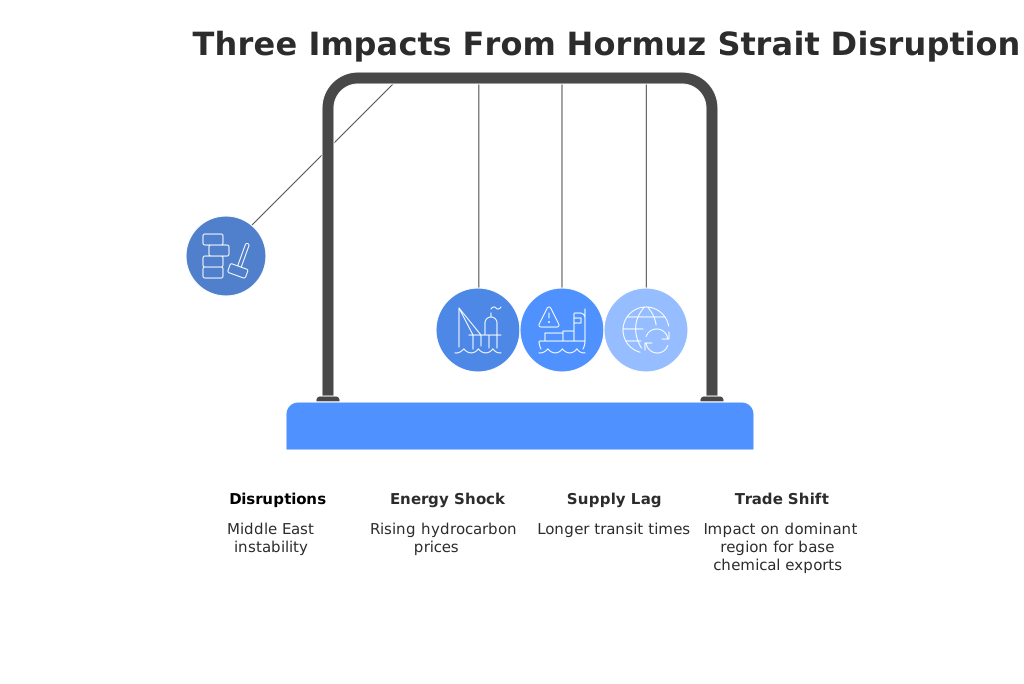
1. Energy Price Volatility & Feedstock Shock
Hydrocarbons serve both as energy sources and feedstocks. As oil and gas prices rise:
- There will be an immediate increase in production costs for ammonia, methanol and ethylene.
- Feedstock costs rise as natural gas (for production of ammonia/methanol) and naphtha/ethane (for production of polyethylene and polypropylene) become more expensive.
- Inflation in the cost of downstream products like plastics, fertilizers and intermediates
For energy-intensive chemicals, energy represents around 40 – 85% of total production cost, making the margins highly sensitive to volatility.
2. Supply Chain “Lag” and Physical Disruption
As the Strait of Hormuz is a critical shipping route, disruptions here can create:
- Longer transit times on rerouting freight via Cape of Good Hope.
- Large-scale backlogs, even after normalization (which could require at least 6–7 weeks.)
- Freight and container imbalances, as well as insurance cost escalations.
These issues can create artificial scarcity, even in regions that are isolated from conflict.
3. Structural Shift in Trade Flows
The Middle East is a dominant exporter of base chemicals. As of 2025, the region contributed:
- Around 56% of the total global export of methanol
- Around 40%+ of global polyethylene exports
- Around 29% of global ammonia supply
Implications of these disruptions include:
- Rerouting of global trade from alternatives like Suez Canal, Cape of Good Hope, etc.
- Encouraging reliance on secondary supply regions
- Persistent cost and availability imbalances
Who’s Impacted by the Crisis?
While the current crisis is affecting the global market, not all buyers are impacted at the same scale. A uniform response will fail as regional exposure varies significantly:
| Stakeholder Type | Exposure | Impact | Level |
| Middle East-Dependent Buyers | Methanol, polyethylene (PE), polypropylene (PP) | Supply disruption and lead time delays | High |
| Fertilizer & Ammonia Buyers | Natural gas-linked ammonia supply | Surge in the cost of feedstock and energy | High |
| Packaging & Plastic Converters | PE and PP as core inputs | Shortage of feedstock and spike in price | High |
| Downstream Industrial Manufacturers | Chemical intermediates (plastics, resins) | Cascading of cost inflation | Medium |
| Low Import / Domestic Buyers | Limited direct exposure | Indirect impact in price | Low |
Crisis Response Roadmap: 3 Phase Action Plan of What to do and When
In a volatile market, timing matters as much as strategy. As per GEP’s experiences in supporting clients through this crisis, leading organizations are sequencing actions across three phases:
Phase 1: Immediate Response (0 – 15 days)
Focus: Buy time and prevent disruption, as speed matters more than cost optimization.
- Identify exposure by assessing the percentage of spend that is dependent on the Middle East and what key chemicals are difficult to replace.
- Increase inventory stocks to ensure that there is a short-term buffer for any delivery delays.
- Engage closely with suppliers to validate their commitments.
- Adjust ERP lead times by 4 to 6 weeks for impacted lanes to reflect longer transit times and delays.
Phase 2: Stabilization (30 - 90 Days)
Focus: Create flexibility and reduce dependency to reduce risks
- Assess alternate suppliers within the same region and regions that are least impacted, even at a temporary cost premium.
- Evaluate index-based pricing vs. fixed pricing to ensure fair cost management.
- Rebalance stocks across regions to reduce shortages and concentrations of stocks.
- Secure forward contracts to avoid delays and cost spikes due to limited availability.
Phase 3: Structural Resilience (6–12 Months)
Focus: Institutionalize resilience to redesign supply chain strategy
- Evaluate and implement dual sourcing strategy to reduce dependency on a single supplier or a single region.
- Explore nearshoring or regional hubs to shorten lead time and reduce exposure to global disruptions.
- Improve contracts by introducing clauses such as volume flexibility, index-based pricing, etc, to handle future volatility.
- Build strategic partnerships with reliable suppliers beyond lowest cost to ensure supply continuity during crisis.
Deep Dive: Europe-Based Packaging Manufacturer
Consider a packaging manufacturer from Europe who depends on Middle East suppliers for 60% of their polypropylene needs. The manufacturer is exposed to two main problems: feedstock price volatility and logistical disruption. GEP would recommend the following procurement strategy.
Phase 1: Immediate (0–15 Days)
- Increase PP inventory stocks as a buffer for shipment delays into Europe
- Engage with suppliers to validate commitments and shipment schedules
- Critically allocate available PP to critical production lines and customers
Phase 2: Stabilization (30–90 Days)
- Assess alternate PP suppliers within Europe and in Southeast Asia
- Transition to index-based pricing (linked to propylene/PP benchmarks)
- Optimize specifications of the product to allow flexibility from across PP grades
Phase 3: Structural Resilience (6 - 12 Months)
- Implement dual sourcing strategy across Europe and other non-Middle East regions
- Reduce Middle East exposure to below 30% of total PP sourcing
- Establish long-term contracts with reliable suppliers to ensure supply continuity along with flexible pricing and volume clauses
The GEP Advantage: Turning Strategy Into Execution
GEP has been supporting clients through this crisis to help them stabilize operations, manage volatility and build long-term resilience. GEP recommends organizations use the following tools to optimize their responses to the crisis:
- Exposure mapping and real-time supply risk monitoring
- Chemical category playbooks and category strategy
- Supplier diversification and regular assessment of suppliers
- Index-based pricing models and should-cost analysis
- End-to-end supply chain redesign for resilience
Conclusion: From Reaction to Readiness
The Hormuz crisis is not just another disruption, but a structural stress test of global chemical supply chains and their ability to respond to geopolitical shocks and conflicts.
Procurement leaders who act early, prioritize their procurement plan based on exposure, and sequence actions effectively to build a strategy will not only safeguard supply continuity but emerge from this crisis with a structural advantage over competitors who waited.
Explore GEP’s Strait of Hormuz Advisory for insights on mitigating the unfolding crisis.
Authors : Alan Biard, Shivansh Arora, Yuga Raut, Bakorlang Myrthong