


The New Operating Reality: What Procurement Leaders Must Do Differently in 2026
- Govern AI as a business discipline, with clear levels of independence and audit trails, to speed up processes without adding excessive risk.
- Translate every procurement initiative into terms that make sense to finance and the C-suite, such as profit, cash, or risk reduction.
- Don't move to a new place where your exposure stays the same. Instead, build resilience through clear dependencies and pre-defined agility playbooks.
May 21, 2026 | Procurement Strategy 6 minutes read
If we look at the macro numbers, the figures might look reassuring right now. Inflation is going down, growth is slowing but remaining steady, and the big problems of the past few years seem to have eased. Don't think that means it's safe.
Volatility is becoming more local, more policy-driven, and faster to move through supply chains, even though those averages are still there. Tariffs can bring back pricing pressure at the category level in just a few weeks. Infrastructure problems around data centers and electrification are becoming emerging risks that weren't even on the radar of most planning frameworks two years ago. The problems are still there. They've only modified their shape.
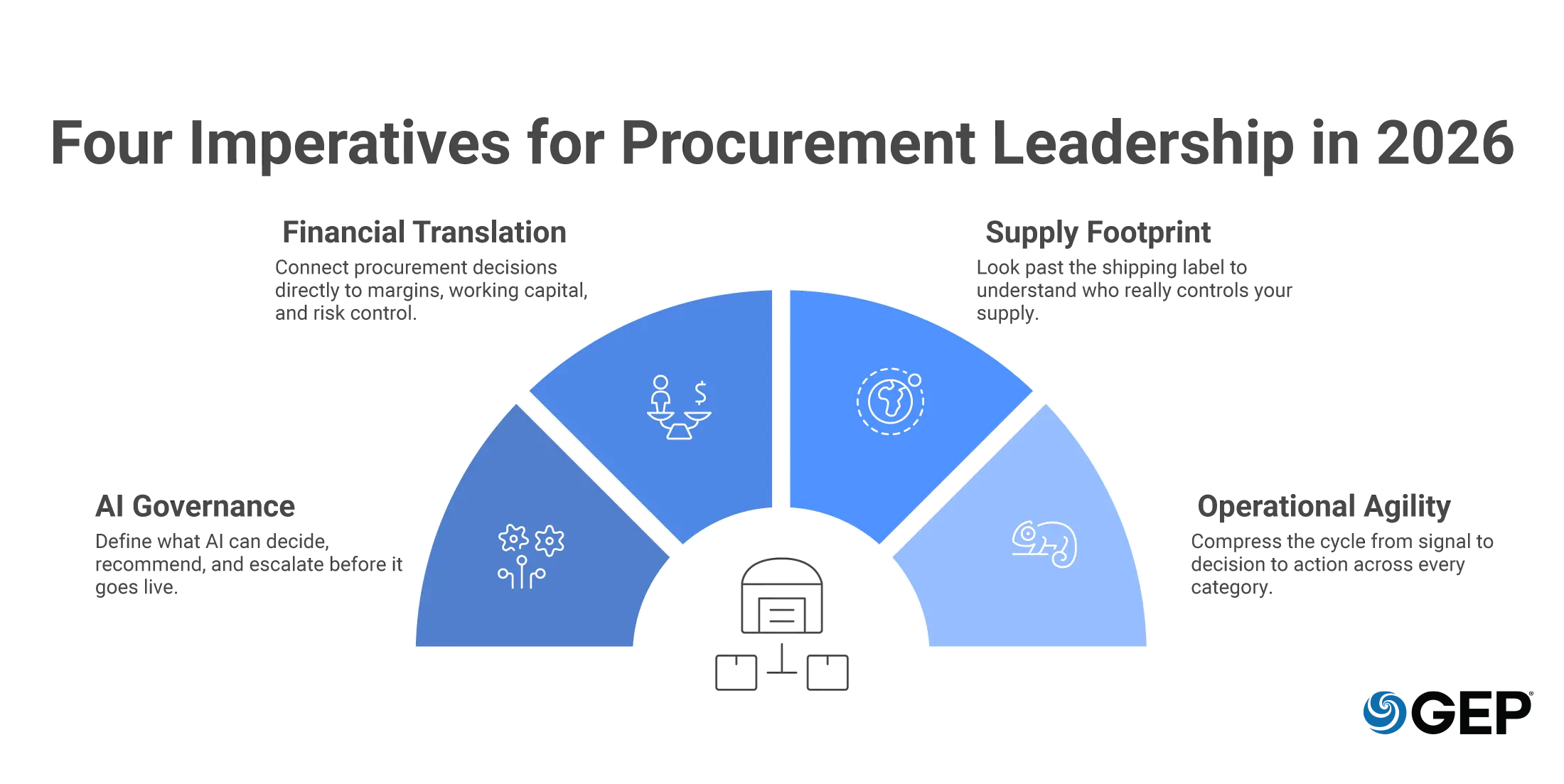
Annual planning cycles weren't made for this. Decision lag now has a real cost, whether it's lost sales, higher shipping costs, or lower profit margins. The teams that do the best job of managing don't always have the most accurate forecasts. They are the ones who have already made up their minds on how to react before the signal comes. Four things set those teams apart from the rest.
1. Govern AI as an Operating Discipline
The question is no longer whether to use AI. How to control it once it starts working for real is the question. The organizations that are getting forward see governance as the most important skill, not just something they have to do to stay in line. Before deployment, they set clear limits on how much freedom an agent has: what it can do on its own, what it can simply suggest, and where a person must give approval. Audit trails, limitations on who can access data, and approval thresholds are all similar to how risk management worked in the past.
This is how you should think about it. AI acts like a junior coworker who is good at their job. It can handle a lot of work, but it needs to be watched. Mistakes grow quickly when there are no clear guardrails. With them, AI becomes a real ability that shortens the time it takes to find suppliers, sign contracts, and manage supplier risk.
Adoption is still not the same across the board. Many teams are still in the pilot stage and don't have full workflow integration. Most of the time, that difference is due to poor management and training, not technology. Leaders who put money into role-specific use cases experience faster adoption and verifiable output benefits.
Also Read: Governance in the Agentic AI Age
Is Your Procurement Function Built for 2026?
Find out how GEP helps enterprises embed AI governance and operational agility into their procurement model.
2. Translate Procurement into Financial Outcomes
Procurement teams rarely lose budget debates because the concepts are weak. They lose because the story sounds more like spending than business impact. The disparity gets clearer as soon as people start to look at AI and digital investments.
High-performing teams have learnt to think about every project in terms of money before walking into the room. They figure out how much money is at stake right now, set a precise KPI to measure the expected effect, and connect the outcomes directly to profit, cash flow, or risk reduction. A project to improve sourcing turns into margin protection. A tool for managing supplier risk turns into a way to keep making money.
But framing isn't enough on its own. Before the project starts, leaders work with finance to come to an agreement on how value will be assessed. Instead of long, complicated roadmaps, they give specific ideas with short time frames and one metric that changes every 60 to 90 days.
Tariff volatility is a good example of this situation. Instead of just watching policy changes happen, good teams create ways to spot them, figure out how they will affect costs, and get quick sourcing solutions. When framed as averted price variance, there's a story that finance will pay for. It is also a story that procurement can claim and back up.
3. Redefine the Global Supply Footprint
Geographic diversification sounds like resilience, but a lot of the time it isn’t. A lot of companies that moved final assembly out of China found that the dependencies that made it possible stayed exactly where they were. The same upstream ecosystem often supplies sub-tier vendors, raw materials, and tools. There was a change to the shipping label. The exposure didn't.
A good footprint plan starts with knowing what really controls your supply, not just where manufacturing is. High-performing teams make maps of beneficial ownership and sub-tier linkages for a small number of important suppliers and parts that interrupt production. That study often calls into question long-held beliefs that have been in supplier records for years.
Reshoring makes things even more complicated, which is easy to underestimate. Moving production closer to demand can lower the risk of shipping, but only if the local area already has the right skills, a working supplier network, and real process control. Reshoring can raise premium freight, ramp-up failures, and downtime instead of lowering risk if those fundamentals aren't in place. Resilience is the ability to adapt and have backup plans.
4. Build Operational Agility as a System
Disruptions are no longer infrequent phenomena that need special reactions. They happen all the time in the operating environment, and treating each one like a surprise wastes time, consistency, and margin.
The first step to operational agility is classification. Teams that do this well break up their suppliers, lanes, and categories into groups based on how important the service is and how sensitive the pricing is. They then set precise reactions that are linked to obvious trigger points, such as price limits, capacity limits, or changes in the law. There is already an agreed-upon response when a threshold is crossed. There is no argument inside as the window closes.
Regulation is based on the same logic. Compliance rules change swiftly from one country to the next, and they add up for the same product in several markets. Under these conditions, static policy documents don't work because by the time they are changed, the situation has already changed.
Top companies establish a live regulatory reaction loop. Cross-functional teams from legal, procurement, supply chain, and data use real-time data to keep an eye on developments, figure out what they mean, and plan what suppliers should do. AI tools help with monitoring and initial triage, but governance makes sure that the decisions are consistent and accountable. The result is not flawless foresight. In 2026, faster execution is the same thing as having a competitive edge.
Your 2026 Leadership Agenda Starts Here
Access the full 2026 Outlook report for detailed insights, key suggestions, and the strategic checklist.
The Shift Toward Real-Time Decision Making
These four imperatives are not separate goals that should be put in order on a three-year roadmap. They help each other out. Governance makes AI work on a large scale. Being financially literate helps you make an investment. Footprint clarity gets rid of hidden danger. Operational agility ensures that things are done the same way every time they need to be.
They work together to turn procurement from a procedural function into something more useful: a real-time decision-making tool that affects business results instead of just reporting on them after the fact.
That is the model that 2026 is going with. The question is whether your team is building it now or waiting for the next problem to show why they need it.
Ready to turn these imperatives into measurable impact? Talk to a GEP expert about how AI-native software, strategy, and managed services may help your business go from being reactive to being deliberate.




FAQs
Deploying before setting up governance. When an agent is live in a core workflow, mistakes happen quickly. Before deployment, everyone needs to agree on the levels of autonomy, the thresholds for approval, and the audit trails. These should not be added after something goes wrong.
Before the project starts, work with finance to create the measuring methodology. Set the baseline, the metric, and the way to keep track of progress. The most convincing proof points are avoided cost variance, cycle time reduction, and working capital improvement.
Not always. Resilience isn't only about where you live; it's also about your skills, backup plans, and control. Reshoring is effective in regions with established local supplier networks, a trained workforce, and robust process control. It can cause new bottlenecks instead of fixing old ones if such foundations aren't there.