


Agentic AI Use Cases Across Media and Telecom Procurement
- Media and telecom procurement moves fast, and traditional manual processes can't keep up with rapid technology changes and market shifts.
- Agentic AI systems watch supplier financial health, technology roadmaps and regulatory changes, flagging risks before operations get disrupted.
- Early adopters are getting better cost optimization, stronger supply chains and faster strategic decisions through AI-powered procurement.
March 14, 2026 | Procurement Software 5 minutes read
Here’s a scenario that might be familiar to telecom providers. You need network equipment, but your supplier is facing semiconductor shortages.
In a traditional setup, someone has to read the supplier's earnings call transcript. Then they analyze what it means. Then they manually search for alternatives. This takes weeks. By then, equipment delays are already locked in. Network deployment slips by months.
Agentic AI changes this process completely. The system watches supplier financial reports, industry news, semiconductor market data and logistics all at once. When the supplier's earnings call mentions "supply constraints," the AI acts fast. It checks current orders, evaluates delivery risk and finds alternative vendors with compatible equipment. All within hours.
Network deployment delays don't just postpone revenue. They hand market position to faster competitors. For media and telecom companies, agentic AI is essential infrastructure, not experimental technology.
Introduction: The Role of Agentic AI in Media and Telecom Procurement
Traditional automation executes set workflows. If invoice matches purchase order, approve payment. Done.
Agentic AI understands objectives and adapts. It maintains network deployment schedules, keeps an eye on supply chain risk and optimizes total cost. All at the same time.
Rule-based automation breaks when it hits scenarios outside its limits. But agentic AI reasons through new situations like experienced procurement professionals do.
Media and telecom procurement benefits because the environment changes constantly. Technology platforms are constantly evolving. Regulatory frameworks shift with politics. Content consumption patterns swing with cultural trends.
Traditional automation needs reprogramming when these changes occur. Agentic AI adapts by continuously updating its understanding and adjusting decisions.
Procurement teams used to manually check supplier news quarterly. AI agents monitor data sources around the clock to surface insights when they matter. This cuts reaction time from weeks to hours.
Key Challenges in Media and Telecom Procurement
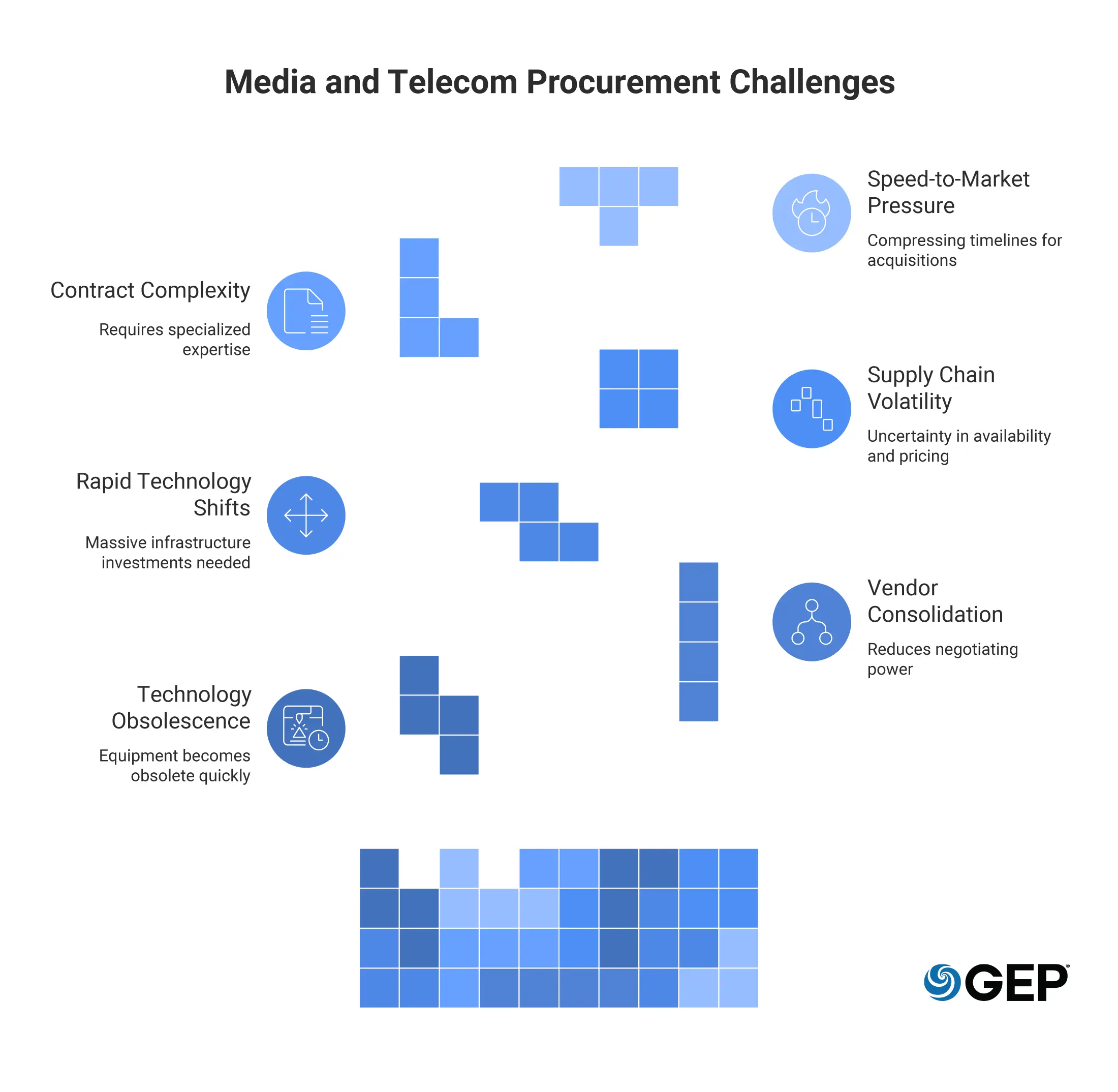
Media and telecom procurement faces major challenges that make traditional manual processes inadequate:
Technology obsolescence:
Equipment purchased today may be obsolete within 18-24 months as next-gen platforms emerge, forcing procurement to balance immediate needs against replacement risk.
Vendor consolidation:
As suppliers merge, a category that once offered six qualified vendors may now have just two or three options, reducing negotiating power.
Rapid technology shifts:
The transition from cable to streaming, 4G to 5G, or traditional broadcast to edge computing requires massive infrastructure investments with incomplete information about which technologies will dominate.
Supply chain volatility:
Semiconductor shortages, geopolitical tensions affecting manufacturing and logistics disruptions all create constant uncertainty in equipment availability and pricing.
Contract complexity:
Media companies juggle content licensing, equipment leases, satellite capacity contracts, cloud subscriptions and professional services, each requiring specialized expertise.
Speed-to-market pressure:
When competitors launch new services, procurement must compress technology acquisitions and vendor partnerships that traditionally took months into just weeks.
Real-World Use Cases of Agentic AI in Telecom and Media Procurement
Supplier Risk Monitoring
AI agents track supplier financial reports, production capacity data, regulatory filings, and industry news across dozens of vendors simultaneously. When patterns suggest risk, the system flags them before they disrupt procurement.
Consider this hypothetical scenario: A network equipment supplier's margins start shrinking because component costs keep rising. The AI agent picks up on this during quarterly earnings calls: not just once, but over two consecutive quarters. It pulls in semiconductor pricing data and connects the dots. The supplier will likely face either production constraints or price increases within the next 6-9 months.
Agentic AI’s Recommendation: Accelerate planned equipment purchases before prices jump, or start qualifying alternative suppliers now rather than scrambling later.
Content Licensing Optimization
Say a streaming platform pays a fixed annual cost to license a content category. The AI agent doesn't just track what was promised, it watches what actually happens. How many people are viewing this content? What's the cost per viewing hour?
The category is generating 30% less engagement than the platform expected when signing the deal. Meanwhile, the licensing fees haven't budged.
Agentic AI’s Recommendation: Don't auto-renew. The data shows that reallocating this budget to a different content category would deliver significantly better audience engagement per dollar spent.
Explore our AI powered procurement software designed to help media and telecom leaders
Network Equipment Timing
AI monitors technology roadmaps from multiple equipment vendors. It tracks performance specs, pricing trends and deployment timelines. Then it recommends optimal purchase timing.
For instance: A telecom provider plans to upgrade cell tower equipment. The AI agent knows next-gen equipment with 40% better performance will be available in 6 months. Same pricing as current-gen equipment.
Agentic AI’s Recommendation: Delay purchase by 6 months. Capture next-gen technology at current-gen pricing.
Production Resource Planning
AI analyzes content production pipelines, historical patterns, market trends and competitor activity. It predicts resource needs for studio space, post-production services and equipment rentals.
Example: A production company's AI agent sees their third quarter content pipeline will require 40% more studio capacity than last year. Same quarter. Based on approved production schedules.
This insight arrives in January. Procurement negotiates favorable terms for studio space in advance. Without this foresight, procurement would face spot-market pricing in June, when demand outstrips supply, driving costs 60% higher.
Regulatory Compliance Monitoring
Telecom regulations change frequently: spectrum rules, net neutrality requirements, data privacy standards, infrastructure access mandates.
AI agents monitor regulatory developments and automatically flag contracts or vendor relationships that may be affected.
Scenario: A government announces new data localization requirements. Customer data must be stored within national borders.
The AI agent immediately scans existing cloud infrastructure contracts. It identifies vendors whose data centers don't meet the new geographic requirements.
Procurement receives this analysis within hours, not months later during a compliance audit
Stop Guessing About Agentic AI. Start Comparing.
Download the Only Agentic AI Buying Guide You Need
The Potential of Agentic AI to Reshape Procurement in Media and Telecom
Media and telecom procurement moves too fast for human-only processes. Procurement teams that rely on periodic manual analysis will lag behind those that adopt agentic AI solutions.
Agentic AI shifts procurement from reactive to predictive. It identifies risks while there's time to develop alternatives. It flags optimization opportunities throughout the year, not just during annual reviews.
Early adopters are measuring real advantages. Faster supply chain risk identification reduces disruption costs. Better contract optimization improves content acquisition efficiency. Smarter technology procurement timing captures next-gen capabilities without premium pricing.
The technology has moved beyond experimental pilots. Media and telecom companies that delay won't just miss efficiency gains. They'll lose competitive positioning to rivals who move faster.




FAQ
Agentic AI watches supplier risks, technology roadmaps, and market conditions around the clock. Instead of alerting procurement after problems emerge, it predicts issues before they happen. Teams make faster decisions, pick better suppliers, and time contracts more strategically.