Beyond Cost Savings: Measuring the Real Impact of Agentic AI in Procurement
- The ROI of agentic AI adoption in procurement cannot be measured in cost savings alone.
- A better metric is risk avoidance that gives teams time to prepare and act proactively.
- As teams stay away from routine tasks, they can focus on more strategic and value-adding tasks.
March 30, 2026 | Procurement Software 5 minutes read
We have a measurement problem in procurement.
When it comes to justifying AI investments, most teams default to the same old playbook. Cost savings projections. Efficiency percentages. Maybe some cycle time improvements if we're feeling ambitious. And then we wonder why the business case feels... underwhelming.
Because here's the thing. Agentic AI in procurement creates value that doesn't fit neatly into traditional cost reduction metrics. It prevents disasters before they happen. It identifies opportunities that weren't visible before. It builds capabilities that compound over time. But none of that shows up as a line item in your quarterly savings report.
If we keep measuring transformational technology with decades-old metrics, we're going to massively undervalue what it's actually doing.
Why Cost Savings Isn’t a True Indicator of ROI in AI-Powered Procurement
Talk to a procurement expert
The Problem With the Cost Savings Obsession
There is little doubt that cost savings matter. They're concrete. Easy to measure. Finance understands them. But when that's your only metric for AI impact, you're basically using a calculator to measure the internet's value.
Think about what agentic AI does in procurement. It monitors supplier risk 24/7. Identifies innovation opportunities in your supply base. Spots market trends before they become problems. Manages relationships at scale. Those things create enormous value. But none of them show up as "cost savings" in your quarterly report.
Consider supplier risk monitoring. An AI agent continuously tracking financial health indicators, news sentiment, and supply chain signals can flag potential bankruptcies months in advance. That early warning creates time to secure alternative sources, renegotiate terms, and avoid production shutdowns worth millions. How do you put "disaster that didn't happen" in a spreadsheet? You can't. But the value is absolutely real.
Check Out GEP’s - AI Powered Procurement Software Solution
What to Measure Instead (Or In Addition)
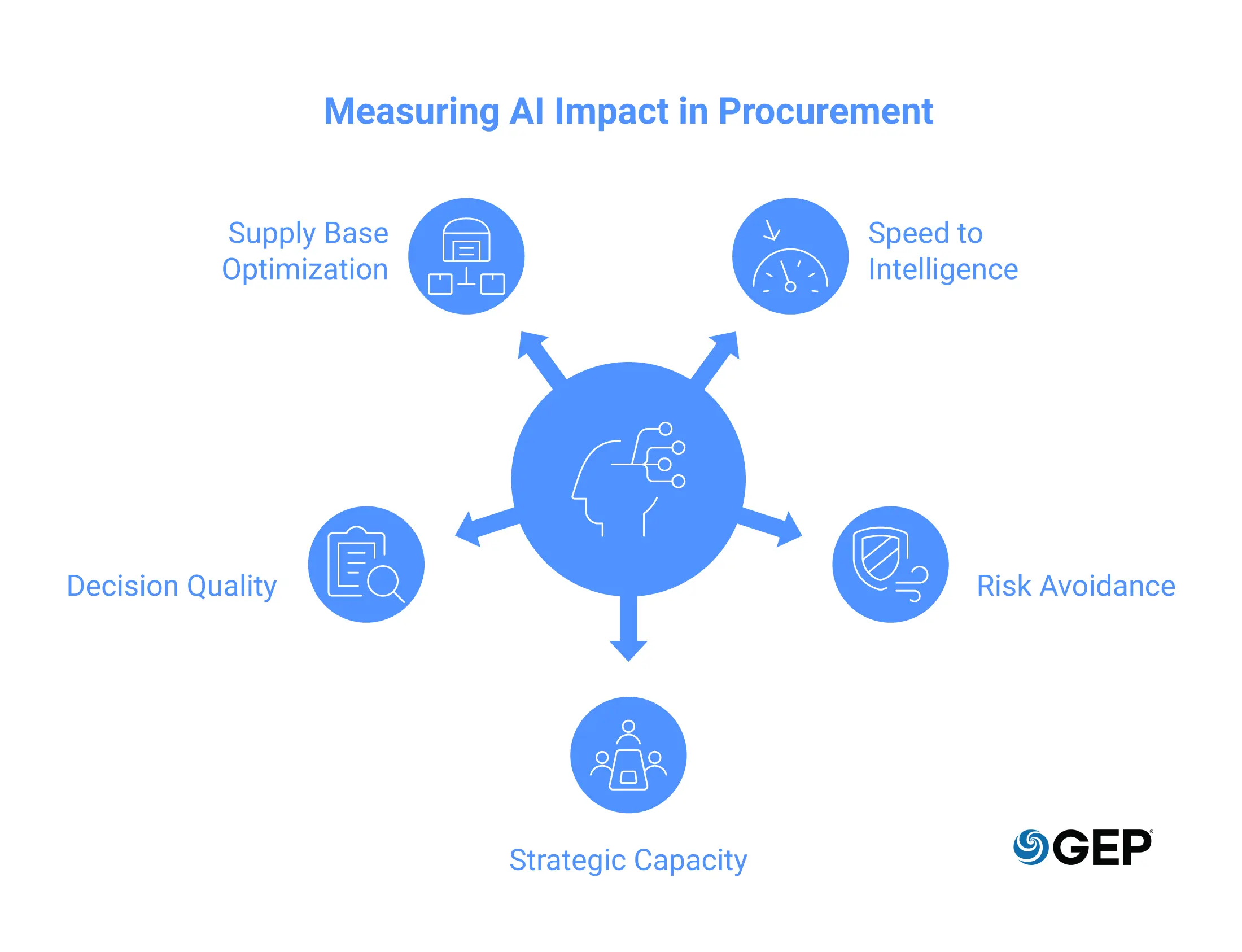
So, what metrics capture AI's impact? Here's where it gets interesting.
Speed to intelligence
How fast can your procurement team answer critical questions? Before AI, getting a comprehensive spend analysis across categories might take weeks. With agentic AI, it's minutes. That speed translates to better decisions, faster response to market changes, and competitive advantage that's hard to quantify but absolutely real.
Risk avoidance and mitigation
This is the big one nobody tracks well. AI agents monitoring your supplier ecosystem can identify risks that would've blindsided you otherwise. Financial instability. Geopolitical exposure. Regulatory changes. Environmental issues. Each avoided crisis has value, even if traditional ROI calculations don't capture it.
Strategic capacity creation
When AI handles routine decisions and transactions, what do your people do with that time? If they're just doing less work, that's efficiency. If they're tackling strategic initiatives they never had bandwidth for before, such as supplier innovation programs, category strategy development, and cross-functional collaboration, that's a different level of value entirely. Track what your team is working on before and after AI deployment. The shift from tactical to strategic work is one of the clearest indicators of real impact.
Decision quality improvement
AI agents bring more data, analysis, and consistency to decisions. How do you measure that? Look at outcomes.
Are contract terms improving? Are supplier selections performing better? Are you avoiding costly mistakes? Tracking "decisions made with complete information" can be revealing. In traditional procurement operations, maybe 30% of sourcing decisions have access to full market intelligence and risk assessments. With AI agents continuously gathering and synthesizing information, that number can jump to 80% or higher. That improvement in decision quality flows through to everything.
Supply base optimization
Here's a metric most teams don't track: how well do you know your suppliers' capabilities? Agentic AI can analyze supplier data, patents, R&D announcements, and capability statements at scale. It can identify which suppliers have untapped potential for innovation, collaboration or category expansion.
The value shows up when you find the right supplier for a critical need in weeks instead of months. Or when you discover a current supplier can solve a problem you were about to source externally.
The Compound Effect Nobody Talks About
Here's the tricky part about measuring AI impact — value compounds in ways that aren't linear.
Month one, your AI agent handles some routine negotiations. Small efficiency gain. Month six, it's learned from thousands of interactions and negotiates better than before. It's freed up your team to tackle strategic sourcing that opens new opportunities. It's building supplier intelligence that makes everyone smarter.
That compounding doesn't show up if you're just measuring immediate savings. You need to track the accumulation of capabilities and strategic capacity over time.
Building a Better Measurement Framework
What does a realistic measurement framework look like?
Start with traditional metrics. Track cost savings and efficiency gains. But layer on impact indicators that capture full value.
Create a "risk incidents avoided" tracker. When your AI flags something that would've caused problems, document it. The pattern becomes clear over time.
Measure strategic initiative capacity. How many high-value projects is your team tackling now versus before? What's their business impact?
Track decision confidence. Survey your team. Do they feel they're making better decisions with more information? That subjective measure often predicts objective outcomes.
Monitor supplier relationship depth. Are you having more strategic conversations instead of transactional ones? Are suppliers bringing innovation opportunities they wouldn't have before?
From Tasks and Workflows to Agentic Orchestration
Learn How GEP Quantum Intelligence is Redefining Procurement
Making the Case for AI Investment
When building a business case for agentic AI, go beyond simple cost reduction projections.
Start with traditional metrics. Acknowledge cost savings and efficiency gains. But then layer on strategic value. Talk about risk prevention and how early warning systems protect against disruptions worth millions. Discuss how AI creates capacity for strategic work. Explain the compounding effect—how intelligence built over time creates exponential value.
Present a measurement framework tracking both immediate financial impact and longer-term strategic value. Risk incidents avoided, decision quality improvements, and strategic initiative throughput tell the complete story.
Because agentic AI in procurement isn't just about doing things cheaper. It's about doing things you couldn't do before. Seeing opportunities you would've missed. Avoiding problems that would've blindsided you.
Those things have real, measurable value. We just need to expand our measurement definition to capture it.