Should You Replace Your ERP Procurement Software? A Cost vs. Value Breakdown
- ERP costs extend beyond licenses into hidden operational inefficiencies.
- Value gaps widen as procurement needs real-time intelligence and speed.
- AI-native procurement platforms deliver measurable outcomes beyond transaction processing.
April 30, 2026 | Procurement Software 5 minutes read
ERP procurement systems don’t fail loudly. They continue to process transactions, enforce controls, and keep operations stable. That surface reliability is exactly why many organizations keep them longer than they should.
The strain shows up elsewhere.
Procurement teams take longer to complete sourcing cycles. Supplier risks appear late, often after they’ve already disrupted operations. Analysts spend days assembling reports that should take minutes. None of this gets traced back to the ERP, yet it shapes cost, speed, and decision quality across the business.
The disconnect comes from how these systems were built. ERP procurement modules were designed to document activity. They capture purchase orders, invoices, and approvals with precision. They were never meant to guide decisions in volatile supply markets.
That limitation matters more now than it did before. Procurement leaders are no longer measured only on cost control. Resilience, supplier reliability, and risk management sit at the center of their agenda. Even when procurement and supply chain align on these priorities, execution breaks down due to fragmented systems and workflows, leading to higher costs and slower responses.
So the question is not whether ERP works. It does. The real question is whether it still delivers enough value to justify what it costs.
Lead with Agentic AI
Drive smarter procurement and resilient supply chains through enterprise-proven technology
How Latest AI Tools Fall Short in Solving the Problem
Most organizations sense the gap and try to close it without replacing the ERP. They add analytics layers, deploy AI tools, and invest in dashboards that promise better visibility.
That approach sounds practical. It rarely changes outcomes in a meaningful way.
AI depends on data consistency. ERP environments struggle with that from the start. Supplier records sit across multiple systems. Spend data follows inconsistent classifications. Contracts, sourcing events, and supplier performance live in different tools. More than half of organizations still operate without fully integrated procurement data.
Teams compensate by preparing the data themselves, by cleaning, reconciling, and standardizing information before feeding it into AI models. The output does improve, but the process around it remains manual.
A deeper problem persists. Insights and execution live in separate worlds.
AI tools can highlight savings opportunities or flag supplier risks. Acting on those insights, however, still requires moving back into the ERP or another system to initiate sourcing events, update contracts, or onboard suppliers. Each step introduces delay. Each handoff creates room for error.
The gap becomes more visible during disruptions. Procurement teams need to understand exposure, evaluate alternatives, and act in real time. Without integrated systems, they either react too late or rely on incomplete information.
Adding AI on top of ERP does not resolve this. It exposes the limitations more clearly.
There is also a cost dimension that often goes unexamined. ERP systems come with visible expenses such as licensing, implementation, and maintenance. Around them sits a layer of hidden costs that grows over time.
Procurement teams spend hours extracting and preparing data. Buyers follow up on approvals through emails and calls because workflows do not adapt easily. IT teams maintain integrations between systems that were never designed to work together. These efforts rarely appear in financial models, yet they consume time and resources every day.
At some point, organizations realize they are paying twice. Once for the ERP, and again for the effort required to make it usable in a modern procurement environment.
How Procurement Software with AI Agents Can Solve the Issue
Replacing ERP procurement software is often framed as a technology decision. It is more accurately a shift in how procurement operates.
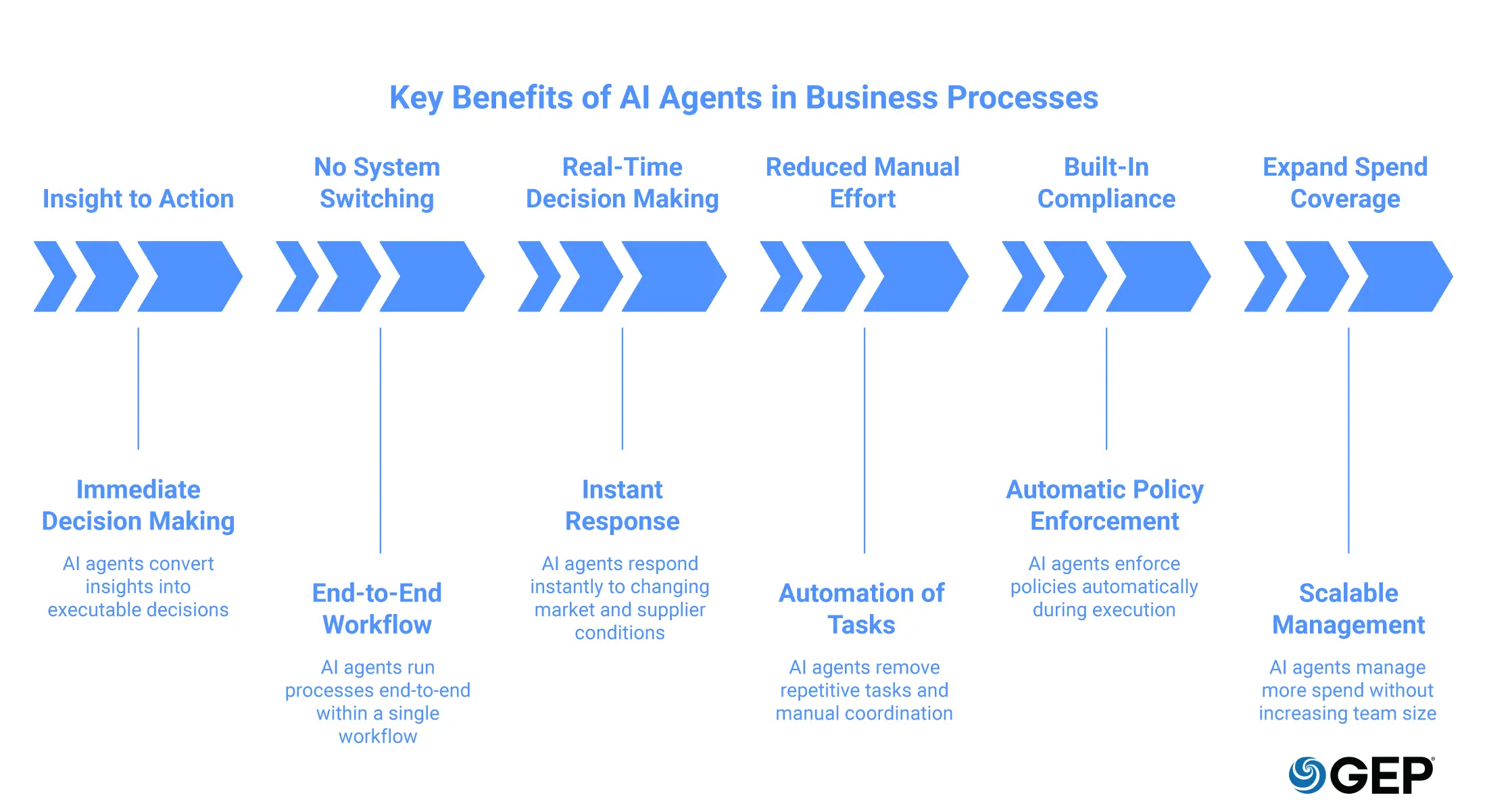
Advanced procurement platforms (with agentic AI at the core) start from a different premise. They do not treat sourcing, contracts, suppliers, and payments as separate activities stitched together through integrations. They connect them into a single workflow where data remains consistent and actions follow naturally from insight. This changes how costs and value align.
When AI operates inside the workflow, it does more than generate recommendations. It evaluates demand, checks existing agreements, assesses supplier risk, and initiates sourcing events without waiting for manual intervention. Decisions move faster because the system acts on current data rather than static reports. The impact shows up in execution.
Cycle times shorten because processes no longer depend on system switching or manual coordination. Supplier risks surface earlier because monitoring runs continuously across the full supplier base. Scenario planning becomes practical because the underlying data reflects real conditions.
Tariff disruptions are a real example. With integrated procurement platforms, teams can identify affected suppliers immediately, model cost implications, and adjust sourcing strategies before margins erode. The cost structure shifts as well.
Organizations reduce reliance on customization-heavy ERP modules and the integrations required to extend them. Manual workarounds decline because processes are connected by design. Teams spend less time managing systems and more time managing suppliers and strategy.
Some of the most meaningful gains come from areas that ERP systems struggle to reach. Tail and mid-value spend categories, often left unmanaged, come under structured control. Supplier collaboration improves because information flows consistently across functions. Procurement, supply chain, and finance operate with shared visibility instead of fragmented views.
Research suggests that many organizations are already preparing for this shift, with a significant majority planning investments in agentic AI. The challenge is not recognizing its importance but having the right foundation to support it.
ERP systems were not designed for that foundation. Extending them further increases complexity without addressing core limitations.
The decision to replace ERP procurement software ultimately comes down to how organizations define value.
If value means stability and control, ERP continues to deliver. If value includes speed, visibility, and the ability to act on real-time information, the equation changes.
Costs have already moved beyond licenses and maintenance. They now include delayed decisions, missed opportunities, and the effort required to bridge system gaps.
At that point, keeping ERP is no longer the safe choice. It becomes the more expensive one.
Explore GEP’s - Agentic AI Procurement Orchestration Platform
Conclusion: The Shift Is Already Underway
Procurement is entering a phase where speed and precision define outcomes. Market volatility, cost pressure, and supplier risk now demand real-time decisions, not delayed analysis. And therefore, systems built to record transactions cannot keep pace.
Organizations that have onboarded unified, AI procurement platforms (more so for those who have gone ahead with platforms that are AI-native and not with AI added in later) will act faster, adapt quicker, and protect margins more effectively. Others will continue adding tools to legacy systems, increasing cost without improving execution.
The shift is already in motion. Replacing ERP procurement is no longer about modernization. It is about staying competitive in an environment that rewards those who can decide and act without delay.