


5 Latest Trends That Engineer Resilience into Modern Procurement Systems in 2026
- 2026 points toward dynamic reconfiguration, where AI agents and hyper-connected networks allow a company to pivot immediately.
- Composable S2P stacks and no-code solutions prove that speed is the ultimate competitive advantage.
- Modern systems now prioritize ease of use for suppliers, and sustainability is now inseparable from the bottom line.
March 09, 2026 | Procurement Software 8 minutes read
Procurement has reached a turning point. Many systems still in use were built for stable environments, not volatility.
They handle basic tasks well enough but strain under today’s multitasking, large-scale, high-volume, multi-geographical, and collaborative needs. This is compounded by changing demands for cost discipline, tight regulations, and the ability to keep up with shifting demand.
Forcing modern expectations on outdated tools and legacy systems creates friction across the procurement function. Most legacy systems were built as systems of record, designed to track what happened in the past. Today’s world requires systems of intelligence that can navigate what is happening now and anticipate potential disruptions in the future.
The procurement system trends emerging in 2026 reflect a clear shift in response. Organizations are moving toward integrated, agentic AI platforms that connect data, systems, and processes, with the added ability to self-learn and self-govern with minimal human intervention.
This article outlines the procurement system trends shaping 2026 and how they are redefining the function in an environment where scale, complexity, and uncertainty are part of day-to-day operations.
Understanding the Shift to Modern Procurement Systems
Modern procurement systems take a platform-based approach. The entire procure-to-pay lifecycle runs on a shared data foundation, from requisition through payment. Approvals, validations, and reconciliations can be fully automated.
Integration is what changes the outcome. Sourcing, contracts, suppliers, and finance operate on the same system of record. Reporting becomes continuous, with dashboards reflecting every minor change in real time.
Visibility improves, and decisions can be made with data-backed insights, helping leaders move from explaining what happened to influencing what happens next.
This foundation paves the way for all other capabilities. AI procurement systems integrate systems into a unified operational perspective. The technology itself is no longer the constraint. The gap now stems from its uneven adoption.
2026 marks a shift from digital-first systems to agent-first ecosystems. Procurement is moving beyond basic automation toward semi-autonomous and autonomous environments that anticipate market disruptions and execute strategies in real time.
The rise of agentic AI and autonomous sourcing reflects this change.
Scale Your Procurement Platform With Multi-Agent Workflows
Adaptive agents steady complex workflows and strengthen decision-making
The Rise of Agentic AI & Autonomous Sourcing
Agentic AI can independently perform complex tasks within defined guardrails, thus acting as a shield for organizations against volatility.
There is also growing demand for AI agents that specialize in a particular role and execute tasks end-to-end. Unlike a standard automated chatbot, which performs specific tasks at a granular level, an AI agent can take on a role in a much broader sense.
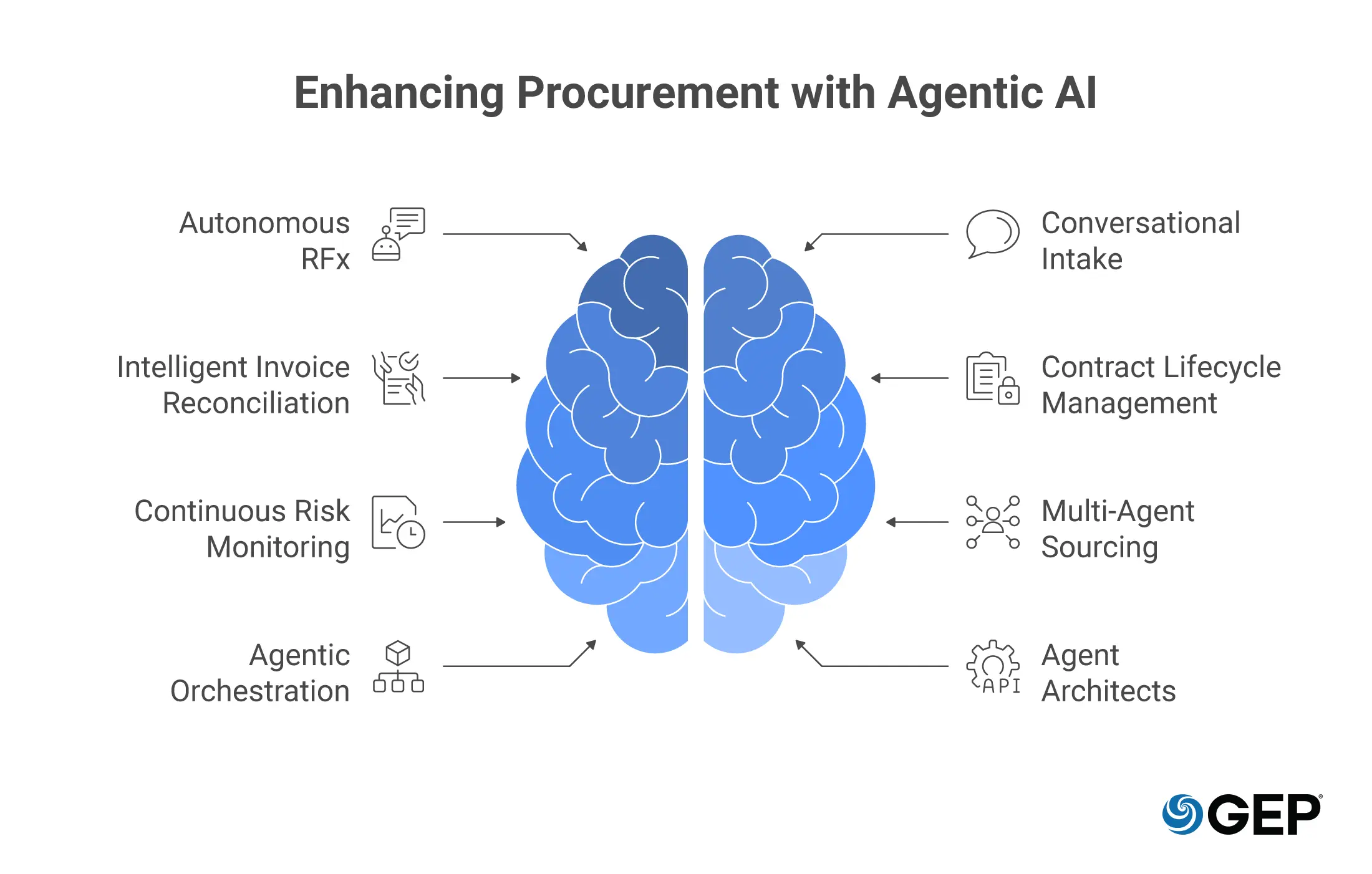
Here are a few use cases of AI agents in procurement
Autonomous RFx
Given the requirements and complexity of the request, AI agents can choose or recommend among different RFX types, draft them in the correct format, obtain internal approvals, share them with vendors, compare incoming bids against live market data, and evaluate scorecards.
Conversational intake
Allows employees to submit requests in natural language (like a chatbot), which agents then convert into structured data and route through compliant workflows.
Autonomous invoice reconciliation and dispute resolution
Applies a similar approach as financial operations, processing three-way matching exceptions at scale, enforcing compliance checks, auditing supplier risk, and adapting to regulatory changes with automated workflows.
Intelligent Contract Lifecycle Management (CLM)
This gives agents the ability to review large volumes of agreements, identify inconsistent force majeure language, flag missing sustainability clauses, and alert teams when a supplier’s performance or reputation drops. Depending on the level of control assigned, agents can support or directly negotiate terms during contract renewals.
Continuous risk and market monitoring
It ties these capabilities together by ingesting live market intelligence and internal operational signals to detect disruptions early, predict risks, and surface mitigation options before they impact procurement activities.
Multi-agent Autonomous Sourcing
AI agents continuously collect and interpret signals from internal and external data sources to look for patterns that indicate when a sourcing event is necessary. It can trigger sourcing events, run negotiations and bids, and recommend award decisions that balance cost, risk, reliability, ESG criteria, and other compliance requirements.
Agentic orchestration
Agentic AI ties multiple agents, AI tools, and people together to collaborate in a synchronized, governed workflow. It breaks broader company goals into specialized subtasks and delegates them to specialized AI agents. Just as an orchestrator in an orchestra plans and oversees multiple functions to achieve a goal, agentic orchestration does the same.
Agent Architects
A new professional role is emerging to manage these digital teammates, focusing on overseeing AI logic rather than manual execution.
Your Procurement Stack Needs More Than Automation
AI agents bring orchestration, accuracy, and role-based execution
Data-driven Decision Intelligence
Unlike traditional analytics tools that give you reports indicating results, decision intelligence tells you what to do next, like shifting 20% of logistics to an alternate supplier to avoid a forecasted price spike.
These systems can serve as decision-support tools, act as high-level advisors, or behave as fully autonomous agents that execute decisions independently.
Advanced analytics uses multiple sources (internal, external, and derived) to help procurement teams track important metrics for success in 2026, beyond cost savings.
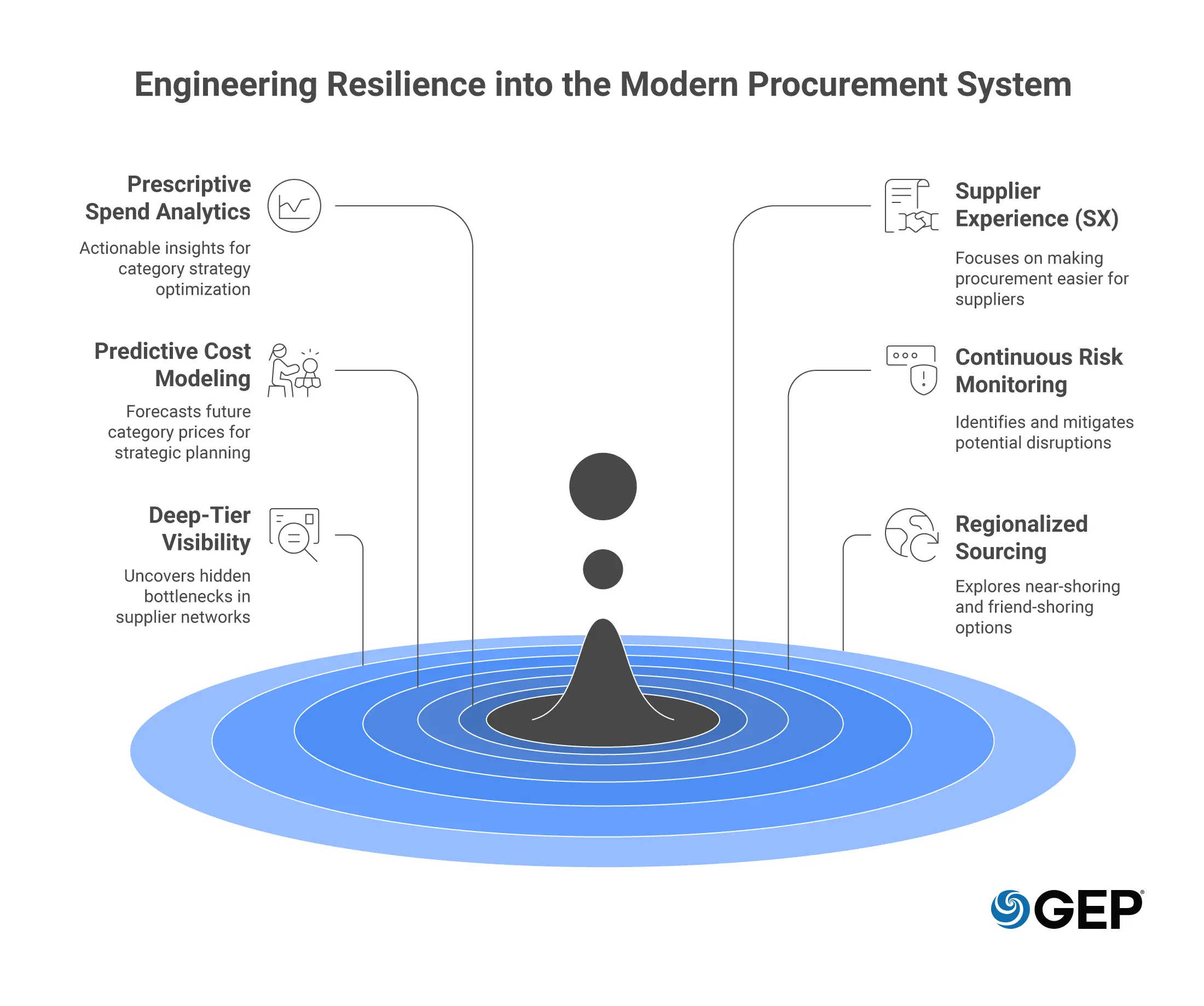
Systems are being redesigned to handle structural global volatility. Procurement software now includes:
Prescriptive spend analytics
Offer the ‘next-best actions' to optimize category strategies rather than simply reporting historical spend.
Supplier experience (SX)
Has also become a priority, with portals designed to make procurement easier for suppliers, reinforcing the importance of being a customer of choice in constrained supply markets.
Predictive cost modeling
lets teams predict the price of a category six months from now.
Continuous risk monitoring
across sanctions, geopolitics, and other disruptions to guide decisions.
Deep-tier visibility
Into Tier 2 and Tier 3 supplier networks, identifying bottlenecks before they cascade into primary suppliers.
Regionalized sourcing strategies
To evaluate ‘near-shoring’ and ‘friend-shoring’ options to reduce exposure to fragile international routes.
A Hyper-Connected Ecosystem
A unified platform creates a single source of truth. Modern architectures use intuitive, role-based design to ensure the path of least resistance and maximum compliance. This reduces friction for internal stakeholders and provides transparent, predictable portals for external partners.
In 2026, systems built around connected ecosystems that bring internal teams, suppliers, and external data into one environment will be the norm.
Unified collaborative environments pave the way for both communication and transparency. Sourcing moves away from fragmented communication toward shared digital workspaces.
Procurement teams require clear visibility into Tier 2, Tier 3, and additional levels beyond their direct suppliers in order to detect vulnerabilities and prevent disruptions before they impact daily operations.
When leaders gain a consolidated view of supplier performance, capacity signals, sustainability indicators, and risk exposure, they can pivot more easily when conditions change, enabling faster, more informed decisions.
Buyers and suppliers co-author contracts and share production forecasts. Over time, this connectivity strengthens supplier relationships. Collaboration improves as procurement operates with fewer surprises.
Composable and Agile Systems
Rigid procurement systems are giving way to modular architectures.
Composable systems use APIs and microservices to let you add or change capabilities without replacing the entire platform. Companies now compose their tech stacks using best-of-breed modules connected by APIs, allowing them to swap out a specialized risk tool or an AI agent without overhauling the entire core system.
New risk models, supplier tools, or AI agents can be introduced through configuration rather than long development cycles. Change happens incrementally, reducing disruption and risk.
Procurement teams have to adapt processes without relying on extended IT backlogs.
Low-code and no-code solutions allow you to design workflows, approval paths, and dashboards directly. Changes that once required months now happen in days. Experimentation feels safer because adjustments are reversible.
For leadership teams, this agility matters. Time to value shortens. Strategic options remain open. Procurement systems can evolve as business priorities shift rather than lag behind them.
Sustainability and ESG Compliance
Procurement plays a visible role in protecting long-term enterprise value. In 2026, sustainability is a legal obligation within the supply contract. Every sourcing and purchasing workflow will incorporate ESG considerations and Scope 3 operationalization at the point of purchase.
Systems can evaluate suppliers based on emissions data, labor practices, and diversity indicators and apply those signals during award decisions.
Carbon tracking systems that embed carbon and emissions tracking directly into the workflow let teams assess the environmental impact of a purchase before it's approved.
Ethical sourcing verification using blockchain and AI-driven audit trails provides credible evidence of labor practices and human rights compliance across the supply chain. If a supplier cannot provide verified emissions data or fails to meet a specific carbon threshold, the system can automatically disqualify them from the bid.
Automated remedial workflows trigger when a supplier fails to meet a carbon threshold or misses their carbon reduction milestones. The remedial action plan could be anything defined in the contract, ranging from mandatory resourcing of the specific materials that cause the highest emissions to an automated reduction in the supplier's performance score.
Is Your Category Spends Strategy Ready for 2026?
Respond to supply shifts faster with data-led, strategic guidance
What This Means for Procurement
The trends shaping 2026 point toward a new ‘system of intelligence’ that is autonomous, sustainable, and agile. Procurement is moving toward a frictionless operating model, taking up the role of the guardian of enterprise value.
In the past few years, companies have digitally transformed manual processes. But moving forward, the goal would be to create an autonomous ecosystem that can self-learn, self-correct, and self-execute complex workflows in real time.
Organizations that modernize their procurement systems with AI agents and agentic AI will position themselves for resilience and sustained value creation. To know more about GEP’s intelligent procurement software, contact us.




FAQs
Start by understanding how work actually gets done today, not how it looks on paper. Pay attention to where teams still rely on manual handoffs, reconciliations, or workarounds to keep things moving. Look at how procurement data flows into finance and planning, and where it breaks or lags. Just as important, be honest about the quality of the data you already have. A new system only performs as well as the information it runs on. The right modernization effort gives you a foundation that connects data, supports intelligent decisions, and grows with the business instead of constraining it.
They give category leaders clearer sightlines and faster feedback. Instead of stitching together reports, you see current spend, supplier performance, and exposure in one place. Intelligence built into the system highlights where consolidation makes sense, where diversification reduces risk, and how different scenarios might play out. Because workflows are configurable, category rules can be applied consistently without slowing teams down. The result is tighter alignment between procurement and finance, grounded in day-to-day decisions rather than after-the-fact analysis.