


Procurement Orchestration: The Strategic Backbone Your Enterprise Can't Afford to Ignore
- A true procurement orchestration framework automatically screens, monitors, and flags exposure across every workflow.
- Agentic AI monitors your procurement ecosystem, makes decisions, and optimizes workflows.
- A well-designed orchestration framework enforces policy automatically, making compliance a byproduct of doing business.
April 14, 2026 | Procurement Software 7 minutes read
Here's a question worth sitting with for a moment: if you asked ten people across your organization how to initiate a purchase, how many different answers would you get?
For most enterprises, the honest answer is unsettling. Some would point to a portal. Others would default to email. A few would call someone they know in finance. And a handful would just figure it out as they go. That's not a people problem; that's a systems problem. And it's quietly draining your organization's speed and strategic potential every single day.
The complexity of modern enterprise procurement involves managing a sprawling ecosystem of suppliers, stakeholders, regulatory environments, and technology platforms, often scattered across multiple regions and business units simultaneously.
Somewhere in this integrated web of complexity lie critical decisions made without context and day-to-day operations that occur entirely outside leaders’ line of sight. The old model of managing procurement as a series of disconnected tasks simply doesn't hold up under such pressure.
What the most forward-looking enterprises have figured out is this: procurement doesn't need more tools but better coordination. That's exactly what procurement orchestration delivers. It's the connective infrastructure that brings your people, systems, and workflows into a single, intelligent operating model. And when it's built right, it becomes a genuine driver of enterprise value.
What Is Procurement Orchestration?
Think of a symphony orchestra. Every musician is talented. Every section knows its part. But without a conductor holding it all together, what you get is noise instead of a melody.
Procurement orchestration is the conductor. It's the centralized coordination of every procurement activity, from the moment a request is submitted to the final invoice reconciliation, ensuring every system, stakeholder, and workflow moves in sync.
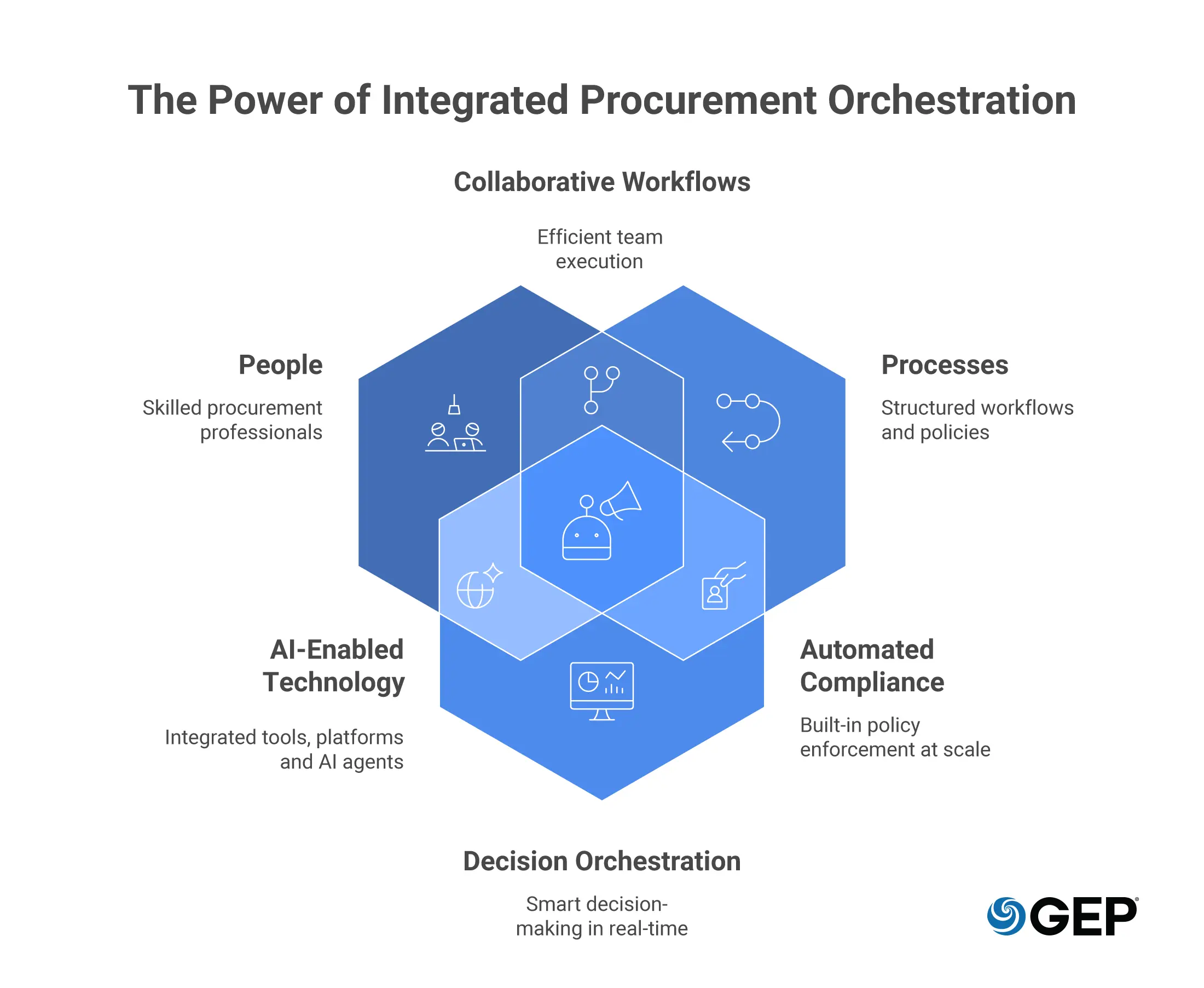
Procurement orchestration is the strategic alignment of people, processes, and technology across the full source-to-pay lifecycle.
It must be supported by integrated platforms driven by AI, which ensures procurement activities don't operate in silos. Instead of relying on manual handoffs, fragmented approvals, or institutional knowledge to get things done, orchestration creates structured, automated pathways that enforce policy, maintain visibility, and adapt in real time to changing business needs.
The distinction from basic automation is important:
Automation handles individual tasks. Orchestration connects them.
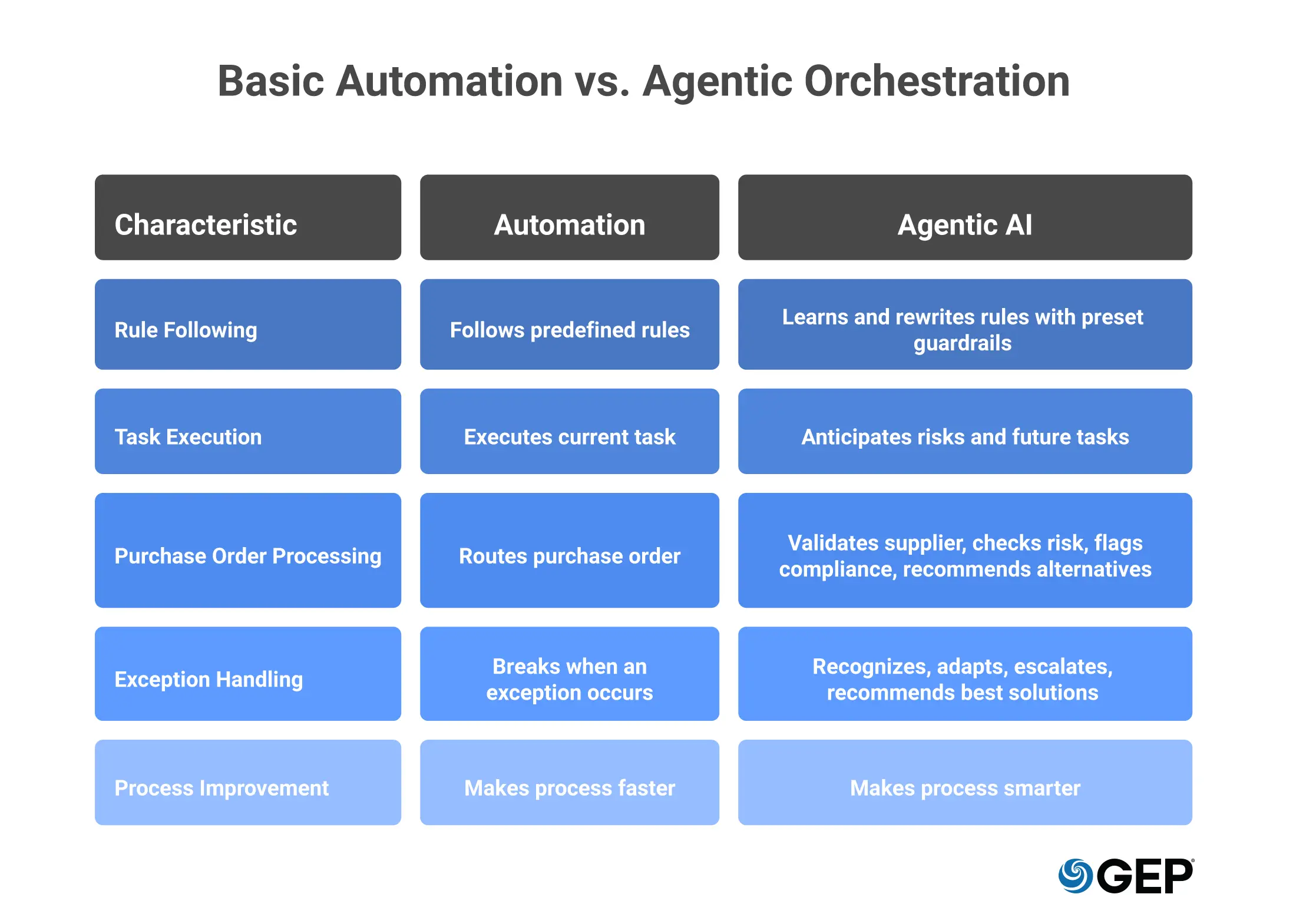
When a purchase request is submitted, orchestration doesn't just route it for approval. It simultaneously validates the supplier, checks budget availability, flags compliance requirements, initiates risk screening, and ensures the right contract template is ready, all before a human ever needs to intervene. That's the shift from reactive procurement to proactive, intelligent procurement at enterprise scale.
Ready to Make Orchestration Your Backbone?
Enterprise coordination turns procurement into strategic infrastructure
Designing a Robust Procurement Orchestration Framework
Getting orchestration right starts with architecture, not technology. Before you evaluate platforms or deploy AI agents, you need to be clear about what you're orchestrating and why.
The most effective frameworks share a set of foundational design principles that separate high-performing procurement operations from those that stall out mid-implementation.
The first principle is intake design. Your framework lives or dies at the front door. If requesting a purchase is confusing, slow, or inconsistent, people will route around your process. And this is when you'll lose the visibility and control that orchestration is supposed to deliver.
The intake experience should be intuitive enough that any employee, regardless of procurement literacy, can submit a request in under two minutes through a single, unified entry point. Everything downstream: routing logic, approvals, compliance checks, should be invisible to the requester but fully operational in the background.
The second principle is systems integration. Orchestration only works when your existing infrastructure, like ERPs, contract lifecycle management platforms, supplier databases, and spend analytics tools, communicates in real time.
Without deep, bidirectional integration, you end up with data moving manually between systems, which is exactly the fragmentation you're trying to solve. Your framework needs to treat integration not as a technical afterthought, but as a foundational requirement.
The third principle is governance by design. Policy enforcement shouldn't depend on someone knowing the rules, it should be embedded in the workflow itself.
Every pathway in your orchestration framework should reflect your organization's risk thresholds, spend authorities, and compliance requirements, automatically, so that governance becomes a byproduct of doing business rather than an additional step.
Check Out GEP’s - AI Powered Procurement Software Solution
7 Critical Factors to Ensure Procurement Orchestration Success
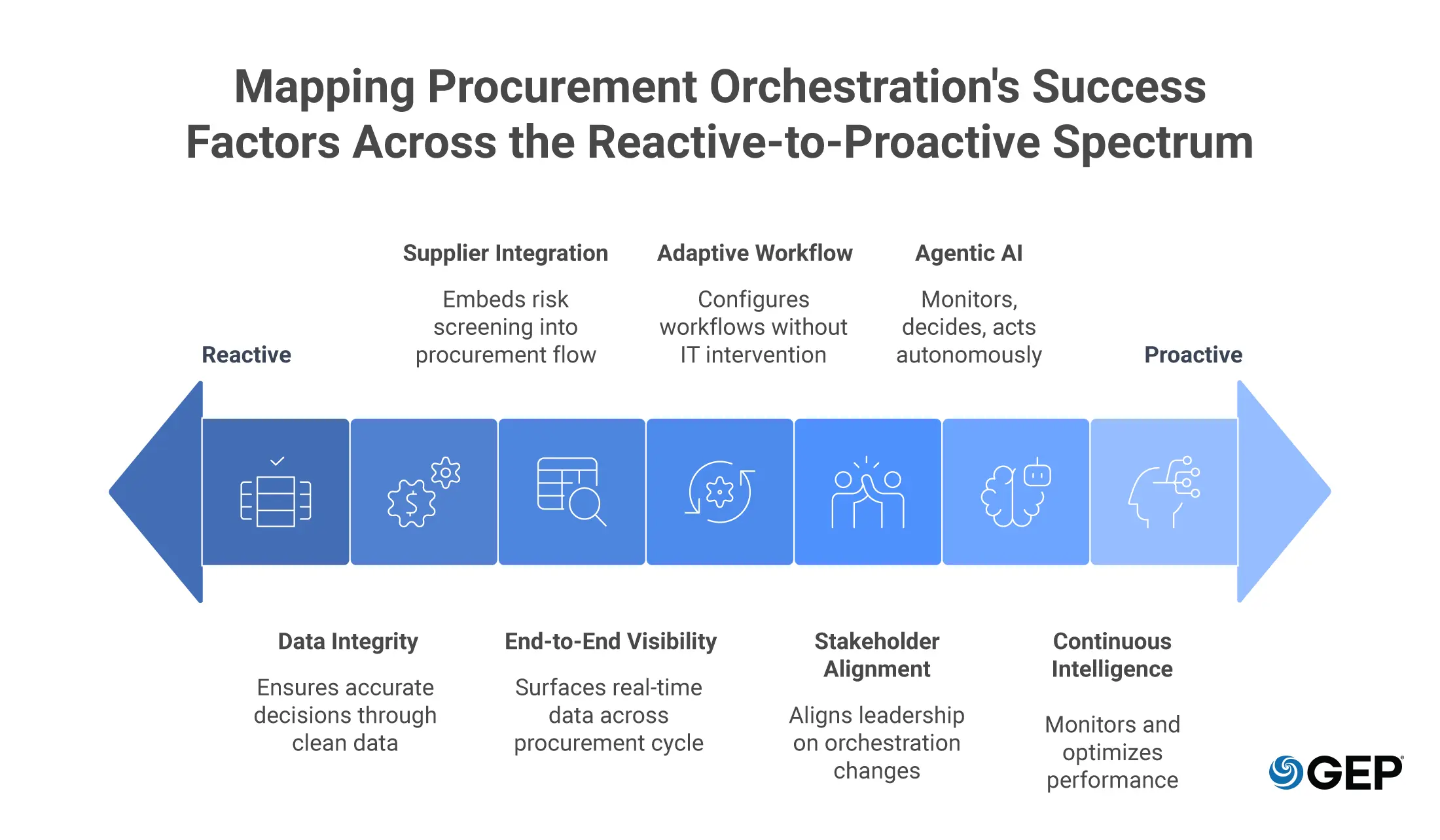
Agentic AI at the Core
The next evolution of procurement orchestration is less about connecting workflows and more about making them intelligent. Agentic AI doesn't wait for instructions; it monitors, decides, and acts.
In procurement, AI agents can autonomously identify preferred suppliers, flag anomalous spend patterns, negotiate routine contracts, and escalate only the decisions that genuinely require human judgment. Embedding agentic AI into your orchestration framework means your procurement function operates with a level of speed and precision that manual oversight simply cannot match.
End-to-End Visibility
Partial visibility is almost as dangerous as no visibility. Your orchestration framework must surface real-time data across every stage of the procurement cycle, from approvals, supplier performance, contract utilization, budget consumption, and compliance status. Leaders who can see the full picture make better decisions, and those operating on lagging reports are always reacting to problems that have already compounded.
Stakeholder Alignment Before Implementation
Technology doesn't transform procurement; adoption does. Before deployment, align your finance, legal, IT, and business unit leadership on how orchestration will change their workflows. The organizations that fail at this stage treat orchestration as a procurement initiative. The ones that succeed treat it as an enterprise initiative with procurement leading the charge.
Supplier Integration and Risk Orchestration
Your orchestration framework should extend beyond your four walls. Supplier onboarding, risk screening, performance monitoring, and contract compliance need to be embedded directly into the procurement flow, and not managed as separate administrative processes.
When supplier risk is part of the orchestration layer, you catch exposure early, not after an incident has already materialized.
Adaptive Workflow Architecture
Business conditions change. Trade policies shift. New categories emerge. Your orchestration framework needs to be configurable without requiring IT intervention every time a process needs to adapt.
Low-code and no-code workflow design capabilities allow procurement leaders to evolve their operating model in real time, keeping pace with business demands rather than falling behind them.
Data Integrity as a Non-Negotiable
Orchestration is only as good as the data flowing through it. If your supplier master data is inconsistent, your spend categorization is unreliable, or your contract repository is incomplete, your orchestration layer will automate bad decisions at scale.
Data governance isn't glamorous work, but it's the foundation that everything else sits on.
Continuous Intelligence and Optimization
Orchestration isn't a one-time implementation. It's an operating capability that should get smarter over time.
Build in mechanisms for continuous performance monitoring: cycle time analysis, exception tracking, savings realization, and process compliance rates. AI-driven analytics can surface optimization opportunities your team would never identify manually, turning your orchestration framework into a self-improving system.
The Path to Autonomous Procurement
Unified source-to-pay designed for agentic AI adoption
Procurement Orchestration: An Operational Imperative for Enterprises
It’s the need of the hour for procurement firms to build the coordination infrastructure that makes every tool, every team, and every transaction work together. That's a fundamental shift in how procurement creates value, moving from tactical execution to strategic orchestration.
For CXOs and procurement leaders navigating this shift, the window to act is now. The convergence of agentic AI, real-time data infrastructure, and enterprise-scale orchestration platforms has made it possible to build procurement functions that are faster, smarter, and more resilient than anything the previous decade could offer.
The question isn't whether orchestration belongs in your enterprise strategy. It must be how quickly you can make it the backbone of how your organization buys, because your competitors are already asking the same question.
Interested in how agentic AI works? Talk to an expert today.




FAQS
Procure-to-pay manages the transactional execution of procurement from purchase orders, invoice processing, payments, and reporting. Procurement orchestration operates at a higher level: it coordinates the entire source-to-pay lifecycle, including strategic sourcing, supplier management, risk and compliance, and stakeholder alignment, while integrating your P2P system with the rest of your enterprise technology stack. Think of P2P as one instrument in the orchestra; orchestration is what keeps the whole ensemble in sync.
AI, specifically agentic AI, fundamentally changes what orchestration can do. Traditional orchestration follows predefined rules. AI-powered orchestration learns, adapts, and acts autonomously. AI agents can monitor spend patterns for anomalies, predict supplier risk before it becomes a disruption, auto-classify spend categories, accelerate sourcing decisions, and handle routine negotiations without human involvement. You get a fully self-governing procurement function that operates continuously, at enterprise scale, with a level of precision and speed that can’t be replicated otherwise.
Success in procurement orchestration is measured across four dimensions: efficiency, which is reduction in cycle times and manual effort; compliant policy adherence and audit-readiness; visibility tracked through percentage of spend under management and real-time reporting capability; and value creation in the form of savings realization, supplier performance improvements, and working capital impact. The most mature organizations also track adoption rates because a framework that procurement teams and business stakeholders actively use is the only one that actually delivers results.