




Every couple of decades, a technology changes what a procurement or supply chain team can reasonably be expected to deliver. ERP did it in the 1990s. Cloud source-to-pay platforms did it in the 2010s. Generative AI is doing it now, and it is moving faster than either of its predecessors.
The difference this time is the interface. Generative AI works in plain language. A category manager can ask a question the way they would ask a colleague, "which of our packaging suppliers are exposed to the port disruption in Rotterdam?" and get a grounded, sourced answer in seconds, drawn from contracts, spend data, supplier records and live market intelligence. No report request. No three-week wait for an analyst.
That shift raises real questions for procurement and supply chain leaders. What can this technology genuinely do today, as opposed to what the demos promise? Where are the risks? And how do you adopt it without creating a governance problem you will regret later? This guide covers all of it. Here is everything you need to know about generative AI in procurement and supply chain management:
What Is Generative AI in Procurement and Supply Chain Management?
Generative AI in procurement and supply chain management is the use of large language models and related foundation models to create new outputs — draft contracts, sourcing events, risk summaries, forecasts, recommendations and plain-language answers — from an enterprise's procurement and supply chain data. Where earlier AI classified and predicted, generative AI produces.
In practice, it behaves less like a piece of software and more like a capable analyst who has read everything. Every contract clause. Every purchase order. Every supplier scorecard, market report and email thread the organization will let it see. Ask it to summarize the termination rights across your top 50 supplier agreements and it will. Ask it to draft an RFP for warehouse automation equipment based on your last three sourcing events, and it will do that too, in minutes.
The technology matters to this function for a simple reason: procurement and supply chain work is drowning in unstructured information. Contracts, specifications, supplier communications, regulatory updates, logistics documentation. Traditional systems could store all of it but understand almost none of it. Generative AI closes that gap, which is why it is being embedded across spend analysis, sourcing, contract lifecycle management and supply chain management software rather than sold as a separate tool.
How are best-in-class procurement teams managing through uncertainty?
The latest CIPS Global State of Procurement & Supply Report answers that question
How Is Generative AI Different from Traditional AI and Automation in Procurement and Supply Chain?
Most enterprises already run some form of AI. Demand forecasting models. Spend classification engines. Anomaly detection in invoices. Robotic process automation moving data between systems. All useful, and all fundamentally different from what generative AI does.
Traditional AI in this space is predictive and classificatory. It takes structured, historical data and tells you what category a transaction belongs to, or what demand will probably look like in the third quarter. RPA is narrower still: it follows deterministic rules and breaks the moment a screen layout changes. Neither can read a contract, hold a conversation or draft anything.
Generative AI does all three. It handles unstructured data natively, interacts in natural language and generalizes to tasks it was never explicitly programmed for. The distinction in brief:
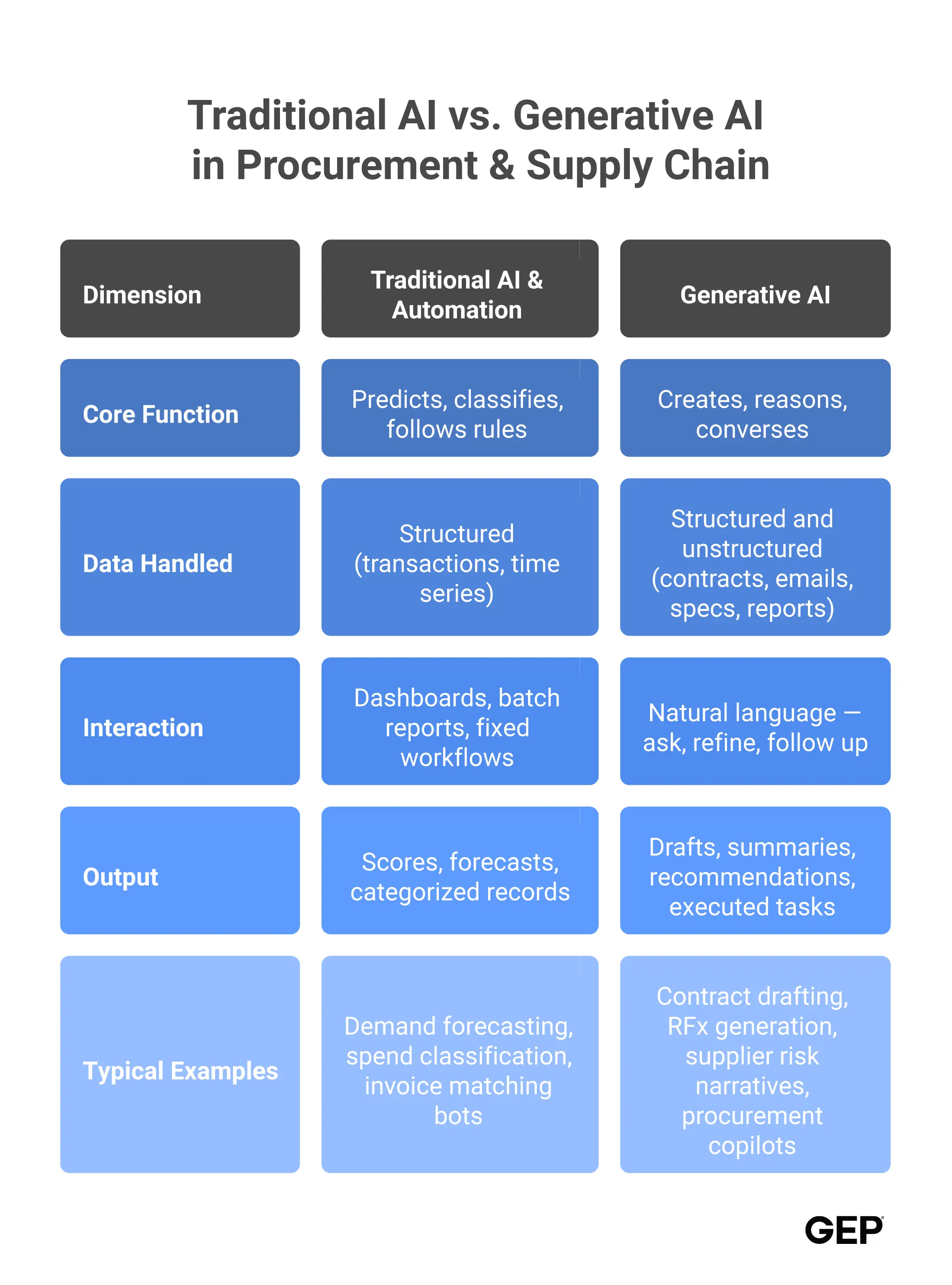
One point worth stressing: these technologies are complements, not rivals. The strongest enterprise deployments pair them — a predictive model produces the demand forecast, and a generative layer explains it, stress-tests it against scenarios and turns the conclusion into an action plan a planner can approve.
Benefits of Generative AI in Procurement and Supply Chain Management
The business case is not hypothetical anymore. In a survey by Foundry and GEP, 65% of senior technology decision-makers said AI/ML-based tools can significantly augment or even revolutionize human decision-making in supply chain and procurement. The benefits below are where that conviction comes from.
Compressed Cycle Times
Work that used to take weeks collapses into days or hours. A first-draft RFP built from prior sourcing events. A contract redlined against your clause library before legal ever opens it. A supplier onboarding questionnaire pre-filled from public filings. The human still reviews, but starts at 80% done instead of zero.
Decisions Grounded in All the Data, Not Just the Structured Part
Roughly speaking, the most valuable information in procurement lives in documents, not databases. Generative AI reads those documents. It can surface that a supplier's force majeure clause quietly excludes labor disputes, or that three regional contracts contain conflicting payment terms — the kind of insight no dashboard was ever going to show.
Institutional Knowledge That Stays
When a 25-year category veteran retires, their negotiation playbook usually walks out the door with them. Generative AI systems capture that knowledge as they are used, including every sourcing decision and every supplier interaction, and make it capable of being queried for the next person in the seat.
Productivity Redirected to Strategic Work
Buyers spend a startling share of their week on status chasing, data entry and report formatting. Offloading that to a copilot does not shrink the team; it moves the team up the value chain, toward supplier strategy, innovation sourcing and risk management.
Earlier Risk Visibility
Generative AI can monitor news feeds, financial filings, weather data and supplier communications continuously, then summarize what matters. A quality problem at a tier-2 supplier gets flagged as an early warning, not discovered as a line-down event.
Savings and Compliance
Guided buying in natural language steers requesters toward preferred suppliers and negotiated rates, cutting maverick spend. Meanwhile, contract-aware invoice review catches overbilling that manual sampling misses.
Key Use Cases of Generative AI in Procurement and Supply Chain Management
Where should a team actually point this technology first? These are the use cases delivering value in production today, not on conference slides.
Contract Creation, Review and Analysis
Drafting agreements from templates and negotiation history, extracting obligations and renewal dates across thousands of legacy contracts, flagging non-standard clauses and suggesting fallback language. Contract work is generative AI's most mature procurement use case, because contracts are exactly the kind of dense, unstructured text these models handle best.
Sourcing and RFx Automation
Generating RFIs, RFPs and RFQs from a short brief; summarizing and scoring supplier responses side by side; drafting award recommendations with the reasoning attached. Sourcing managers report the biggest gains on mid-tail categories that previously went unsourced for lack of time.
Conversational Spend Analysis
"Show me IT spend growth by region, net of the DataCo acquisition." Questions like that used to become analyst tickets. Now they are just questions, answered against classified spend data in seconds, with the follow-ups handled in the same conversation.
Supplier Discovery, Onboarding and Risk Monitoring
Scanning markets for alternative suppliers against technical specs, pre-filling onboarding and ESG questionnaires, and producing continuously updated supplier risk narratives that blend financials, sanctions lists, cyber ratings and news sentiment.
Negotiation Preparation
Briefing packs that pull together a supplier's contract history, performance record, market benchmarks and should-cost data, as well as suggested negotiation strategies and counterarguments. Preparation that took a week now takes an afternoon.
Demand Planning and Scenario Modeling
Predictive models generate the forecast; generative AI makes it usable. Planners can interrogate assumptions in plain language, run what-if scenarios, such as a supplier outage, a tariff change, a demand spike, and get narrative summaries executives actually read.
Procure-to-Pay Copilots
Employees describe what they need; the copilot finds the right catalog item or contract, builds the requisition and routes the approval. Invoice exceptions that once queued for AP specialists get resolved automatically, with an audit trail.
Disruption Response and Control Tower Intelligence
When something breaks, such as a port closure, a recall, a geopolitical shock, generative AI summarizes exposure across orders, inventory and suppliers, then drafts the mitigation options. Hours matter in these moments. This is where they get saved.
Challenges and Risks of Generative AI Adoption (and How to Solve Them)
Capturing value takes more than buying a license. The failure modes are well documented by now, and more usefully, so are the fixes.
Fragmented, Low-Quality Data
Generative AI amplifies whatever data foundation it sits on. If supplier records are duplicated across five systems and spend is 40% unclassified, the answers will reflect that. The fix is unglamorous: master data management, spend classification and a unified data layer before ambitious use cases, not after.
Accuracy and Hallucination
A model that invents a contract clause is worse than no model at all. Enterprise deployments solve this with grounding: retrieval-augmented generation that forces answers to cite actual documents in your repository, confidence thresholds, and human review gates on anything consequential. Treat unverified model output the way you would treat an unverified supplier claim.
Security, Privacy and Intellectual Property
Pricing terms, supplier costs and product specifications are among the most sensitive data an enterprise holds. Public consumer AI tools are the wrong place for them. Enterprise-grade deployment means contractual guarantees that your data never trains shared models, role-based access controls carried through to AI responses, and full audit logging.
Integration With the Existing Landscape
An AI assistant that cannot see the ERP is a toy. Real value requires deep integration with ERP, P2P, sourcing and planning systems — which argues for AI embedded in the platforms that already run these processes, or connected through well-governed APIs.
Skills and Change Management
Technology adapts to people faster than people adapt to it. Teams need training on what to ask, how to verify outputs and when to override them. Appoint champions in each function. Redesign the workflow around the copilot rather than bolting it onto the old process, otherwise adoption stalls at the curiosity phase.
Governance and Responsible AI
Who approves a model-drafted contract? What decisions may the AI take autonomously, and which require a human signature? Set the policy before scale: documented decision rights, bias monitoring, model performance reviews and a clear escalation path. Regulators are moving; enterprises with governance already in place will move faster, not slower.
Lead with Agentic AI
Drive smarter procurement and resilient supply chains with GEP’s enterprise-proven AI-native platform
Best Practices for Implementing Generative AI in Procurement and Supply Chain
Patterns from enterprises that got measurable value (and from those that ran expensive pilots that went nowhere) point to seven practices:
Start where value is provable.
Two or three use cases with baseline metrics beat a ten-workstream transformation program. Contract analysis and sourcing support are common first wins.
Keep a human in the loop for consequential decisions.
Let AI draft, summarize and recommend; let people award, sign and commit. Loosen the leash only as trust is earned, use case by use case.
Fix the data foundation early.
Classified spend, clean supplier master data and a searchable contract repository multiply the value of everything built on top.
Prefer AI-native over bolted-on.
Platforms designed around AI — such as GEP QUANTUM Intelligence — embed intelligence in the workflow itself, rather than adding a chatbot beside it.
Set governance before scale.
Decision rights, audit trails, model monitoring and data-use policies are far cheaper to establish at pilot stage than to retrofit.
Measure relentlessly and publicize the wins.
Cycle-time reductions, savings captured, adoption rates. Internal proof is what converts skeptics and unlocks the next budget cycle.
Invest in people, not just licenses.
Prompting skill, output verification and process redesign are trainable — and they are what separates teams that use AI from teams that merely have it.
Technologies that Power Generative AI in Procurement and Supply Chain
A quick tour of what sits under the hood — useful vocabulary for anyone evaluating vendors.
Large Language Models and Natural Language Processing
The foundation. LLMs trained on vast text corpora provide the language understanding and generation; domain tuning on procurement and supply chain content sharpens them for this work.
Machine Learning and Predictive Analytics
The established workhorses, such as demand forecasting, price prediction, anomaly detection, supply the quantitative signals generative layers interpret and explain.
Retrieval-Augmented Generation and Knowledge Graphs
RAG grounds model answers in your actual contracts, policies and records, with citations. Knowledge graphs map the relationships, from supplier to site to part to product, so the AI reasons over your supply network, not a generic one.
AI Agents and Orchestration
Beyond answering questions: agents that carry out multi-step tasks run a sourcing event, chase a late shipment, resolve an invoice exception under an orchestration layer that coordinates them, sequences the handoffs and enforces the guardrails.
Low-Code Platforms and APIs
The connective tissue. APIs feed enterprise data to the models and carry actions back into ERP and P2P systems; low-code tooling lets teams compose new AI-driven workflows without waiting on scarce engineering capacity.
Conclusion: The Future of Generative AI in Procurement and Supply Chain
The direction of travel is clear. Copilots were the opening act; agentic AI is the main event. Autonomous agents are beginning to execute complete workflows — sourcing events, order recovery, supplier onboarding — with humans setting the strategy and approving the exceptions rather than pushing every button.
Underneath that shift sits a deeper architectural change. AI-native platforms are converging predictive, generative and autonomous capabilities into what might be called multi-intelligence: coordinated systems in which forecasting models, language models and optimization engines work a problem together, under an orchestration layer that decides which intelligence to apply when. GEP's agentic AI platform, GEP Quantum Intelligence, is built on exactly this principle.
For procurement and supply chain leaders, the practical takeaway has not changed since the technology arrived: the risk of moving deliberately is small, and the risk of not moving is compounding. Start with grounded use cases, govern from day one, and build on platforms designed for this era.
Frequently Asked Questions
Baseline first, then measure the delta. Hard metrics include sourcing and contracting cycle times, cost per transaction, savings captured, forecast accuracy, working capital tied up in inventory and invoice-exception rates. Pair them with adoption metrics such as active users, tasks completed via AI, override rates, because a tool nobody uses returns nothing. Most enterprises attribute ROI per use case rather than for "AI" in aggregate, which keeps the business case honest and makes the next investment decision easier.
Yes, and integration depth is precisely what separates a useful deployment from a demo. AI-native procurement and supply chain platforms embed generative capabilities directly in their workflows, while API-based architectures and prebuilt connectors link AI layers to ERP systems, P2P suites and planning tools. Retrieval-augmented generation then lets models draw on data in those systems without moving it. The practical prerequisites are clean master data, defined access permissions and a security review of how data flows to and from the models.