Global Manufacturers Accelerate Stockpiling To Guard Against Inflation and Supply Shortages: GEP Global Supply Chain Volatility Index
- North American and European manufacturers sharply increase stockpiling to protect against rising costs and potential supply disruptions, despite slowing global purchasing growth.
- U.S. and German factory expansions continue, while demand for production inputs across Asia remains strong, signaling resilience in global manufacturing despite mounting cost pressures.
- Global transportation costs rise for the second consecutive month, adding to inflationary pressures on manufacturers.
Clark, N.J., Nov. 11, 2026 – GEP Global Supply Chain Volatility Index — a leading indicator tracking demand conditions, shortages, transportation costs, inventories and backlogs, based on a monthly survey of 27,000 businesses, showed that manufacturers accelerated precautionary stockpiling in October, reflecting growing concerns about future inflation and supply disruptions.
The increase was particularly pronounced in North America, where the safety stockpiling indicator more than doubled from September, and Europe, where inventory building rebounded sharply.
This signals that manufacturers are purchasing additional materials to protect production against higher future costs and potential shortages, even as the pace of global purchasing growth moderates.
While this inventory buildup may support manufacturing activity in the near term, it also ties up working capital and creates a risk of weaker purchasing demand once companies have accumulated sufficient stock.
Meanwhile, global transportation costs increased for the second consecutive month, adding to already high inflationary pressures here.
Despite these concerns, global manufacturing activity remained resilient. Purchasing demand continued to grow, supported by sustained strength across Asia and improving European demand. However, overall global supply chain pressures eased in October as material and labor shortages declined.
"Manufacturers are increasingly concerned about what's ahead, particularly inflation and the risk of renewed supply disruptions," said John Piatek, vice president, consulting, GEP. "They're responding by building larger inventory buffers to protect production and manage future costs. The concern is what happens next. This additional purchasing is supporting manufacturing activity today, but it also ties up working capital. Once inventories are built, purchasing could slow, creating a drag on manufacturing and the wider economy in 2027."
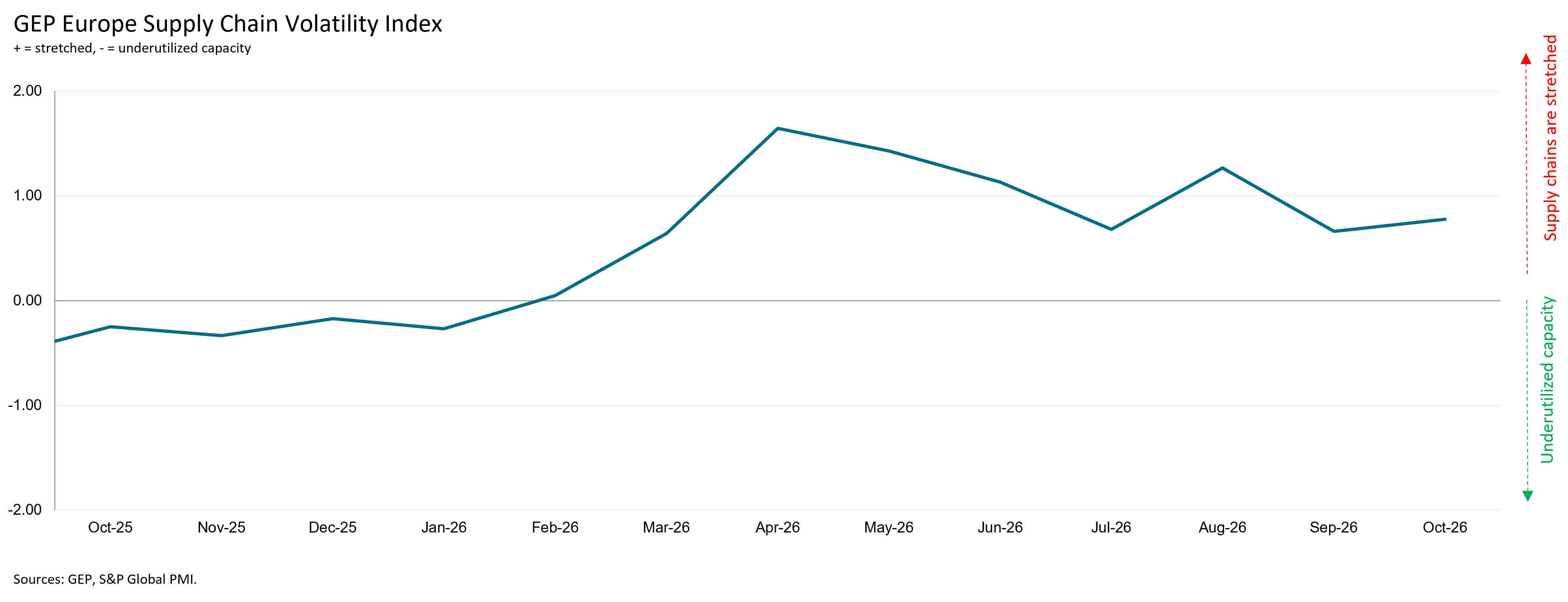
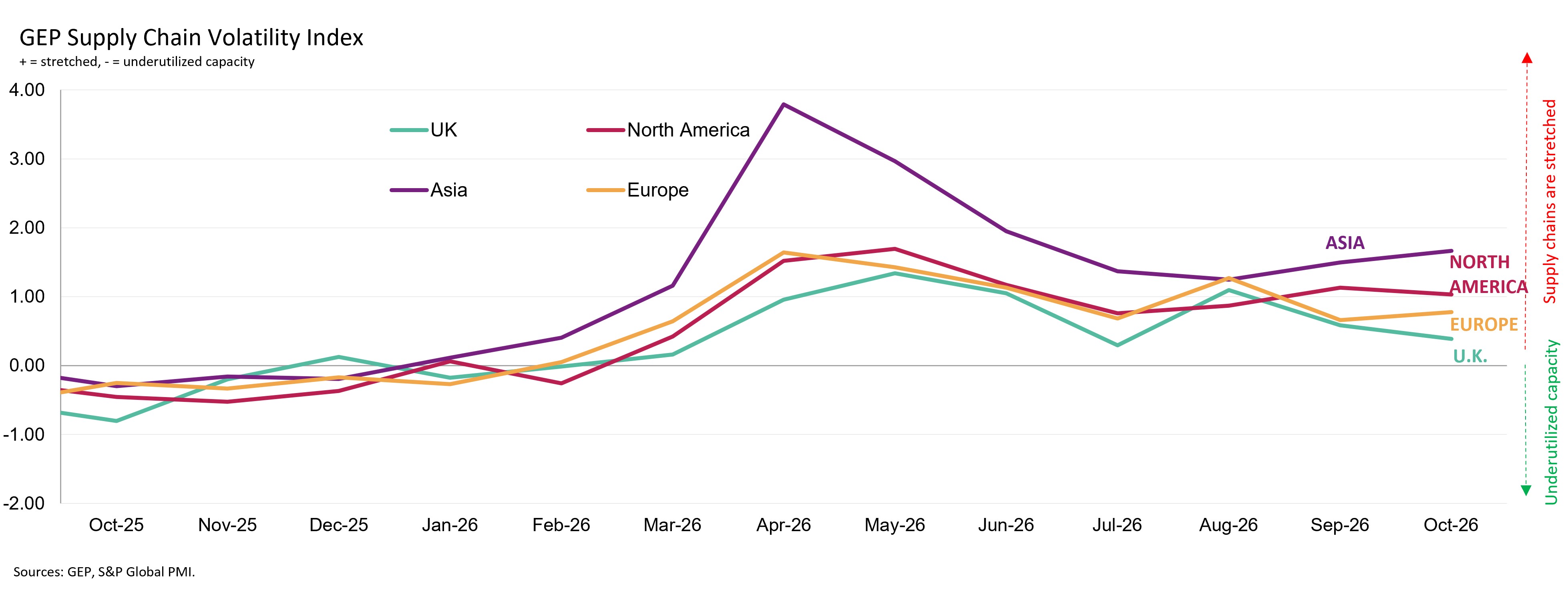
Interpreting the data:
Index > 0, supply chain capacity is being stretched. The further above 0, the more stretched supply chains are.
Index < 0, supply chain capacity is being underutilized. The further below 0, the more underutilized supply chains are.
OCTOBER 2026 REGIONAL KEY FINDINGS
- ASIA: Index rose to 1.67, from 1.49, signaling the greatest degree of pressure on Asia’s supply network in four months.
- NORTH AMERICA: Index ticks lower to 1.03, from 1.13, but North American manufacturers report greater safety stockpiling and backlog accumulation due to shortages.
- EUROPE: Index rises to 0.78, from 0.66, reflecting growth in purchasing and inventories. Germany was a key driver of these trends.
- U.K.: Index drops to a three-month low of 0.39, from 0.59, signaling another sharp climbdown in supply-chain pressures for U.K. manufacturers.
OCTOBER 2026 KEY FINDINGS
- DEMAND: Factory purchasing activity growth remained strong in October, in line with the general trend seen across most of the year-to-date. The U.S., China and Germany were key drivers of this expansion. Resilient demand for inputs also reflected concerted efforts by procurement managers to protect against further material price inflation and shortages.
- INVENTORIES: Globally, reports of stockpiling due to price or supply concerns rose in October and were historically high. Safety stockpiling was the strongest in five months in North America, and European manufacturers also rapidly bolstered their inventory buffers.
- MATERIAL SHORTAGES: Reports of supply shortages were historically high, registering above the long-run average for an eighth successive month, although they were the least pronounced since March, just after the outbreak of the Middle East conflict. Oil, electronic and electrical components were widely reported as being in short supply, as well as metals.
- LABOR SHORTAGES: Reports of manufacturers accumulating backlogs due to staff shortages were their lowest since February 2025, indicating that labor was not a restrictive factor for capacity in October.
- TRANSPORTATION: With global oil prices rising throughout October, the transportation cost index rose to a four-month high.
For more information, visit www.gep.com/volatility.
Note: Full historical data dating back to January 2005 is available for subscription. Please contact economics@spglobal.com.
The next release of the GEP Global Supply Chain Volatility Index will be 8 a.m. ET, Dec. 10, 2026.
About the GEP Global Supply Chain Volatility Index
The GEP Global Supply Chain Volatility Index is produced by S&P Global and GEP. It is derived from S&P Global’s PMI® surveys, sent to companies in over 40 countries, totaling around 27,000 companies. The headline figure is a weighted sum of six sub-indices derived from PMI data, PMI Comments Trackers and PMI Commodity Price & Supply Indicators compiled by S&P Global.
- A value above 0 indicates that supply chain capacity is being stretched and supply chain volatility is increasing. The further above 0, the greater the extent to which capacity is being stretched.
- A value below 0 indicates that supply chain capacity is being underutilized, reducing supply chain volatility. The further below 0, the greater the extent to which capacity is being underutilized.
A Supply Chain Volatility Index is also published at a regional level for Europe, Asia, North America and the U.K. For more information about the methodology, click here.
About GEP
GEP is a global leader in AI-first procurement and supply chain transformation, helping large global enterprises and mid-size businesses advance toward autonomous operations with agentic AI. GEP creates competitive advantage for clients by improving margins, unlocking value, strengthening resilience and accelerating growth. AI-native GEP Quantum Intelligence is the world’s leading agentic platform for procurement and supply chains, with embedded intelligence and deep domain expertise. With GEP Quantum Intelligence at the core, powering its strategy consulting and managed services, GEP delivers unified, end-to-end procurement and supply chain solutions — from strategy through execution — helping enterprises transform and lead in the age of agentic AI. GEP is consistently recognized as a leader in source-to-pay, supply chain and agentic AI by leading industry analysts and research firms, including Gartner, Forrester, IDC, ISG, Everest Group and The Hackett Group. New Jersey-based GEP has offices and operations across 120+ countries in the Americas, Europe, the Middle East and Asia-Pacific.
Disclaimer
The intellectual property rights to the data provided herein are owned by or licensed to S&P Global and/or its affiliates. Any unauthorised use, including but not limited to copying, distributing, transmitting or otherwise of any data appearing is not permitted without S&P Global’s prior consent. S&P Global shall not have any liability, duty or obligation for or relating to the content or information (“Data”) contained herein, any errors, inaccuracies, omissions or delays in the Data, or for any actions taken in reliance thereon. In no event shall S&P Global be liable for any special, incidental, or consequential damages, arising out of the use of the Data. Purchasing Managers’ Index™ and PMI® are either trade marks or registered trade marks of S&P Global Inc or licensed to S&P Global Inc and/or its affiliates.
This Content was published by S&P Global Market Intelligence and not by S&P Global Ratings, which is a separately managed division of S&P Global. Reproduction of any information, data or material, including ratings (“Content”) in any form is prohibited except with the prior written permission of the relevant party. Such party, its affiliates and suppliers (“Content Providers”) do not guarantee the accuracy, adequacy, completeness, timeliness or availability of any Content and are not responsible for any errors or omissions (negligent or otherwise), regardless of the cause, or for the results obtained from the use of such Content. In no event shall Content Providers be liable for any damages, costs, expenses, legal fees, or losses (including lost income or lost profit and opportunity costs) in connection with any use of the Content.
Media Contacts
| Derek Creevey Director, Public Relations GEP Phone: +1 646-276-4579 Email: derek.creevey@gep.com | Joe Hayes Senior Principal Economist S&P Global Market Intelligence Phone: +44-1344-328-099 Email: joe.hayes@spglobal.com | S&P Global Market Intelligence Corporate Communications Email: Press.mi@spglobal.com |
Media contact