


3PL vs. 4PL vs. 5PL: How Deep Should Your Logistics Outsourcing Go?
- 3PL adds execution capacity without requiring you to build it in-house.
- 4PL adds coordination and visibility across complex logistics networks.
- 5PL extends optimization across interconnected networks using advanced technology.
September 21, 2026 | Logistics 6 minutes read
Enterprise procurement leaders trying to manage separate shipping companies while maintaining fast delivery times struggle to control costs and track shipments across many vendors. The decision to choose technology that seamlessly outsources logistics complexity ultimately comes down to how much of the logistics value chain you want to delegate and how much decision-making you still want to own.
When logistics complexity starts consuming strategic attention, the model you choose can determine how much control you retain over the network, which gives you more control over how you handle disruption. Each model solves a different problem, yet the labels alone do not tell you which capabilities you are buying.
Understanding how 3PL vs 4PL vs 5PL models work and how they differ in control and technology will help you simplify your supply chain and choose the right logistics strategy for your business.
Decoding Logistics Outsourcing with 3PL, 4PL, and 5PL Models
Large enterprises require a match between the operating model and the complexity of the network.
As supplier networks and shipping lanes multiply across regions, the coordination burden grows faster than headcount can absorb it. Getting this decision right protects service levels during volatility and frees up the strategic bandwidth your team needs for higher-value sourcing work.
The value of an outsourced model increasingly depends on how well it can coordinate decisions across the network rather than simply perform individual logistics tasks.
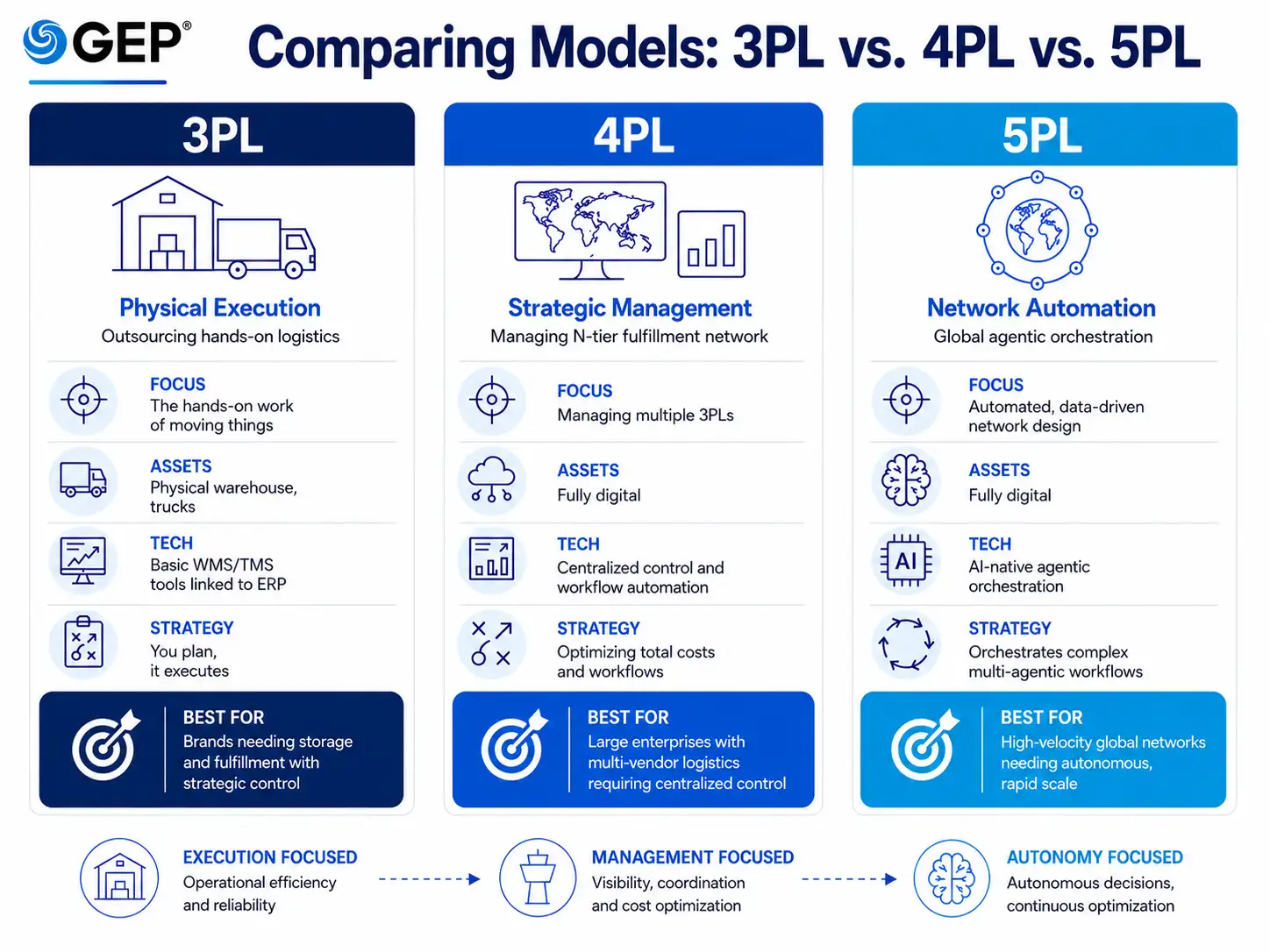
- In a 3PL setup, an outside provider handles physical work like warehousing, packing, and trucking.
- 4PL introduces a manager who coordinates multiple 3PL vendors, designing full end-to-end workflows as your main contact for logistics operations.
- A 5PL manages entire supply chains by using smart automation and modern software to connect global shipping networks.
Comparing 3PL, 4PL, and 5PL Capabilities
A logistics model can now be evaluated not only on how many physical activities a provider performs, but also on how effectively intelligence is embedded into the operating model.
Third-Party Logistics (3PL)
A 3PL takes care of hands-on logistics execution. They manage the daily heavy lifting of moving and storing goods while you retain control over the high-level strategy. This setup makes perfect sense if your organization already has a clear roadmap. You just get the extra physical capacity or carrier network required to keep operations running smoothly.
Fourth-Party Logistics (4PL)
A 4PL acts as your central coordinator. Your partner oversees multiple logistics providers to integrate activities across the entire network. Everything becomes much easier to monitor. The provider optimizes the system for speed and strategic alignment. This approach is highly valuable for complex enterprise setups where vendor management has grown overwhelmingly difficult.
Fifth-Party Logistics (5PL)
A 5PL model coordinates and optimizes large, interconnected logistics networks that are complex and prone to supply chain disruptions. While a 4PL focuses on integrating and managing the network, a 5PL ensures continuous, data-driven optimization across the broader ecosystem, where agentic AI orchestrates multiple AI agents specialized to perform highly specific tasks, complete with risk management, compliance, and governance applied in every action across N-tier supplier ecosystems.
The progression from 3PL to 5PL reflects the increasing scope from executing basic logistics and inventory management to coordinating global supplier networks while continuously optimizing how the network operates.
Agentic AI takes it up a notch by independently planning and executing actions across connected workflows, subject to pre-defined rules, thresholds, and human oversight.
Can Procurement See Risk Before It Hits?
Learn how predictive intelligence helps CPOs act before supplier risk becomes a business threat.
Benefits of 3PL, 4PL, and 5PL
Logistics tiers offer different advantages based on your company's size and tech needs. Let's break down the benefits.
Third-Party Logistics (3PL)
A 3PL saves you money through established carrier relationships. It turns fixed warehouse and vehicle expenses into flexible costs. You only pay for what you use. You get instant access to existing distribution centers alongside discounted shipping rates. This model handles peak demand surges effortlessly. Your team can then focus on core business goals instead of managing boxes.
Fourth-Party Logistics (4PL)
A 4PL acts as a single control tower for your shipping operations. This setup provides total visibility across your supply chain. Managing multiple vendors gets complicated quickly. A 4PL removes that headache. They optimize delivery routes while cutting down administrative paperwork. If your logistics needs shift, your 4PL adjusts the underlying provider network for you.
Fifth-Party Logistics (5PL)
A 5PL targets multinational corporations. These companies manage incredibly complex global networks. A 5PL relies on an advanced platform trained heavily on procurement data. The system practically runs itself. It reacts to market intelligence instantly. The software automatically reroutes deliveries or shifts inventory between warehouses. Global supply chains stay balanced with almost zero human intervention.
Explore more about GEP’s Logistics Management Services
Critical Considerations for Choosing the Right Outsourcing Model for Your Supply Base
Define your goals
The starting point should be your strategic sourcing goals, not the provider's service menu. Ask what you want logistics outsourcing to accomplish over the next several years. If the priority is lower execution costs and more reliable service, a 3PL may provide enough leverage. If the bigger challenge is coordinating a fragmented provider landscape, a 4PL may offer greater value. When the priority is continuous network optimization, advanced analytics and increasingly autonomous decision-making, a 5PL model may be worth considering.
Know the dynamics of your supplier network
A relatively stable network with predictable flows may not justify the complexity of a highly integrated model. A global network with frequent changes in demand, suppliers, transportation capacity, and service requirements may benefit more from centralized orchestration and continuous optimization.
Find out which technology stack your business needs
AI-driven logistics depends on access to reliable data and clarity on how workflows operate. Before selecting a model, assess whether information can move across transportation, warehouse, inventory, and supplier workflows without extensive manual intervention.
Know who owns the decision right
If an AI system identifies a better route, shifts capacity, or changes a fulfillment decision, who has authority to approve the action? If the model is expected to operate with increasing autonomy, governance must be designed alongside the technology.
Know the commercial structure
A provider that is accountable for a narrow activity may optimize that activity effectively while missing opportunities across the wider network. Your sourcing model should therefore reward performance against the outcomes that matter to the enterprise, not only isolated operational metrics.
Need More Control Across Your Logistics Network?
Explore technology that connects suppliers, systems, and operations across your supply chain.
Choosing the Right Level of Control
Ask: how much operational responsibility, coordination, and decision-making your logistics network needs to support your business goals. The right model should improve performance without creating more complexity than your organization can govern.
As logistics networks become more connected, Agentic AI will make it possible to automate more workflows and optimize supply networks.
Start with the right technology foundation. AI-Native Supply Chain Management Software can help you connect data, systems, suppliers, and operations workflows and help make more informed decisions as conditions change.



BLOG CATEGORIES
FAQs
A company should choose a 3PL logistics provider when it already has strong internal supply chain management and simply needs extra physical capacity to handle storage or transport, and wants direct control over carrier contracts without turning over high-level planning or vendor management to an outside manager across supply chains.
In practical supply chain management, 5PL stands out because it relies heavily on software-driven automation and automated decision-making. Unlike a 4PL that relies mostly on human managers to oversee partners, a 5PL uses AI-native software and real-time data to analyze shipping lines, choose optimal carriers, and balance retail and online shipping automatically across global supply chains.