


How Agentic AI is Transforming Supplier Collaboration in Procurement
- Agentic AI removes operational friction by automating supplier communication, validation, and follow-ups.
- Supplier collaboration becomes proactive as AI detects risks early and keeps both sides aligned on expectations.
- As AI agents act as trusted co-pilots, procurement shifts from task management to value creation.
July 23, 2026 | Procurement Strategy 5 minutes read
You already know that supplier collaboration has always been one of those things everyone agrees is important but rarely gets the attention it deserves. Teams get buried in emails, spreadsheets, follow-ups, escalations, re-quotes, and risk checks. Suppliers get frustrated because the process feels opaque or slow. And somewhere in the middle, value leaks out of the system.
That’s exactly where Agentic AI is starting to make an impact. Not the old “AI as a fancy calculator” story but real, autonomous agents that can interpret, decide, act, and learn. Think of them as highly competent digital teammates that never forget, never get tired, and always move the next task forward.
In this piece, we’ll walk through how Agentic AI is reshaping supplier collaboration across procurement.
The Rising Role of AI Agents in Supplier Collaboration
We’ve had automation in procurement for years but most of it has been rules based. If X happens, do Y. Helpful but limited.
Agentic AI is different. These AI agents can understand context, interpret policies, and take actions that feel almost human. For example, they can:
- Read supplier emails.
- Understand whether a supplier’s proposal meets the spec.
- Compare terms across documents.
- Initiate clarifications or request updates.
- Escalate issues only when they genuinely require human judgment.
In short, AI is no longer just recommending; it’s doing. And that’s why it fits so naturally into supplier collaboration — a space full of repetitive but cognitively heavy tasks.
Want to See How Leaders Are Moving From Automation to Autonomy?
Get the Agentic AI Playbook to embed intelligent autonomy into procurement
Autonomous sourcing is often where teams feel the impact first. Instead of waiting for someone to notice an opportunity, the system identifies it. Instead of manually comparing bids, scenarios are evaluated instantly. Procurement professionals stay in control, but they are no longer starting from a blank page.
The Strategic Importance of Supplier Collaboration in Procurement Using Agentic AI
If you zoom out, the big strategic shift is this. Procurement is no longer judged only on cost savings. Today, the scorecard includes resilience, sustainability, innovation, speed, and customer impact. None of these can be achieved without deeper supplier collaboration.
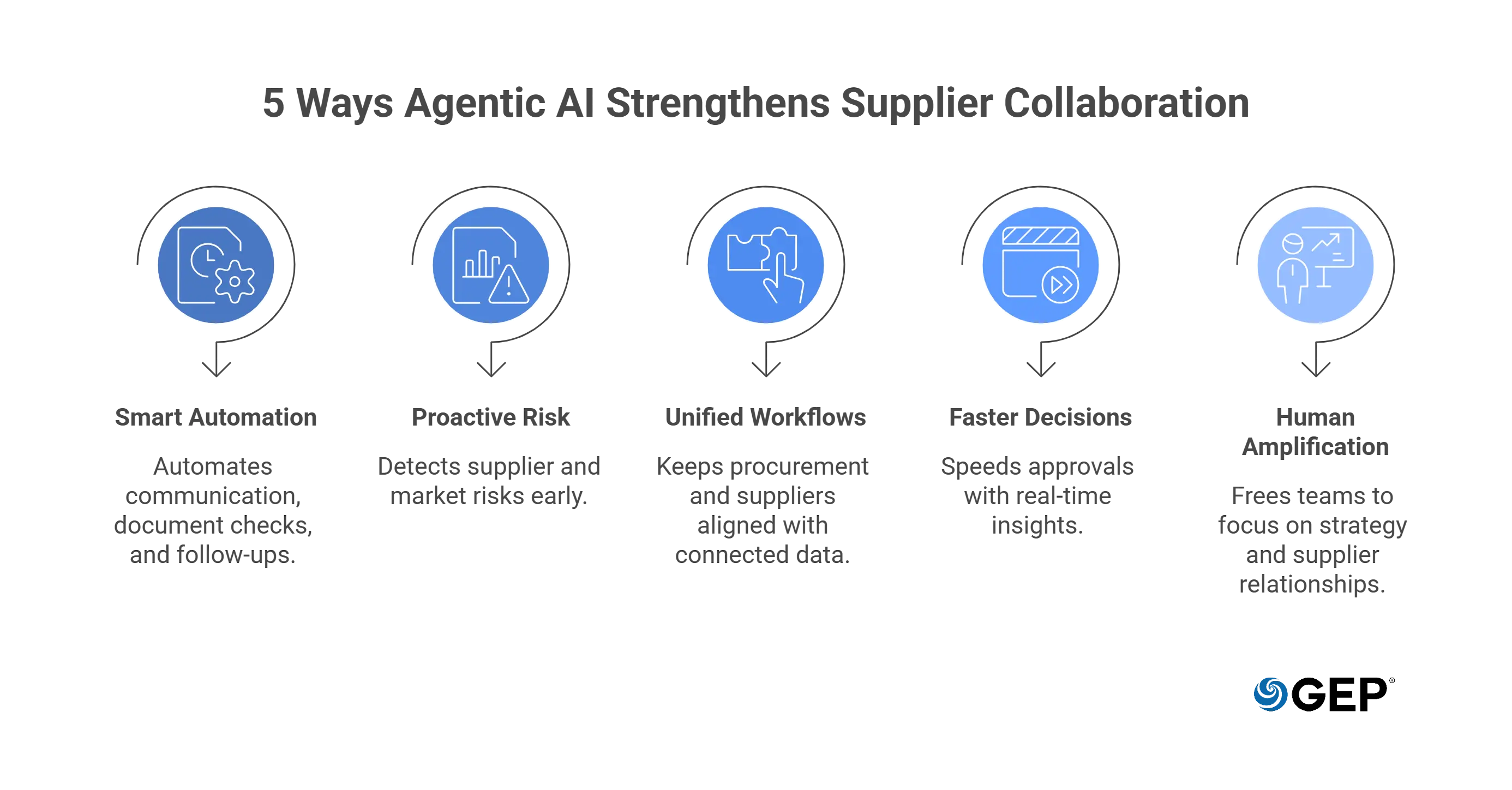
Agentic AI strengthens this collaboration in a few powerful ways.
First, it ensures information flows seamlessly between both sides. Suppliers aren’t left chasing updates and procurement teams aren’t left reconciling multiple versions of the truth.
Second it removes friction. A large chunk of supplier frustration comes from slow approvals, unclear specs, or inconsistent communication. AI agents can detect inconsistencies, pre-validate requirements, and keep everyone aligned.
Third, it frees human time. When teams aren’t buried in admin, they finally make space for genuine supplier development — joint business planning, innovation sourcing, or capability building.
So, Agentic AI isn’t just about efficiency. It’s about expanding procurement’s strategic bandwidth.
Check Out GEP’s - Supplier Collaboration Software
Enhancing Supplier Risk Management Through Agentic AI in Procurement
Risk management is where Agentic AI really shines. Because let’s be honest — manual risk monitoring has never been scalable. You check a supplier’s financials once a quarter, maybe scan their ESG scores annually, and hope nothing slips through.
AI works differently. It monitors continuously. An AI agent can:
- Track supplier financial signals in real time.
- Flag geopolitical or logistics disruptions as soon as they appear.
- Detect anomalies in pricing or delivery patterns.
- Compare contract terms with actual supplier behavior.
- Monitor news feeds for compliance or regulatory incidents.
Think of it as a 24/7 radar system.
And here’s the important part — early detection makes collaboration stronger, not more punitive. When you catch a potential issue early, you’re able to work with the supplier to resolve it before it becomes a crisis.
Risk becomes proactive and partnership driven rather than reactive and tactical.
Automating Supplier Collaboration Management (SCM) with Agentic AI
Supplier collaboration management has always been a logistical nightmare. On-boarding, document exchange, technical clarifications, SLA tracking, quality updates, invoicing alignment — it’s all important but incredibly time consuming.
Agentic AI automates most of this work. For example:
- Supplier on-boarding becomes smoother because AI agents can validate documents, check completeness, and automatically flag missing compliance data.
- Negotiation cycles become faster as AI agents compare versions, highlight deviations, and suggest next steps.
- PO and forecast alignment becomes more accurate as agents cross-check data across systems and reconcile mismatches before suppliers even notice them.
- Quality issue resolution becomes faster because agents triage incidents, gather evidence, and initiate corrective action workflows.
- Communication becomes cleaner because AI agents can synthesize updates into a single thread instead of scattered emails.
The result is less chaos and better flow. Suppliers feel like the organization “just works” and teams get to spend time on meaningful decisions instead of follow-ups.
And yes — this is where linking to a supplier collaboration portal like GEP makes sense because AI is truly effective only when it sits on top of a unified platform.
Ready to Transform Supplier Collaboration?
Uncover how Agentic AI can streamline workflows and elevate procurement performance
The Future of Supplier Collaboration in Procurement: AI Agents as Trusted Co-Pilots
Fast forward a few years and the procurement function will look very different. You’ll still have category managers, supplier relationship leads, sourcing experts, and risk specialists but they will be augmented by fleets of specialized AI agents.
These agents won’t replace humans — they will amplify them.
Imagine an AI co-pilot that:
- Joins supplier calls and summarizes actions.
- Suggests negotiation positions based on historical data.
- Spots opportunities for consolidation or innovation.
- Drafts contract clauses aligned with risk policy.
- Tracks whether commitments from both sides are being fulfilled.
Workflows feel more orchestrated. Supplier relationships feel more transparent. And procurement feels more proactive.
We’re moving from “manage tasks” to “manage outcomes”.
Get Ready for Agentic AI
Agentic AI is not a buzzword. It’s becoming a structural force in procurement. It reduces friction. It enhances trust. It creates transparency. And most importantly, it allows procurement and suppliers to collaborate as true partners rather than two sides struggling to stay in sync.
If the last decade was about digitizing procurement, the next decade is about intelligent collaboration — where AI agents quietly run the operational backbone so humans can focus on strategy, innovation, and value creation.
And honestly, that’s the shift the function has needed for a long time.

FAQs
It eliminates manual tasks like document checks, version comparisons, and communication follow-ups so teams and suppliers move faster with fewer errors.
Mid-sized organizations often benefit even more because AI removes workload constraints and scales supplier governance without expanding headcount.
It enhances transparency, maintains consistency of information, monitors risks early, and ensures both sides stay aligned on commitments and expectations.
AI agents consolidate updates, interpret context, route messages correctly, and maintain one continuous conversation thread instead of scattered channels.