


Vetting AI Vendors: The Questions Your Standard Checklist Misses
October 28, 2026 | Vendor Management 5 minutes read
A procurement team can thoroughly review a software vendor's security certifications and financial stability, only to discover months later that the real exposure lay in how the vendor trained its model on customer data. Standard vendor scorecards were built for licensed software, not for systems that keep learning after the contract is signed.
Regulators are already treating AI procurement as its own risk category, and boards are asking what controls exist before a contract clears legal. Procurement is where those questions get answered, or skipped.
What Is an AI Vendor Due Diligence Checklist?
An AI vendor due diligence checklist is the set of questions, and the evidence behind the answers, that procurement collects before buying, renewing, or expanding an AI tool. It goes beyond the standard vendor questionnaire to cover how a model was trained, what happens to company data once it reaches the vendor, and who is accountable when the model gets something wrong.
Done well, it protects the business from data exposure and staff from acting on unreliable output, while giving leadership a documented answer when a board or auditor asks how a vendor decision was made.
Get the Complete AI Vendor Risk Framework
How to tell an AI-native procurement platform from one with AI bolted on, and what that difference means when you're evaluating a vendor's claims
Why AI Vendor Due Diligence Requires an Overhaul of Traditional TPRM
Most third-party risk management programs were built around a fixed set of controls, covering data handling and uptime guarantees. Those controls still matter, but they weren't designed to catch a vendor that trains its model on customer inputs by default, or one that routes prompts through a subcontractor never disclosed in the original agreement.
Shadow AI compounds the problem. Business units adopt tools directly and skip procurement entirely. By the time a tool shows up in a spend report, sensitive data may already have passed through a model nobody reviewed. A one-time TPRM assessment does not account for a vendor whose model changes shape after the contract is signed, and that is precisely where traditional frameworks fall short.
Essential Questions to Add in the AI Vendor Due Diligence Checklist
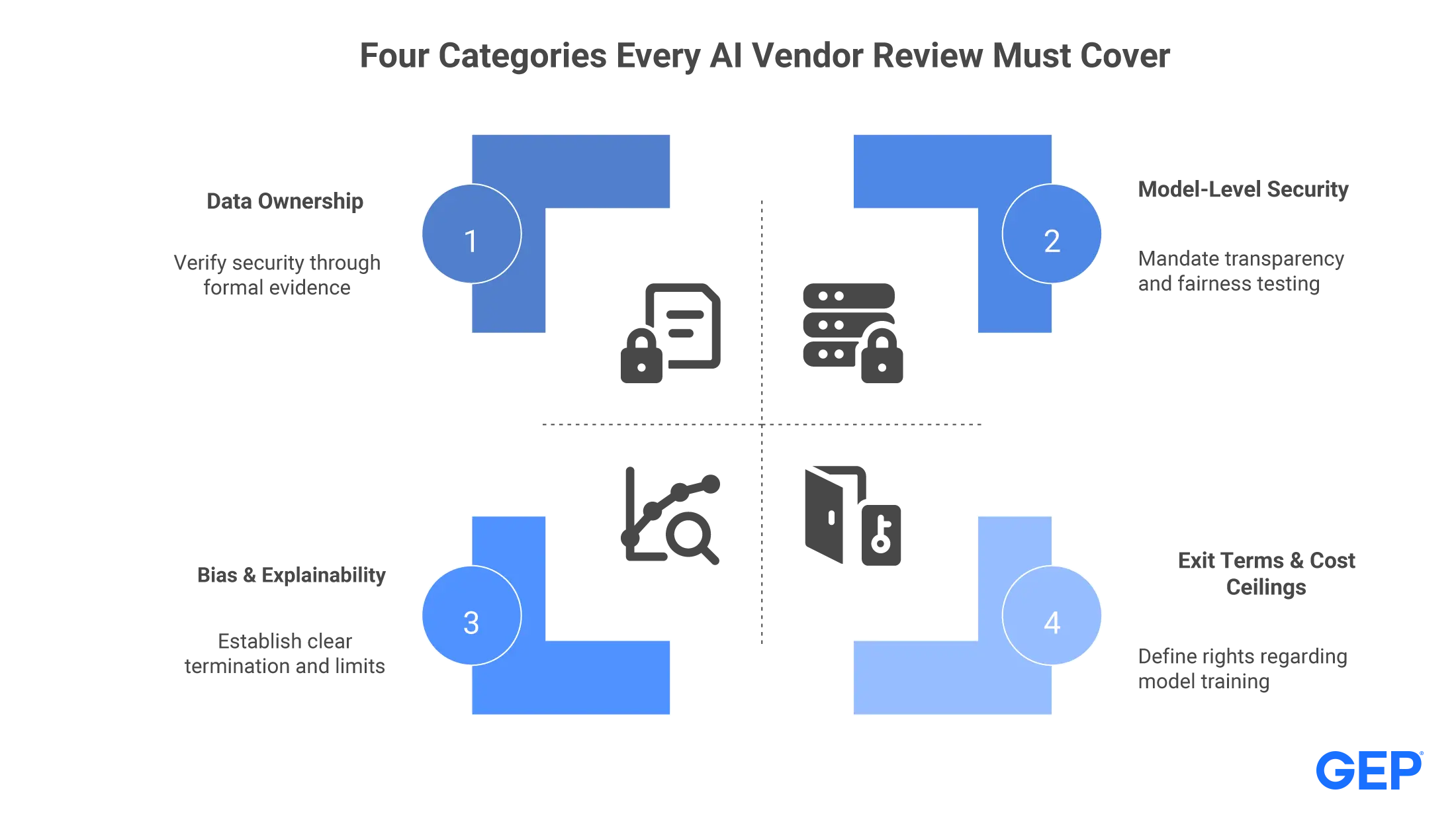
Four categories carry most of the new risks. Each one needs its own line of questions, not a single checkbox buried in the standard vendor form.
Data Governance, Intellectual Property, and Model Training
Find out where the training data came from and whether the vendor uses a company's own data to improve its model for other customers. Confirm whether that use can be switched off contractually, and get output ownership and intellectual property rights specified in writing rather than assumed from a standard software license.
Cybersecurity, Threat Surfaces, and Shadow AI Prevention
The vendor's model needs its own security review, separate from the infrastructure it runs on. Ask for evidence rather than assurance: a SOC 2 Type II report or ISO 27001 scope, encryption details, and a breach notification timeline stated in hours rather than left vague. A traditional software audit rarely tests for prompt injection or cross-customer data leakage, and unauthorized fine-tuning needs a question of its own, since it can happen without any visible change to the contract.
Ethical AI, Algorithmic Bias, and Explainability
Ask how the vendor tests for bias before launch and how often it retests afterward, since fairness benchmarks drift as usage patterns change. Require a plain-language explanation of how the model reaches an output, including the sources or logic it relied on, and confirm those explanations get logged for later audit rather than only shown on screen once.
Total Cost of Ownership (TCO), Commercial Viability, and Exit Terms
Contract terms should spell out what happens to trained models and historical prompts once the relationship ends. Vendors rarely volunteer a clean data return process, so put it in the agreement before signature rather than negotiating it during renewal, when negotiating power has already shifted to the incumbent. Consumption-based pricing also needs guardrails: usage alerts, rate caps, and a defined ceiling before a pilot turns into an unplanned spend line.
Operationalizing the Checklist Across Source-to-Pay
A checklist only works if it survives contact with the buying process. Embedding these questions into intake forms means every AI vendor request triggers the same set of risk prompts, instead of relying on someone remembering to ask them at the right moment.
Ownership matters as much as the questions themselves. Procurement typically manages the intake and contract mechanics, but security and legal need a seat during the shortlist stage, ahead of signature rather than after it.
Automated Risk Questionnaires: Deploying AI Control Forms in Third-Party Risk Management
Static questionnaires get skipped or answered half-heartedly under deadline pressure. Automated control forms built into the intake workflow route each AI vendor request through the same structured questions, flag incomplete answers, and hand procurement a comparable risk profile before the vendor reaches a shortlist.
Smart Contract Safeguards: Auto-Redlining AI Risk Terms via AI-Native Contract Management Software
AI-native contract management software can scan incoming vendor paper for missing data, training rights, vague liability language, or absent breach notification timelines, and redline those clauses automatically before a document reaches legal. That catches the recurring omissions human reviewers miss when they are working through a stack of contracts on a deadline.
Automated Spend Enforcement: Applying Hard-Stop Requisition Blocks in Procure-to-Pay (P2P) for Unapproved AI Vendors
Procure-to-pay systems can go further and block requisitions outright for AI vendors that haven't cleared the assessment. That turns the checklist into an enforced control at the point of spend, rather than a document someone fills out once and files away.
Assess Your AI Vendor Risk
Connect with GEP to strengthen third-party risk management for AI procurement across your supply base
Shifting from Point-in-Time Checklists to Continuous AI Risk Telemetry
A one-time review catches what a vendor discloses at signature. A model retrained six months later, or a subcontractor added without notice, slips past that same review. Continuous monitoring covers that blind spot: contract triggers that require re-disclosure when a vendor's AI capabilities change, paired with periodic reassessment for categories carrying higher risk.
Procurement teams that build this into standard practice now will spend less time reacting to AI incidents later. They will also make sharper calls before a contract gets signed in the first place, which is a far better position than negotiating cleanup after the fact.



BLOG CATEGORIES
FAQs
A standard IT vendor review tests what a product does at the point of purchase. An AI vendor review has to test what the underlying model can become after purchase, since retraining, fine-tuning, and new data connections can change behavior without ever touching the contract.
Require the vendor to indemnify the business against third-party IP claims arising from model outputs, and confirm in writing who owns content generated from proprietary inputs. Ask whether that indemnification excludes claims tied to the vendor's own training data choices, since some vendors carve that scenario out by default.
Set usage alerts and a hard ceiling before the pilot stage ends, not after invoices start arriving. Ask the vendor to model a worst-case usage scenario in the proposal itself, so the number in the contract reflects realistic volume rather than an introductory estimate.
A P2P platform can block requisitions and renewal payments for AI vendors whose compliance status has lapsed, tying financial enforcement directly to the assessment result. That keeps the check active for the life of the contract, not just at the moment of signature.