


Why ISO/IEC 42001 Matters for Procurement and Supply Chain Leaders
- ISO/IEC 42001:2023 is the global standard that defines how organizations should manage AI.
- The certification is awarded after a third-party assessment of how well an AI provider governs AI.
- Explore five areas where vendors must prove they build, deploy, and maintain AI responsibly.
October 21, 2026 | Awards and Events 6 minutes read
AI has changed how most businesses operate. In procurement and supply chain, it can now evaluate suppliers, manage sourcing, process purchase requests, and help leaders make strategic, data-backed decisions.
Increasingly, AI can go beyond recommending actions to acting on them.
That creates enormous opportunities. But it also raises an important question: How can enterprises be confident that the AI they rely on is secure?
This’s where ISO/IEC 42001 comes in.
What Is ISO/IEC 42001 Certification?
ISO/IEC 42001:2023 is the world’s first international standard for Artificial Intelligence Management Systems (AIMS). It sets out the policies and processes an organization needs to develop, deploy, manage, and continually improve AI responsibly.
The International Organization for Standardization (ISO) and the International Electrotechnical Commission (IEC) published the standard in December 2023.
The certification examines how an AI provider governs its technology, looking at the management practices that sit underneath the features and performance it promises enterprise buyers.
It is conducted by an independent body that checks if AI management system meets the standard's requirements within its certified scope.
Why Is ISO/IEC 42001 Important for Enterprises?
AI has already become part of everyday business operations in procurement and supply chain operations. It can shape decisions that impact costs, compliance, supplier relationships, and business continuity.
ISO/IEC 42001 establishes a credible framework to assess if AI is being managed responsibly, how risks are handled, and who will be held accountable for them.
This encourages confidence in procurement leaders and their teams who need clarity in reviewing how AI systems are managed and controlled by their AI vendors from conceptualization to deployment and day-to-day management.
With agentic orchestration of entire procurement and supply chain workflows, clear governance and accountability are more important than ever.
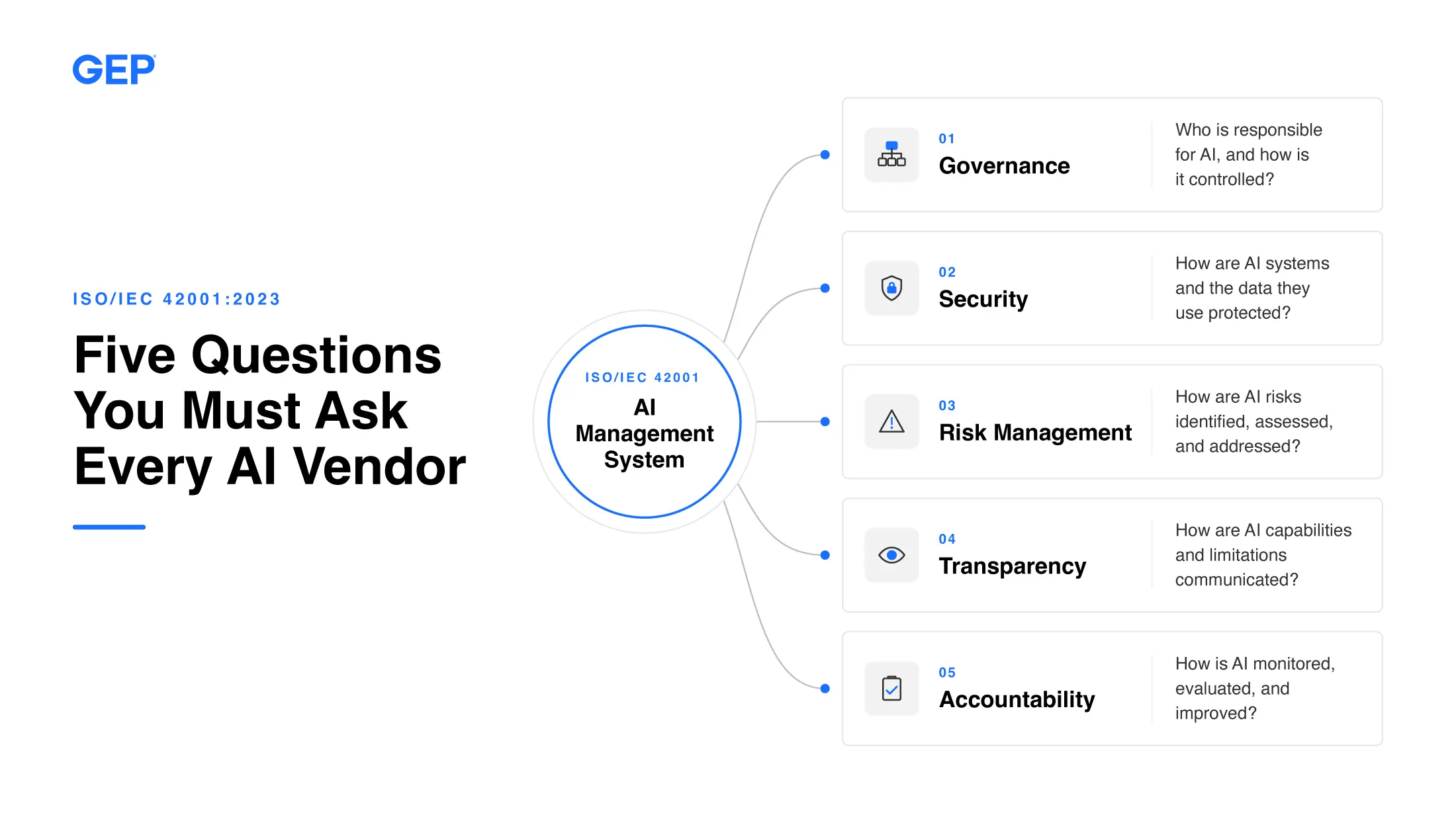
Five Key Areas of ISO/IEC 42001, and What They Mean for Your Business
The ISO/IEC 42001 covers AI across its full lifecycle. For procurement and supply chain teams, five areas stand out.
1. AI Governance: Who Owns & Controls AI
ISO/IEC 42001 requires organizations to define AI policies and assign accountability for each AI system, backed by processes that manage those systems responsibly.
In procurement, AI now helps evaluate suppliers and recommend sourcing decisions. If a provider’s AI handles that work, enterprises need confidence that the provider has clear rules governing how its AI is developed and managed.
2. AI Security: How Systems & Data Stay Protected
Procurement and supply chain AI systems often handle sensitive data. This is why security needs to be considered throughout the AI lifecycle, not only when a system goes live.
ISO/IEC 42001 requires that organizations address AI-related risks and complement established information security management practices.
When selecting an AI provider, procurement professionals can assess how they protect the data AI uses and how they manage and maintain safeguards.
3. AI Risk Management: Identify Potential Threats Early
AI can introduce risks like bias and misuse, which may lead to unintended decisions and unexpected business outcomes.
Without risk management, AI may choose an unsuitable supplier, overlook a potential risk, or make wrong decision based on incomplete information.
ISO/IEC 42001 provides a structured approach to risk management. It allows leaders to anticipate and evaluate potential risks and their impact, while establishing preemptive controls.
The goal isn't to claim that AI is risk-free, but to ensure risks are managed systematically.
4. AI Transparency: How Capabilities and Limits Are Documented
As AI becomes increasingly involved in business decisions, having a clear and complete understanding of its abilities and limitations is crucial.
ISO/IEC 42001 ensures that transparency is communicated and documented so you know how AI systems work, including what they can and cannot do.
Procurement teams must know how and where AI is involved at every stage of the source-to-pay cycle, and which decisions require human judgment. This clarity helps them decide how much to rely on AI judgment.
5. AI Accountability: How AI Is Monitored and Improved
In procurement and supply chains, regulations shift, and business requirements evolve. AI systems learn and adapt alongside these changes.
ISO/IEC 42001 holds AI providers accountable for continually evaluating their AI management system through performance monitoring, internal audits, management reviews, and corrective actions.
Enterprises gain confidence that their AI providers don’t simply deploy technology and move on. Providers demonstrate ongoing oversight and consistently strengthen and update AI management practices.
Together, these five areas form the foundation for enterprise AI you can trust.
What Does ISO/IEC 42001 Certification Mean for Procurement and Supply Chain Leaders?
ISO/IEC 42001 certification makes procurement and supply chain professionals:
- Better informed with a benchmark to assess AI management practices.
- Better prepared to review how AI-related risks are evaluated and managed.
- Better aligned with IT, security, risk, and legal teams through a shared framework.
- Better positioned to adopt AI with third-party evidence of how vendors develop and manage AI across its lifecycle.
This evidence matters when enterprises choose AI technology that will increasingly influence business decisions and outcomes.
Measuring AI Value in Utility Supply Chains
Four areas where AI delivers value, and how to track it
Why Did GEP Pursue ISO/IEC 42001 Certification?
ISO/IEC 42001 certification is voluntary.
GEP chose to pursue it because we believe our customers should be able to trust the AI they rely on for critical procurement and supply chain operations.
We are committed to delivering high-quality, effective AI solutions built on strong foundations.
GEP Quantum Intelligence, our AI-native procurement and supply chain platform, reflects that commitment. We sought independent certification to validate our approach.
Auditors assessed GEP as an AI service and product provider across governance, risk management, lifecycle management, and responsible AI practices.
GEP achieved ISO/IEC 42001:2023 certification with zero nonconformities.
For our clients, the certification provides additional confidence in the management practices behind the AI solutions they use. It also reinforces our commitment to continuously strengthening how we develop, deploy, and manage AI.
Trusted AI Is the Foundation for Greater Business Value
AI delivers its greatest value when businesses can trust it enough to put it to work.
At GEP, we're committed to delivering AI-native solutions that combine powerful intelligence with responsible AI management.
We went the extra mile to build our platform on the right foundations. ISO/IEC 42001 provides an important framework that enterprises can use to put AI to work confidently.
GEP will continue to audit its AI systems regularly and with increasing rigor, holding the platform to the highest standards as it continues to evolve.



BLOG CATEGORIES
FAQ's
No. Certification is voluntary. Organizations choose it when they want independent confirmation that their AIMS meets the standard. It doesn’t replace AI laws or regulations, though it can help organizations meet their compliance obligations more effectively.
ISO management system certificates, including ISO/IEC 42001, are typically valid for three years. The certificate stays valid only if the organization passes annual surveillance audits, and a recertification audit renews it at the end of the cycle.
An AIMS is a set of policies, processes, responsibilities, and controls for managing AI responsibly. ISO/IEC 42001 sets out what an organization must do to implement that system, maintain it, and keep improving it over time.
ISO/IEC 42001 covers the responsible management of AI systems, including governance, risks, and impacts. ISO/IEC 27001 covers information security management. Each standard serves a different objective, and together they give enterprise buyers a fuller picture of a provider’s practices.
Certification applies to an organization’s AI management system within a defined scope. It says nothing about the performance or accuracy of any single AI product. Check the scope of a provider’s certificate to see which activities it actually covers.
It gives procurement, IT, security, and risk teams an independently assessed reference point for judging a provider’s AI management practices. That includes how the provider handles governance, risk assessment, oversight, and continual improvement.
No. Certification does not establish compliance with every AI law or regulation. Its structured management approach does help organizations meet relevant regulatory and governance obligations, which puts them on firmer ground when rules tighten.