


Logistics Control Tower: From Visibility Dashboard to Decision Engine
- Shift from tracking shipments to resolving exceptions, so delays get fixed before customers feel them.
- Layer a control tower over your current TMS to unify carrier and fleet data without a rip-and-replace project.
- Automate routine fixes and keep approvals for costly calls to lift OTIF and cut resolution time.
November 10, 2026 | Logistics 5 minutes read
Freight now moves across owned fleets, 3PLs, regional carriers and gig drivers, and each reports status in its own format. A late truck in one region can quietly break a delivery promise somewhere else.
Most teams answer with a visibility dashboard. It shows where everything is, yet a planner still has to spot the problem, judge the impact and chase a fix. Seeing a delay is not the same as resolving it.
This blog explains how a logistics control tower turns visibility into decisions, how it differs from a TMS, and how to get there in phases.
What is a Logistics Control Tower?
A logistics control tower is a centralized, AI-native layer that connects your TMS, WMS, ERP, carrier and telematics data into one live view of goods in motion. It then goes further: it spots exceptions, weighs options and recommends or triggers the next action.
Think of air traffic control. It doesn’t just display planes. It sequences them.
Why Do Traditional Visibility Dashboards Fall Short in Logistics?
Dashboards were built to report, but logistics runs on decisions. They show where a shipment is, then leave the cause and the fix to a planner. Four gaps explain why.
Visibility Without Action Is Overhead
A map full of red dots tells a planner what is wrong, not what to do. Every exception still needs someone to find the cause, check capacity and approve a change, while the delivery window keeps closing.
Alert Fatigue and Manual Triage
When every deviation fires an alert, teams stop trusting alerts. Planners end up sorting dozens of low-impact notices to find the three that threaten a key account.
Slow Reporting vs Live Exceptions
A report that lands the next morning describes yesterday’s failures. A live exception feed lets a team act while the truck is still on the road.
Last-Mile Cost and Multi-Carrier Complexity
Last-mile is where cost and complaints concentrate. Add carriers with different status codes and rate cards, and no one can compare performance or quickly reroute overflow. A GEP-Economist Impact study found that 57% of enterprises need greater transparency and control over their supply chains.
Get the Analyst View on Supply Chain Platforms
See where supply chain platforms stand in The Forrester Wave™ Q3 2026
How does a Logistics Control Tower Work as a Decision Engine?
A control tower sits on top of your existing systems as an orchestration layer. It ingests live data, detects deviations, recommends a response and pushes it back into execution.
4 Architectural Layers of a Logistics Control Tower
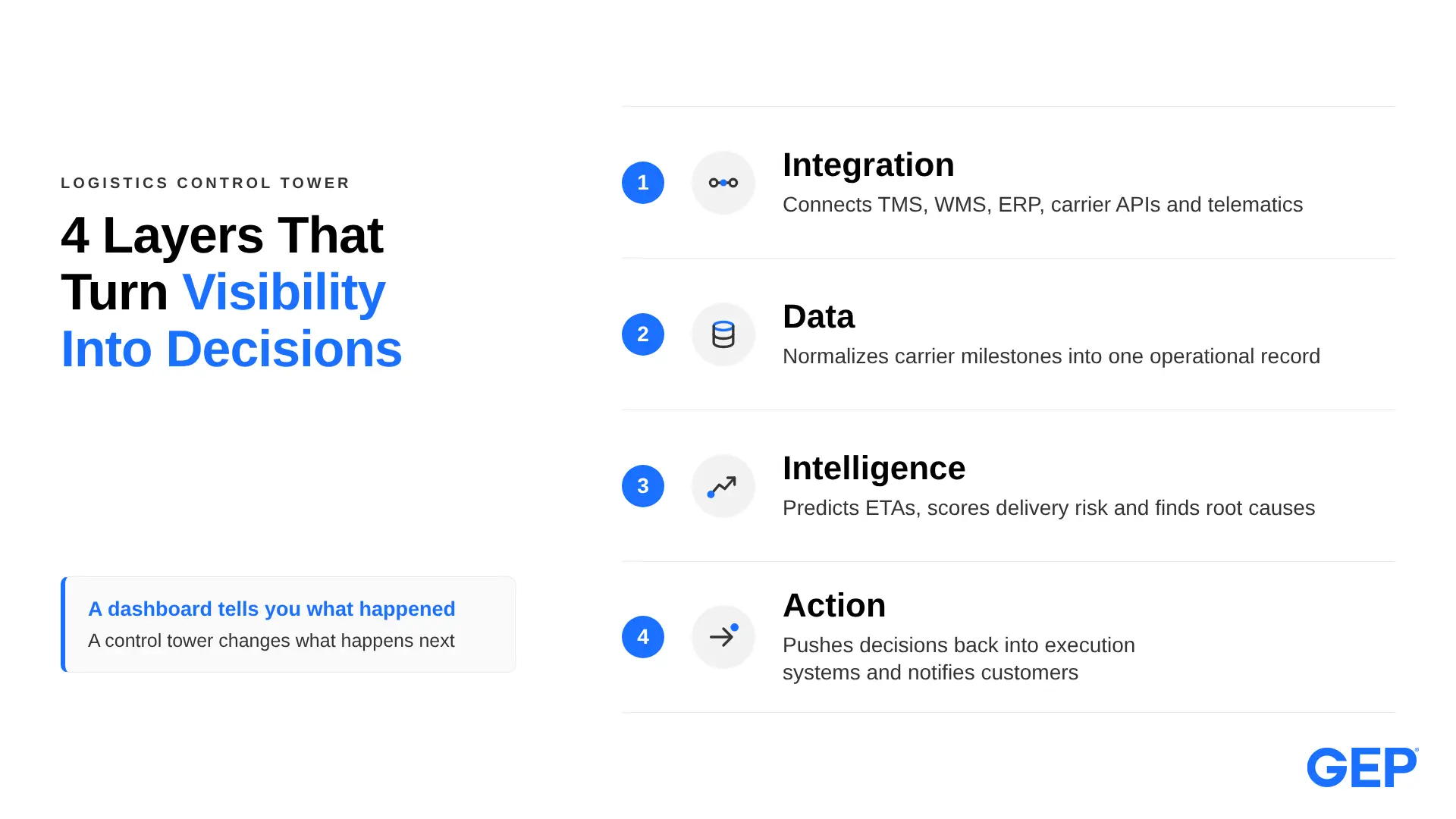
Integration: connects TMS, WMS, ERP, carrier APIs and telematics.
Data: normalizes carrier milestones into one operational record.
Intelligence: predicts ETAs, scores delivery risk and finds root causes.
Action: pushes decisions back into execution systems and notifies customers.
From Exception Detection to Resolution
The system flags a risk, such as a delayed vehicle threatening three time-window stops. It identifies the cause, ranks exceptions by customer and cost impact, and lines up resolution options.
Prescriptive Action and Orchestration
This is where agentic AI earns its place. It compares options such as resequencing stops, shifting a load to another carrier or updating ETAs, then proposes the best one with its cost trade-off. Orchestration carries it out across systems.
What to Automate vs What Needs Approval
Automate actions that are cheap and reversible: ETA updates, delay notices and reassignments within cost limits. Send costly or hard-to-undo calls to a human, such as premium carrier spend or changes to high-value shipments.
Logistics Control Tower vs TMS, Supply Chain Control Tower
These tools get confused, yet each does a different job. A TMS runs execution, a logistics control tower coordinates across systems, and a supply chain control tower widens the view to the full chain.
Control Tower vs TMS
A TMS plans and executes tendering, rating, routing and documentation. A control tower sits above it, and above other execution systems, to coordinate across them. You need both.
Logistics vs Supply Chain Control Tower
A supply chain control tower spans procurement, manufacturing, inventory and distribution. A logistics control tower focuses on movement: transport, dispatch, carriers and delivery. Many teams start with logistics, where cost and customer impact show up fastest.
Explore GEP’s - AI-Native Supply Chain Control Tower Software
How to Move From Dashboard to Decision Engine
Moving from a dashboard to a decision engine happens in stages, not in one release. Start by knowing where you stand, then follow a phased plan, clear the usual blockers and track results from day one.
The 4 Maturity Stages: Descriptive, Predictive, Prescriptive, and Autonomous
Descriptive shows what happened. Predictive flags what will go wrong. Prescriptive recommends the fix. Autonomous executes approved fixes within set rules.
A 4-Phase Deployment Model: Data Ingestion, Alerting, Prescriptive Analytics, and Autonomy
Start with data ingestion: connect high-volume systems and agree on status definitions. Next, build alerting ranked by SLA risk. Then add prescriptive analytics with cost trade-offs. Finally, grant autonomy to approved actions, with full audit trails.
Overcoming Enterprise Friction: Legacy API Silos and Carrier Data Incompleteness
Wrap legacy systems with middleware, EDI and event streams instead of replacing them. Where carrier data has gaps, fall back on driver app scans or telematics, and score carriers on data quality too.
Measuring ROI: Freight Cost Variance, On-Time In-Full (OTIF) Rates, and Exception Resolution Time
Baseline three numbers before rollout: planned versus actual freight cost per shipment, OTIF rate, and the time from detection to fix.
Ready to Bring Your Logistics Network Together?
Explore how a control tower can coordinate your carriers, fleets and exceptions in real time
Turning Signals Into Decisions
A dashboard tells you what happened. A decision engine changes what happens next. Begin with one lane or region, prove the gain on OTIF and cost variance, then widen the scope.
If you want to explore how to operationalize this at scale, talk to us.




BLOG CATEGORIES
FAQs
It adds reasoning and action. AI agents evaluate options, choose a resolution within business rules and execute it, with humans approving high-impact moves.
Through role-based access, encryption in transit and at rest, audit logs and data minimization. Confirm certifications with your vendor.
Yes. It integrates through APIs and EDI, adding orchestration the TMS was never built to provide.