


Agentic AI in Procurement: How to Move from Automation to Autonomous Outcomes
- Agentic AI enables procurement teams to shift from manual task execution to autonomous, outcome-driven workflows that reduce cycle times and increase spend control.
- Multi-agent orchestration connects fragmented systems, suppliers, and data streams into a unified operating model built for scale and compliance.
- Organizations that adopt AI-native procurement transformation position the function as a strategic engine for enterprise value, not just a cost center.
July 15, 2026 | Procurement Strategy 5 minutes read
Procurement has spent the last decade automating the wrong things. Approval workflows, PO generation, supplier onboarding forms: these tasks got faster, but the underlying decisions stayed slow, manual, and reactive. Fragmented systems, siloed data, and staff stretched thin across operational firefighting left transformation programs stalled at the point of execution.
Something has shifted. The question procurement leaders are now asking is not whether AI belongs in their function. It's whether their function is built to harness what AI-native procurement orchestration software can do.
This blog breaks down what agentic AI means for procurement, where the next evolution is headed, and how organizations can translate the technology shift into measurable business outcomes.
Why Agentic AI Represents the Next Evolution of Procurement Transformation
Generative AI gave procurement teams faster answers. Agentic AI gives them faster outcomes.
The distinction matters enormously. Where generative tools assist human decision-making, agentic systems act on it. They intake, analyze, route, negotiate, escalate, and resolve, operating across enterprise environments with minimal human intervention at each step.
For CPOs, this reframes transformation entirely. The goal is no longer process digitization. It's building a procurement function that can execute end-to-end workflows at machine speed, with human judgment applied where it creates the most value.
The Execution Wall: Why Legacy Procurement Transformation Has Stalled
Most procurement transformation programs hit the same ceiling. Technology is deployed, but adoption stays low. Data improves, but decisions stay slow. Savings targets get hit in year one, then plateau.
The reason is structural. Legacy transformation efforts digitize existing workflows rather than redesign them. The result: the same handoffs, the same approval bottlenecks, the same dependency on individual expertise sitting in isolated pockets of the organization.
Agentic AI surfaces this problem clearly. When you deploy a system capable of autonomous action, rigid, fragmented workflows become visible liabilities. The transformation ceiling is not a technology problem. It's an operating model problem.
From Generation to Action: Defining the Agentic Frontier
An Agentic AI system does not wait to be asked. It monitors, interprets, decides, and acts, within defined parameters and governance guardrails.
In procurement, this looks like a system that flags a contract approaching expiration, benchmarks renewal terms against live market data, drafts a counter-proposal, and routes it for approval, all before a category manager opens their inbox. That is not automation. That is intelligence operating with intent.
The critical enabler is the agent's ability to interact with external systems, suppliers, and data sources in real time. AI-native platforms provide this infrastructure, enabling agents to access ERP data, supplier portals, risk feeds, and contract repositories simultaneously.
From Hype to Outcomes: Your Agentic AI Playbook
Learn how to operationalize agentic AI across your procurement function with practical use cases, governance frameworks, and a clear path to value.
The Power of Multi-Agent Orchestration in Enterprise Spend
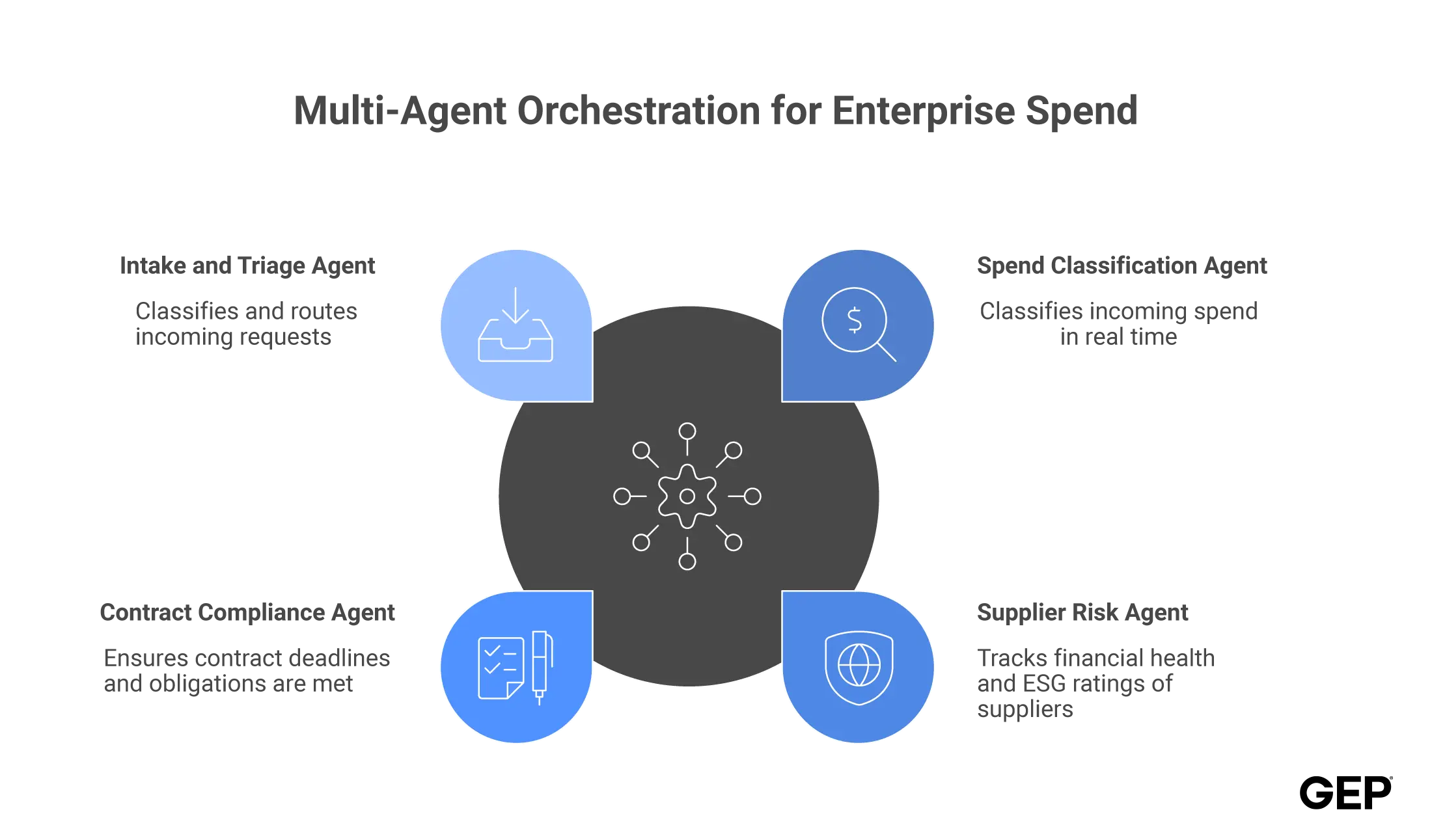
No single agent handles enterprise complexity alone. The real capability unlocked by Agentic AI is orchestration: multiple specialized agents working in coordination across intake, sourcing, contracting, supplier management, and payment.
One agent handles spend classification. Another monitors supplier risk. A third tracks contract compliance. Each acts autonomously within its domain, but shares intelligence across the network. The orchestration layer routes exceptions, manages escalations, and keeps humans in the loop where judgment is genuinely required.
This is the architecture that transforms procurement from a sequential process into a continuous, adaptive system. It closes the gap between data and action, and between policy and practice.
High-Impact Agentic AI Use Cases Transforming Procurement
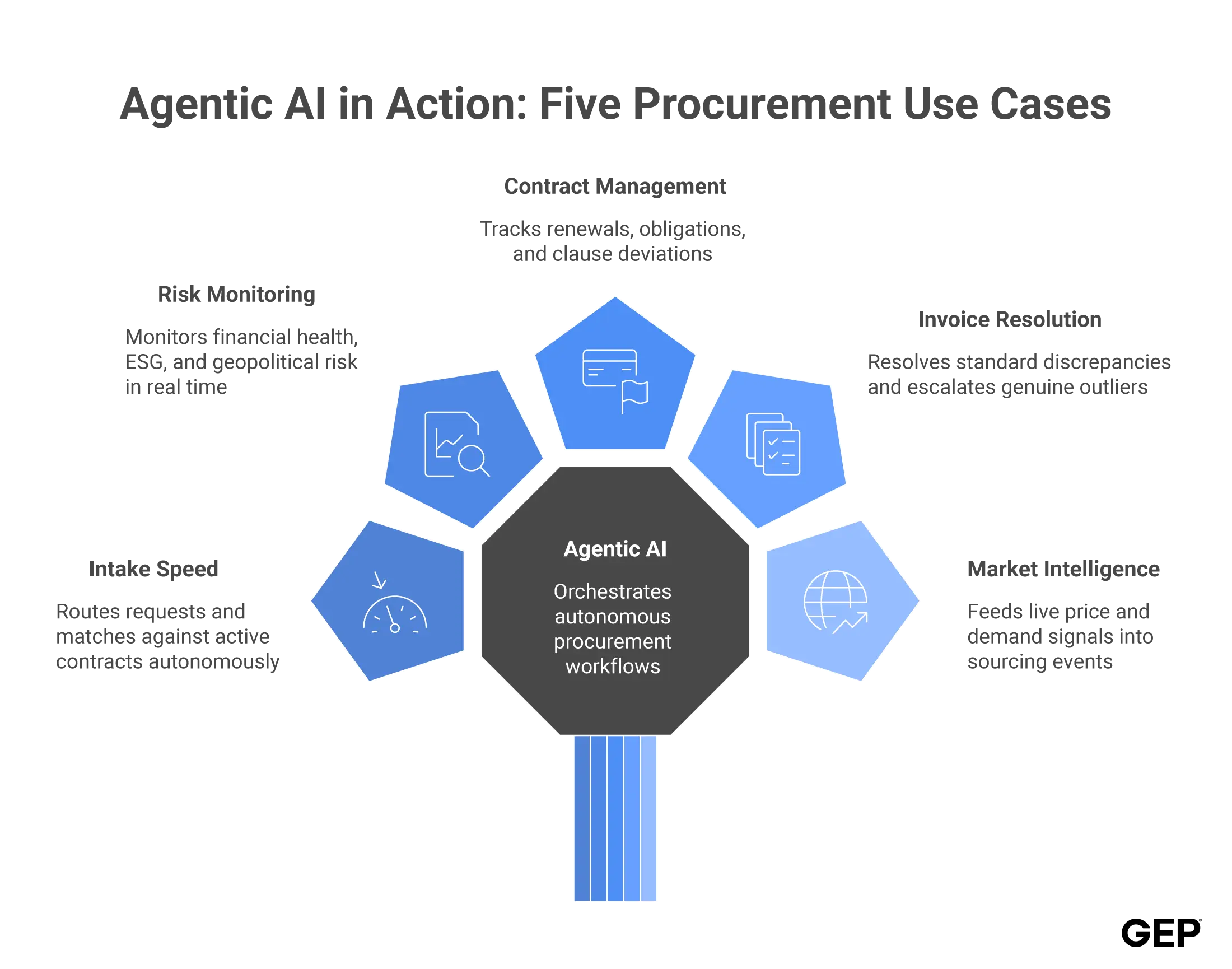
The shift is already visible in early-adopter organizations. Key areas where agentic AI is generating measurable impact include:
Intake and triage
Rather than funnel every request through a human queue, bots classify incoming demands, match them against active contracts or catalog possibilities, and push only truly non-standard ones into sourcing. As a result, procurement teams enjoy speedier reaction times and a lighter operational workload.
Supplier risk monitoring
Static quarterly evaluations of outdated data are being replaced with continuous surveillance. Agents monitor real-time financial health signals, ESG ratings, and geopolitical events by presenting alarms with recommended actions.
Contract lifecycle management
Missed renewal deadlines. Clause deviations go undetected. There is no place for teams to track obligations. Agentic AI closes all three, auto-flags concerns, and ties them directly to spend data so category managers may act before exposure rises.
Invoice exception resolution
Matching invoices to purchase orders and goods receipts is a tedious process that rarely involves real judgment. Agents may autonomously handle normal cases and only escalate outliers for human review, freeing up finance and procurement bandwidth for the decisions that matter.
Market intelligence and benchmarking
Static category reviews are based on conditions that were in place months ago. Agentic AI integrates live price data and demand signals straight into sourcing events so teams bargain on current market reality, not obsolete assumptions.
Ready to Build an AI-Native Procurement Function?
Talk to GEP's procurement experts and explore how agentic AI can reshape your operating model at enterprise scale.
The Change Management Hurdle: Transitioning from Task to Strategy
The technology is ready. The harder work is organizational.
Procurement professionals who have spent years managing supplier relationships, running RFPs, and chasing approvals face a genuine role transition. Agentic AI does not eliminate these skills; it elevates where they get applied. The analyst who spent three days building a spend cube now has three days to interpret it, challenge assumptions, and drive category strategy.
Organizations that invest in this transition early, reskilling teams around judgment, governance, and strategic supplier engagement, will unlock the full productivity benefit of agentic AI. Those who wait for role clarity to arrive from technology itself will fall behind.
Reimagining Procurement as an Outcome-Driven Engine
The procurement function that relies on human capacity to execute routine workflows at scale cannot compete in a market where AI-native organizations are processing thousands of transactions, monitoring hundreds of suppliers, and adjusting sourcing strategies in near real time.
Agentic AI does not replace procurement expertise. It removes the friction between expertise and outcomes, allowing procurement to operate with the speed, consistency, and intelligence that enterprise performance now demands.
The organizations that move now, rebuilding their operating models around agentic orchestration and AI-native platforms, will redefine what it means for procurement to create value.
If you want to explore how to operationalize this at scale across your function, get in touch with GEP.


FAQs
It shifts the focus from task execution to judgment and oversight. Routine activities, classification, matching, routing, and monitoring are handled by agents. Procurement professionals spend more time on supplier strategy, risk interpretation, and cross-functional alignment, where human expertise creates the highest return.
The highest-impact areas include intake orchestration, supplier risk monitoring, contract lifecycle management, invoice exception resolution, and dynamic sourcing intelligence. Together, these cover the full procure-to-pay lifecycle and replace reactive, manual processes with continuous autonomous execution.
By operating continuously across systems and data sources, agentic AI compresses cycle times, improves compliance, and surfaces decision-relevant intelligence without waiting for human initiation. The result is faster savings realization, stronger supplier governance, and a procurement function that responds to market change in real time rather than in quarterly reviews.