


How Agentic AI Is Challenging Traditional Procurement ROI Frameworks
- Agentic AI generates value through autonomous decisions, and not just process automation.
- Traditional ROI models tend to overlook gains such as risk avoidance and business resilience.
- CPOs and CFOs need new frameworks to measure procurement outcomes in the agentic era.
June 25, 2026 | Procurement Strategy 4 minutes read
Procurement teams have long justified technology investments using a familiar formula — reduce manual effort, shorten cycle times, and also lower operating costs. That math was relatively simple because traditional systems followed predefined rules. Agentic AI however changes that logic.
Unlike workflow automation, agentic systems have that capability to assess situations, make recommendations, initiate actions, and adapt as conditions change.
The challenge is not adoption. It is measurement.
Many organizations still evaluate AI investments using frameworks built for automation projects. Those models capture efficiency gains. They miss much of the value agentic AI creates. And procurement leaders can clearly see potential beyond basic automation.
The Path to Autonomous Procurement
Explore how AI-native S2P platforms enable orchestration and agentic execution for 1.5–2.5x higher ROI over time
Limitations of Legacy Procurement ROI Frameworks
Most procurement ROI frameworks focus on measurable operational improvements, including:
- Reduced processing costs
- Faster sourcing cycles
- Lower transaction volumes
- Increased productivity
- Cost savings
These metrics still matter. But they just tell an incomplete story.
A supplier disruption avoided rarely appears in a savings report. Revenue protected through faster sourcing decisions often sits outside procurement scorecards. Improved resilience is difficult to fit into a traditional ROI calculator.
All of these create a disconnect.
Despite waking up every day to the reality of technology influencing business outcomes, procurement continues measuring it through operational metrics designed for a different era.
From Rules-Based Automation to Autonomous Execution
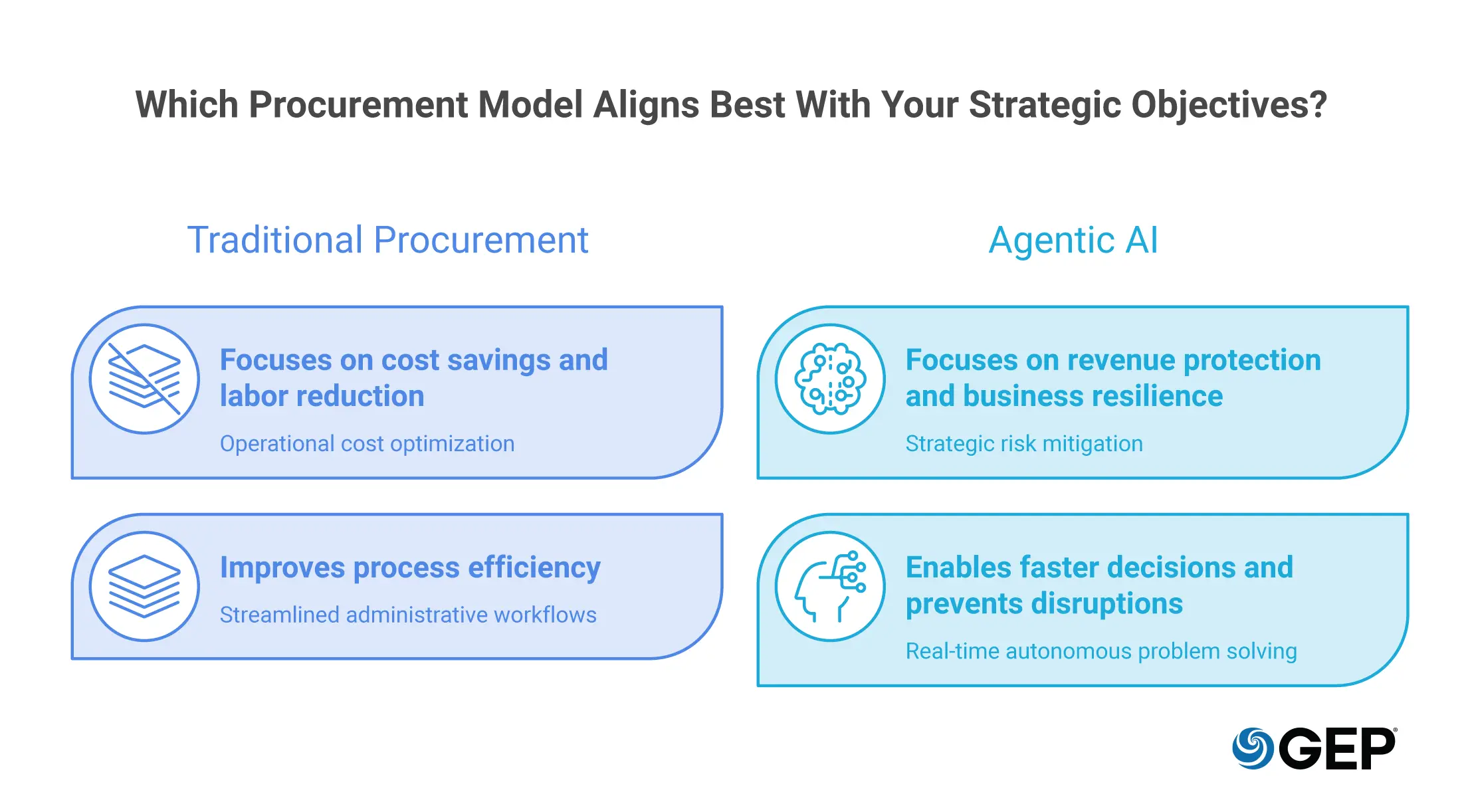
Traditional automation looks for instructions, while agentic AI works toward objectives.
A conventional procurement system may flag a supplier risk issue. A procurement professional reviews the alert, gathers information, and decides what to do next.
An agentic system, on the other hand, can identify the issue, assess business impact, evaluate alternative suppliers, prepare sourcing events, and recommend corrective actions.
The distinction matters — because value shifts from task completion to decision execution.
Organizations start seeing benefits in resilience, agility, and business continuity. Those outcomes often carry greater financial significance than labor savings alone.
Procurement technology now influences decisions that affect operations, suppliers, inventory, as well as revenue.
Key Dimensions Where Agentic AI Breaks Traditional ROI Math
Several value drivers sit outside conventional procurement calculations — such as risk avoidance, decision velocity, spend coverage, and cross-functional impact.
Risk Avoidance
Traditional ROI models reward realized savings.
Agentic AI often creates value by preventing losses. Early identification of supplier failures, compliance issues, or market disruptions can protect production and revenue.
Most ROI frameworks struggle to quantify that impact.
Decision Velocity
Procurement delays can create downstream consequences. Production schedules, inventory levels, and customer commitments are all likely to be affected.
Agentic systems compress decision cycles by gathering data, evaluating options, and presenting recommendations quickly.
The financial benefit clearly extends well beyond procurement.
Spend Coverage
Many teams focus on strategic spend while tail spend receives limited oversight.
Agentic AI enables broader coverage without adding headcount. Compliance improves, leakage falls, and more spend comes under management.
Cross-Functional Impact
Procurement rarely operates in isolation.
Disconnects between procurement and supply chain functions are now known to contribute to higher costs, longer cycle times, as well as weaker resilience. Procurement orchestration can help close those gaps through shared visibility and coordinated decision-making.
Traditional procurement ROI models rarely capture these enterprise-wide gains.
Explore GEP’s - Procurement Transformation Services
Why CPOs and CFOs Are Rethinking Value?
The conversation is changing. A few years ago, technology investments were often justified through productivity improvements.
Today, executives are asking different questions. Can we reduce supplier risk? Can we respond faster to disruption? Can we protect margins during market volatility?
Agentic AI directly affects those outcomes.
CPOs view it as a way to extend procurement's influence. CFOs see opportunities to reduce volatility and improve business resilience. Bottom line — neither group is focused solely on transaction efficiency anymore.
Lead with Agentic AI
Drive smarter procurement and resilient supply chains through enterprise-proven technology
Blueprint for an Advanced, Agentic-Ready ROI Framework
Procurement leaders need a broader lens. A modern framework should include:
Efficiency metrics for cycle time reduction, productivity improvements, and automation rates.
Risk metrics for avoiding supplier disruptions, preventing compliance incidents, and reducing contract leakage.
Decision metrics for response speed, time-to-decision improvements, and forecast accuracy.
Business metrics for revenue protection, working capital improvements, and margin preservation.
The goal is not to replace traditional procurement metrics. It is to supplement them with measures that reflect how autonomous systems contribute to business performance.
Conclusion: Why Agentic AI Forces a Rethink of Procurement Value Measurement
Procurement ROI frameworks were built for systems that executed instructions. Agentic AI does more than that. It helps prevent disruptions, accelerates decisions, broadens spend coverage, and improves coordination across functions. Those outcomes affect far more than procurement operations.
Companies that continue evaluating agentic AI through traditional savings models risk understating its contribution. Technology is changing how procurement operates. The measurement framework needs to catch up.



FAQs
Most legacy ROI calculators focus on labor savings, process efficiency, and transaction costs. Agentic AI creates additional value through risk avoidance, faster decision-making, stronger resilience, and better cross-functional coordination. Those outcomes rarely fit into traditional procurement calculations.
No. Existing procurement metrics remain relevant. Organizations should continue tracking savings, cycle times, and compliance while adding measures for risk reduction, decision quality, business continuity, and operational resilience.
CPOs can combine traditional efficiency metrics with indicators such as disruptions avoided, revenue protected, supplier risks mitigated, contract leakage reduced, and improvements in working capital or margin preservation. Together, these provide a more complete picture of agentic AI's impact.