


How AI Copilots in Procurement Act as a Bridge Between Generative and Agentic Intelligence
- AI copilots prepare procurement for agentic AI by connecting data, decisions, and workflows.
- Human supervision builds the trust and governance autonomous agents need to act safely.
- Procurement autonomy is a journey: copilots enable the transition, not a shortcut around it.
September 15, 2026 | Automation 6 minutes read
You've probably noticed that everyone in procurement is suddenly talking about agents. But before your function gets to full autonomy, there's a quieter, more important shift happening: the rise of the copilot. Here's why that middle step matters more than the hype suggests.
Want to See How Leaders Are Moving From Automation to Autonomy?
Get the Agentic AI Playbook to embed intelligent autonomy into procurement
Clearing the Confusion: Generative Assistants vs. Interactive Copilots vs. Autonomous Agents
Let's untangle the jargon first, because it's genuinely confusing right now. A generative assistant is the simplest layer: you ask it something, it drafts text or summarizes a document, and that's the end of the interaction. Think of it as a smart typist sitting next to you.
A copilot is a step up. It doesn't just respond; it works alongside you inside your actual procurement systems, pulling live data, flagging risks, suggesting next actions, and remembering context across a task. It's interactive, not just generative; you're still driving, but it's reading the map and calling out turns.
An autonomous agent goes further still. It can plan a multi-step workflow, make decisions within defined boundaries, and execute actions like issuing a purchase order or routing a contract for approval, all without you clicking through every step. The key difference isn't intelligence; it's who holds the steering wheel. Copilots assist your judgment. Agents act on your behalf, within guardrails you set.
The AI Copilot as a Data Translator: Building the Infrastructure for Autonomous Networks
Here's something people miss: agents can't function well in messy data environments. They need clean, structured, connected information to make reliable decisions. That's where the copilot earns its keep long before autonomy ever enters the picture.
Every time a copilot pulls supplier data from one system, reconciles it against a contract in another, and presents you with a unified view, it's quietly doing translation work. It's converting fragmented, siloed procurement data into something structured and machine-readable. That structured layer becomes the foundation an agent will eventually rely on to act independently. Skip this step, and you're asking an agent to make autonomous decisions on top of the same broken spreadsheets and disconnected systems that have plagued procurement for years. The copilot phase isn't a detour on the way to agentic AI; it's the plumbing that makes agentic AI possible at all.
Why Procurement Can't Jump Straight to Full Autonomy
It's tempting to want to skip ahead. Full autonomy sounds efficient, and vendors love to pitch it. But procurement carries real financial, legal, and supplier-relationship risk, and handing that over to a system with no track record is asking for trouble.
Think about it from a trust standpoint. Would you let a new hire approve a six-figure contract on day one? Of course not. You'd watch them work, correct their judgment a few times, and gradually extend more responsibility. Copilots let you do exactly that with AI. You see its recommendations, you approve or override them, and over time you build confidence in where it's reliable and where it still needs your eyes on it. Jumping straight to autonomy skips that trust-building entirely, and in a function where a single bad contract clause or missed compliance flag can cost real money, that's a gamble most CPOs shouldn't take.
From Assisted Decisions to Autonomous Execution: How Human Supervision Trains Agentic Logic
There's a practical mechanism at work here too, not just a risk argument. Every time you accept, reject, or tweak a copilot's suggestion, you're generating a feedback signal. Multiply that across thousands of sourcing events, contract reviews, and invoice approvals, and you get a rich dataset of human judgment applied to real procurement scenarios.
That's exactly the kind of data agentic logic needs to mature. It's how a system learns which supplier risk flags actually matter to your business, which contract terms you'll never compromise on, and which invoice discrepancies are worth escalating versus auto-resolving. Your day-to-day interactions with a copilot aren't just getting your work done faster; they're quietly training the decision logic that autonomous agents will eventually rely on. Supervision today is what earns the system permission to act independently tomorrow.
Inside the S2P Transition: Sourcing, Contracts, and Payments in Practice
Let's make this concrete across the source-to-pay cycle. In sourcing, a copilot can analyze RFP responses, benchmark pricing against market data, and recommend a shortlist, but you still make the final call on supplier selection. In contracting, it can redline clauses against your playbook and flag deviations, while you decide what's negotiable. In payments, it can match invoices to POs and catch discrepancies, but you approve the exceptions.
As trust builds in each of these areas, the handoff shifts. Routine, low-risk sourcing events might move to agent-led execution first, since the downside of a small stationery order going slightly wrong is minimal. Complex contract negotiations and high-value payments will likely stay copilot-assisted much longer, because the stakes are higher and the judgment calls are subtler. S2P won't flip to full autonomy in one motion; it'll happen unevenly, category by category, as each area proves itself.
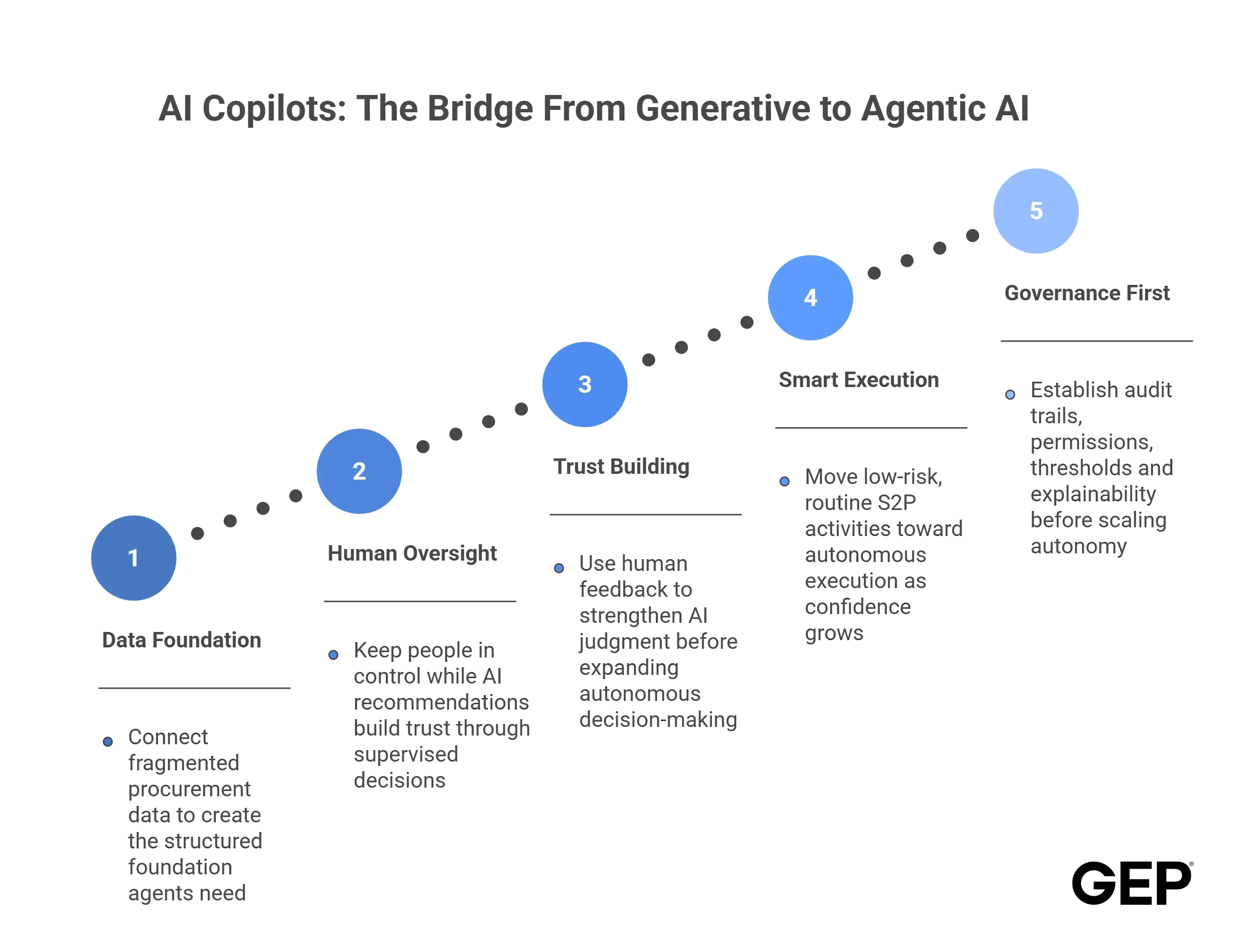
AI Copilots: The Bridge to Agentic Procurement
See how AI copilots bridge generative and agentic AI in procurement
Governance First: Keeping Humans in Control as Copilots Gain Autonomy
None of this works without governance built in from the start, not bolted on later. That means clear audit trails showing why a system recommended what it did, defined thresholds for when a decision needs human sign-off, and role-based permissions so autonomy expands only where you've explicitly allowed it.
It also means treating explainability as non-negotiable. If you can't trace why an AI system flagged a supplier as high risk or approved a payment, you can't defend that decision to a regulator, an auditor, or your own CFO. Good governance isn't a brake on progress; it's what lets you extend autonomy with confidence instead of crossing your fingers. The procurement leaders who get this right are the ones building governance frameworks now, while copilots are still in the loop, rather than scrambling to retrofit controls once agents are already making live decisions.
What This Means for Procurement Leaders Right Now
If you're a CPO or a procurement director reading this, the practical takeaway is simple: don't wait for agentic AI to be "ready" before you act. Start using copilots now, in real workflows, with real data. That's how you build the clean data foundation, the trust calibration, and the governance muscle that autonomous execution will eventually depend on.
Treat this as a maturity curve, not a light switch. Map out which categories in your S2P process are lowest risk and highest volume; those are your best candidates for early agentic pilots once your copilot has proven itself there. Everywhere else, let the copilot keep doing what it does best: making you faster and sharper while it quietly builds the case for how much more it can eventually be trusted to do on its own.
Conclusion
AI copilots aren't a stopgap on the road to agentic procurement; they're the bridge itself. They clean your data, calibrate trust, and build governance muscle, all while making your daily work easier. Skip that bridge, and full autonomy has nowhere solid to land.



FAQs
No. A copilot assists your decisions by surfacing insights and recommendations while you remain in control. An agent can independently plan and execute multi-step tasks, like issuing a PO, within boundaries you've set, without needing your approval at every step.
Agents need clean, structured data and proven trust to act reliably. Copilots build both by organizing fragmented data and letting you calibrate confidence through supervised, everyday decisions before handing over full execution authority.
Look at data quality and system connectivity, governance and audit capabilities, explainability of recommendations, and how well the tool fits existing S2P workflows. Also assess which categories carry low enough risk to pilot autonomy first.
It translates raw generative output into structured, contextual recommendations grounded in live procurement data, then captures human feedback on those recommendations. That feedback loop trains the judgment and data foundation agentic systems later rely on to act independently.
Supplier risk analysis, RFP and bid comparison, contract redlining against playbooks, invoice-to-PO matching, and spend analytics. Each builds a track record of reliable, supervised decisions that can gradually shift toward autonomous execution over time.