


The Procurement Leader's Guide to AI-Driven Spend Analytics
- AI-driven spend analytics is not just another software upgrade or dashboard feature refresh that is a ‘nice-to-have’.
- It’s a core shift in leadership infrastructure that will drive changes in global supply outcomes before disruptions hit.
- The real value of data lies not in adopting more and newer technology, but in the value captured through workflow-embedded analytics.
May 18, 2026 | Digital Supply Chain Transformation 7 minutes read
Procurement leaders have more data now than they could’ve ever imagined a decade ago, yet they are making fewer data-driven decisions than ever. Research confirms that only 4% of procurement functions consistently use data and analytics to drive decisions. An overwhelming majority of strategic choices are still shaped by intuition, institutional habit, and organizational pressure rather than hard evidence.
Most leaders assume there’s a technology gap and invest in more tools and visualization layers, only to watch the needle barely move. What research consistently shows is that technology alone accounts for roughly 9% of the total value generated from data and analytics, meaning you are likely spending your budget solving the wrong problem entirely.
The deeper issue is that insights are produced in isolation, completely disconnected from the workflows where decisions are actually made. And until that changes, your analytics investment will continue to underperform, regardless of how sophisticated your tools become.
This guide gives you a clear, strategic view of where AI-driven spend analytics stands today and how procurement leaders can move toward fully autonomous, action-oriented intelligence.
Your Analytics Is ‘Backward-Looking’ by Design
There is a structural flaw in how most spend analytics tools were originally built. They were designed to tell you what happened, not what should happen next.
Analytics use tends to be ad hoc, driven by the habits of individual buyers rather than consistently embedded across the function. Some people check the data; others never do. There is rarely a defined cadence, a shared framework for interpretation, or a structured pathway from insight to action. The result is noise dressed up as intelligence, and a senior leadership team that has lost confidence in procurement's ability to translate data into commercial outcomes.
This is the insight-action gap, and it’s the root cause of underperformance in spend analytics programs across virtually every sector and organization size.
Analytics that cannot be translated directly into procurement decisions will always fall short, regardless of the underlying technology.
Scale Operations with an Integrated Digital Supply Chain
Align global sourcing and logistics into a single, high-performance engine
Critical Barriers Standing Between You and Autonomous Analytics
If AI is the obvious solution, why have so many initiatives been living in a coma? The answer lies in seven distinct barriers that most organizations stumble over more from time to time.
Data quality and Availability
When nearly three-quarters of chief data officers report spending more than a quarter of their time just preparing data for reporting, you can see how little bandwidth remains for actual analysis.
Without clean, standardized, and consistently categorized spend data, even the most advanced AI models produce unreliable outputs and lose credibility fast.
Integration and Legacy Systems
More than half of procurement professionals identify them as a primary barrier to data quality. Spend data trapped across disconnected ERP environments, procurement platforms, and supplier portals means no single system ever has the full picture.
Beyond the technical hurdles, you are also dealing with a shortage of domain expertise in AI, governance, and risk concerns around autonomous decision-making, fragmented sponsorship from executive leadership, and deep-seated cultural resistance to changing how procurement work gets done.
None of these barriers is insurmountable, but all of them require an honest assessment before a realistic transformation plan can be built.
Where the Real Value Is Hidden
Here is the finding that should fundamentally reshape how you think about your analytics investment.
Of all the factors that drive value from data and analytics, workflow-embedded analytics accounts for 42% of total captured value, more than any other single element. talent contributes 30%, data access and quality account for 18%, while technology contributes just 9%.
Read that hierarchy carefully. It tells you that the returns you are chasing are not locked inside your technology stack but rather lie in the cracks between your current analytics setup and the operational processes (where your team makes sourcing, contracting, and supplier management decisions).
When analytics becomes embedded in the daily workspace, it begins delivering sustainable, compounding value.
This also reframes where investment should go. Building AI capability in your team and designing workflows that make data-driven decisions the path of least resistance will consistently outperform spending on additional data infrastructure or more powerful visualization layers.
From Predictive to Agentic: The Four Stages of AI Maturity
The evolution of spend analytics follows a predictable maturity curve and that determines what your next move should be.
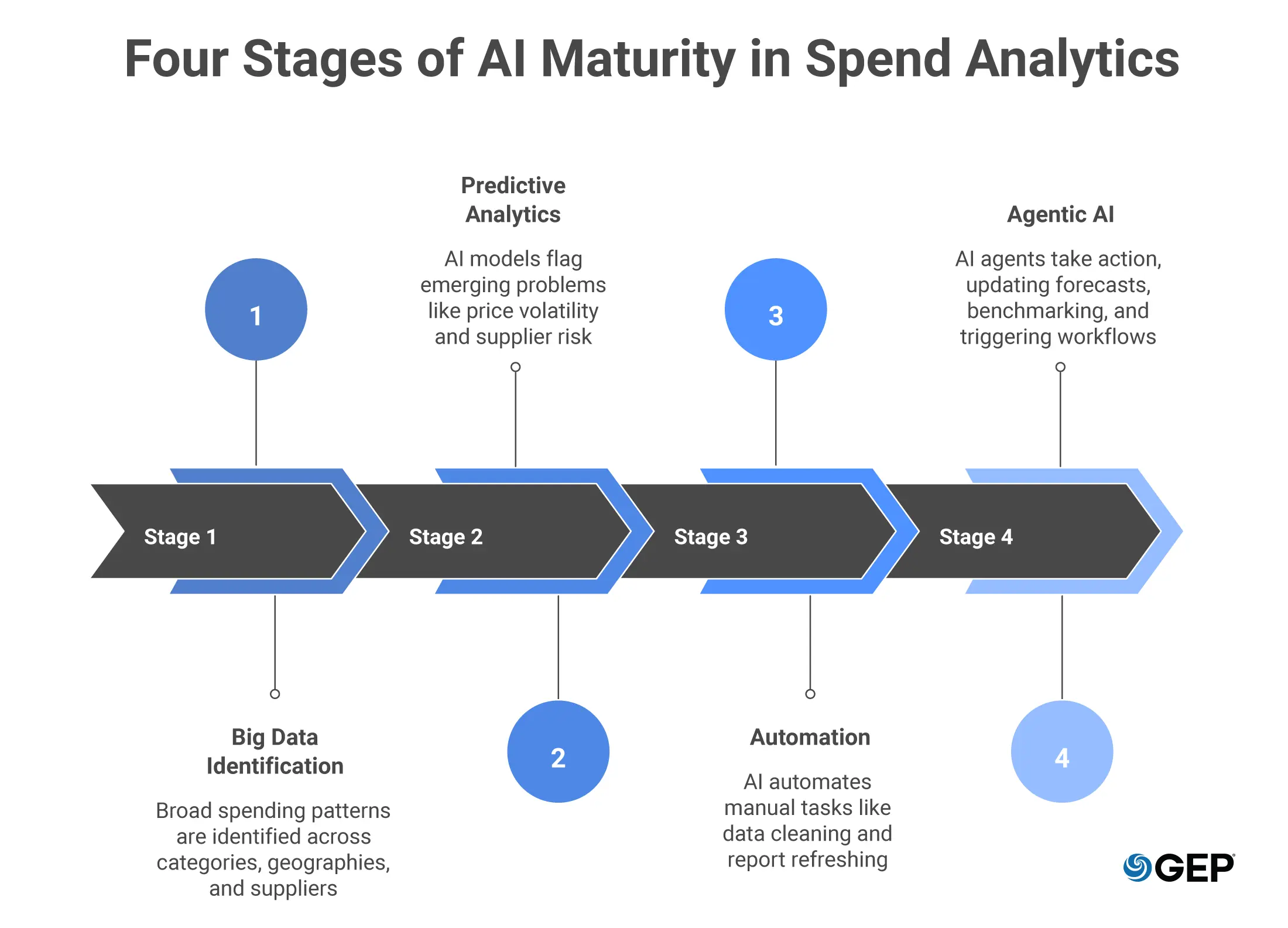
Stage 1: Moving from small data to big data
The goal here is simply identifying broad spending patterns across categories, geographies, and supplier relationships.
Stage 2: Predictive analytics
AI models begin flagging emerging problems before they materialize, alerting you to commodity price volatility or supplier concentration risk before they hit your P&L.
Stage 3: Automation
A massive chunk of manual work, like data cleaning, pipeline management, and report refresh cycles, is taken over by AI automation, freeing your team for higher-value analysis and strategic work. Most organizations today are operating somewhere in stages one through three.
Stage 4: Agentic AI
It is where the real digital AI transformation comes alive and becomes more visible. Agentic AI does not just surface insights and wait for a human to act. It takes action.
Picture a procurement taskforce operating continuously in the background: one AI agent updates cost forecasts in real time, another benchmarks your internal spend against external market rates, a third identifies alternative sourcing options when a supplier relationship deteriorates, and a fourth triggers a sourcing workflow automatically when costs breach a defined threshold.
The architecture for multi-agent collaboration of this kind exists today, and the procurement leaders building toward it now are establishing a compounding advantage over those still debating whether to invest.
What This Means for Your Role and Your Team
With agentic AI, you are rebuilding how intelligence flows through your entire function.
The work shifts from executing individual tasks to managing how the work gets done at scale, which requires a fundamentally different and considerably more strategic skill set.
Your team will need to develop competencies around reviewing AI-generated actions for accuracy and strategic alignment, setting the escalation thresholds that determine when a human judgment call is required, and continuously calibrating AI behavior to reflect your organization's evolving risk tolerance and commercial priorities.
This is governance work and systems-level strategy, which is a significant upgrade from manual data preparation and report formatting.
The Agentic AI Playbook for Procurement Pros
Your roadmap to move from pilots to production, with AI that adapts, learns, and delivers
Six Steps to Operationalizing AI-Driven Spend Analytics
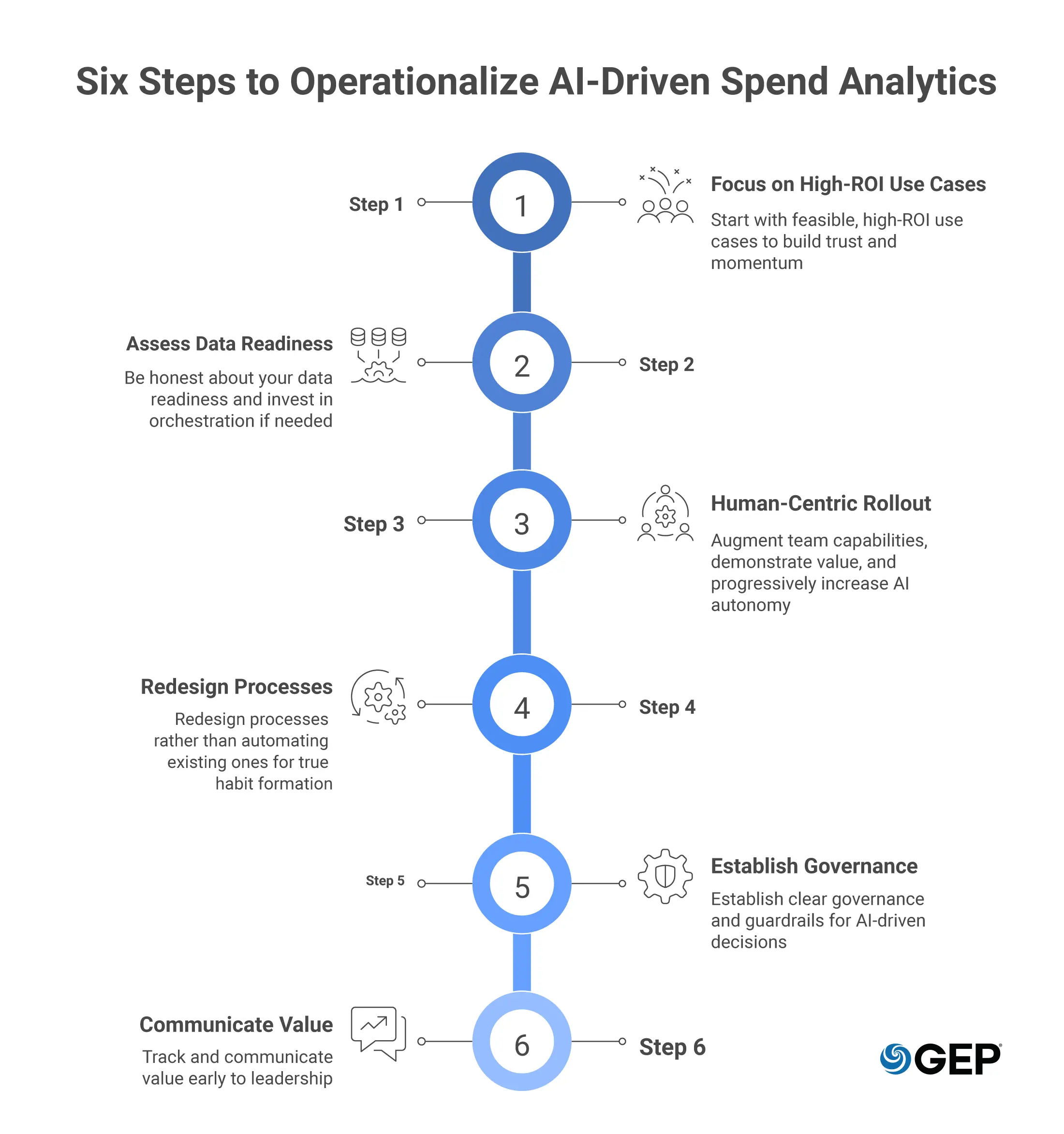
1. Start with feasible, high-ROI use cases
Resist the impulse to fix everything at once. A focused win in a single category or spend domain builds internal trust and creates the organizational momentum needed for larger initiatives to gain leadership support.
2. Be honest about your data readiness
If your spend data is fragmented across systems, the first infrastructure investment you need is an orchestration layer that unifies it before you attempt to feed it into AI models. Skipping this step is one of the most expensive mistakes procurement organizations make.
3. Adopt a human-centric rollout
Augment your team's capabilities first, demonstrate measurable value, and then progressively increase the level of AI autonomy as reliability and trust are established over time.
4. Redesign your processes rather than automating existing ones
Analytics only becomes a habit when it is embedded in the daily workspace. Bolting AI onto a workflow that was designed without it produces marginal gains at best and organizational frustration at worst.
5. Establish clear governance and guardrails
A single bad AI-driven decision can erase the value created by dozens of good ones, so your escalation protocols, decision thresholds, and audit trails need to be as robust as the AI itself.
6. Track and communicate value early and consistently
If the impact of your AI investment is invisible to executive leadership, your ability to scale the program disappears with it. Telling the story of the data is not a communications task. It is a strategic imperative.
What Comes Next (and What You Must Do Today)
AI-driven spend analytics will achieve greater autonomy and faster execution and bring more strategic leverage to the functions that lay the right foundations.
The procurement function will increasingly resemble a strategic intelligence operation. Agentic AI systems will autonomously handle an expanding range of sourcing, forecasting, benchmarking, and compliance tasks. Companies will invest in clean data infrastructure, embedded workflows, and AI-capable talent, who will set the standard for everyone else.
Starting with an honest assessment of where analytics is currently disconnected from decision-making and building systematically from there will compound your advantage year over year.
Will your organization lead the next big wave in procurement transformation, or will you spend the next five years responding to problems caused today?
If you’re investing in AI for spend analytics or want insights that influence sourcing, supplier strategy, and cost decisions, this GEP report is essential reading.




FAQs
Predictive analytics identifies patterns and surfaces recommendations for human review, such as flagging a likely cost overrun in a specific category before it materializes. Agentic AI goes further by taking autonomous action based on those insights, executing sourcing workflows, benchmarking rates, or triggering supplier outreach without waiting for manual input. The distinction is the difference between intelligence that informs and intelligence that acts.
Analytics tools are deployed without integration into the workflows where most day-to-day procurement decisions usually occur. When insights live in a separate dashboard rather than within the decision process itself, adoption remains low, and the gap between data and action never closes. The issue is almost never the technology, but the absence of workflow strategies redesigned around it.
Effective governance starts with defining clear decision thresholds that determine when an AI agent can act autonomously and when it must escalate to a human for review. Audit trails, escalation protocols, and regular calibration of AI behavior against current business priorities are the foundational elements of a framework that enables autonomy without sacrificing accountability or control.