



Why AI Is Turning Memory Into a Strategic Procurement Category
- AI demand is reshaping the global memory market.
- HBM growth is tightening DRAM supply and increasing costs.
- Procurement needs stronger forecasting, sourcing, and supply assurance.
October 06, 2026 | Automation 6 minutes read
For years, the AI race has been defined by compute. More powerful processors have enabled larger models, faster training and increasingly sophisticated AI applications. But as AI infrastructure scales, another constraint is becoming harder to ignore: memory.
AI systems need enormous amounts of memory to move data between processors and storage fast enough to keep compute resources fully utilized. That is driving demand for high-bandwidth memory (HBM), a specialized form of DRAM designed to deliver the bandwidth required by modern AI accelerators.
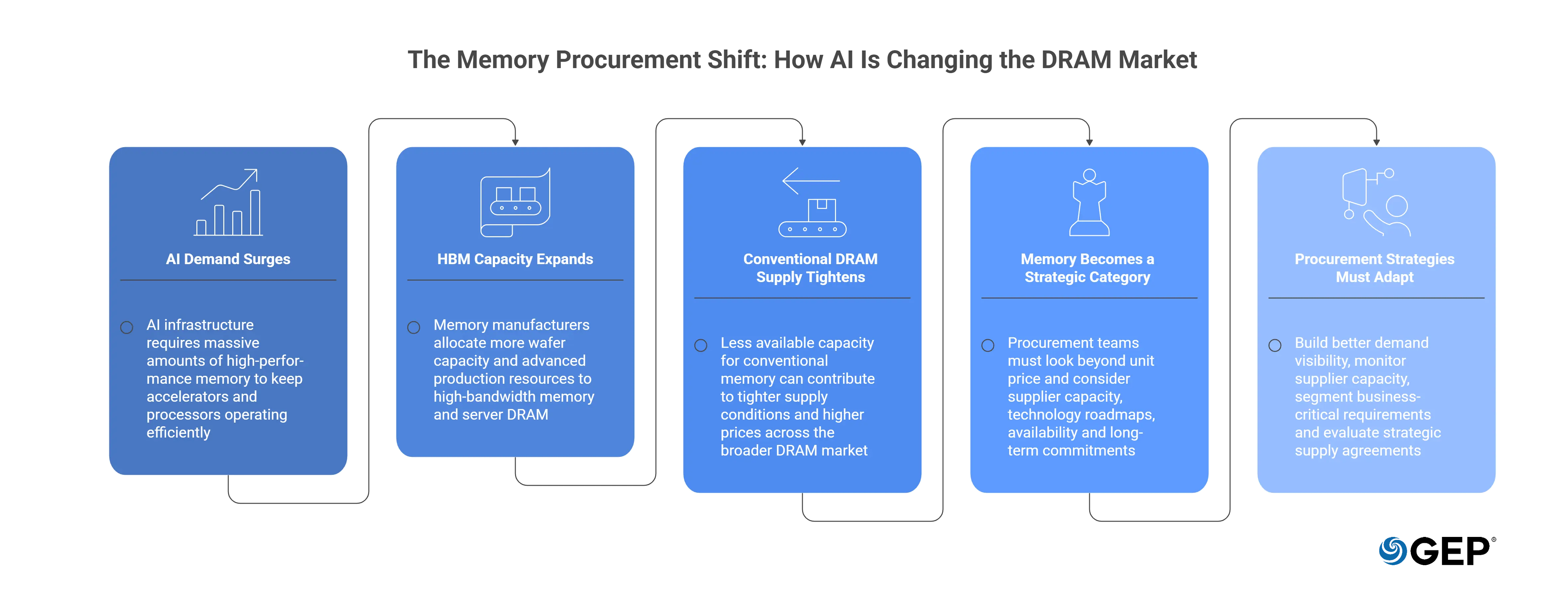
The impact is reaching beyond HBM itself. As memory manufacturers dedicate more production capacity to HBM and server DRAM, less capacity is available for conventional memory products. TrendForce expects AI-driven demand and HBM production to continue putting pressure on conventional DRAM supply, contributing to higher prices and tighter market conditions.
For procurement leaders, this changes the memory category in an important way. DRAM has traditionally been treated as a highly competitive, price-driven commodity. Increasingly, however, availability, supplier capacity and long-term commitments are becoming just as important as unit price.
AI Is Changing the Economics of Memory
Modern AI workloads are fundamentally different from many traditional enterprise applications. Large models contain billions or even trillions of parameters, while inference workloads can involve continuous movement of data between processors and memory.
That makes both memory capacity and bandwidth critical to performance.
HBM addresses the bandwidth challenge by placing memory closer to AI accelerators and enabling substantially faster data movement than conventional server memory. At the same time, DDR5 remains an important memory technology across AI servers and host systems, while DDR4 continues to support a large installed base of enterprise servers, networking equipment, telecommunications infrastructure and industrial systems.
The result is a more interconnected memory market. AI infrastructure does not operate in isolation from the rest of the technology ecosystem. The same manufacturing base ultimately supports multiple generations and types of memory products.
As AI demand grows, manufacturers therefore have to make increasingly strategic decisions about where to allocate production capacity.
That is where the procurement implications begin.
How High-Growth Firms Can Catch Up Now with AI?
Download this whitepaper to learn the latest insights
HBM Is Reshaping the Broader DRAM Supply Equation
HBM is itself a form of DRAM, but producing it requires significant wafer capacity and advanced manufacturing and packaging capabilities. As demand for AI accelerators increases, memory suppliers are directing more resources toward HBM and high-end server memory.
TrendForce has reported that the growing wafer consumption associated with HBM production is squeezing capacity available for conventional DRAM. It expects this pressure to support stronger supplier pricing power and elevated pricing momentum.
The effect is already visible in the market. TrendForce forecast conventional DRAM contract prices to rise by 13% to 18% quarter over quarter in the third quarter of 2026, following substantial increases earlier in the year.
For businesses that do not operate AI data centers, this may seem like someone else's problem. It isn't.
Enterprise servers, networking equipment, storage platforms, telecommunications systems and industrial technology all depend on the same global memory supply chain. When manufacturers shift capacity toward higher-value AI products, buyers of conventional memory can face higher prices and tighter availability even if their own workloads have nothing to do with AI.
Also Read: Mitigating Hardware Supply Chain Risk
Memory Procurement Is Becoming More Strategic
This is changing the traditional procurement model.
Historically, memory buyers could focus heavily on price benchmarks, supplier competition and short-term purchasing cycles. Those tools remain important, but they are no longer enough when supply itself becomes a strategic variable.
Memory manufacturers are increasingly looking for greater visibility into future demand. Micron, for example, has secured $22 billion in commitments through strategic customer agreements that include mechanisms such as take-or-pay provisions, cash deposits and pricing floors. Samsung has also been pursuing multi-year supply agreements with major data center customers as the memory market remains tight.
These arrangements signal a broader shift.
Suppliers want demand visibility. Strategic customers want supply assurance. Both sides are increasingly willing to make longer-term commitments to achieve it.
For procurement teams, that creates a different set of questions:
- How much memory will the business actually need over the next 12 to 36 months?
- Which applications are most exposed to supply disruption?
- Which memory requirements justify longer-term commitments?
- How much price flexibility should be traded for greater supply assurance?
- Which suppliers have the capacity and technology roadmap to support future requirements?
The objective is no longer simply to negotiate the lowest price available today. It is to secure the right combination of cost, availability and flexibility over the life of the requirement.
What Procurement Leaders Should Do Now
Build better demand visibility
Memory requirements should be connected to broader technology and infrastructure plans. Procurement teams need visibility into server refresh cycles, AI deployments, data center expansion, networking requirements and other initiatives that could change memory demand.
Better forecasting gives suppliers more confidence while giving procurement teams a stronger position in capacity discussions.
Segment requirements by business criticality
Not every memory purchase requires the same sourcing strategy.
Business-critical infrastructure may justify longer-term supply agreements or capacity commitments. Less critical requirements may retain greater flexibility and continue to benefit from competitive sourcing.
Segmenting demand allows procurement teams to direct strategic attention where a shortage would have the greatest operational impact.
Monitor supplier capacity, not just market prices
Quarterly DRAM prices provide only one view of market conditions.
Procurement teams should also monitor HBM capacity expansion, supplier capital expenditure, wafer allocation, technology transitions, production lead times and major customer commitments.
These indicators can provide earlier signals of tightening supply than price movements alone.
Reconsider strategic supply agreements
Long-term agreements can reduce exposure to sudden shortages, but they also introduce commitments that need to be carefully structured.
Procurement teams should evaluate mechanisms such as volume bands, allocation commitments, pricing formulas, flexibility provisions and alternative sourcing options. The right agreement should provide supply assurance without unnecessarily sacrificing commercial flexibility.
Strengthen cross-functional planning
Memory demand is rarely determined by procurement alone. IT, infrastructure, finance, engineering and business teams all influence future requirements.
Bringing these functions together around a shared demand forecast can help procurement identify future constraints earlier and negotiate from a stronger position.
Turn Memory Risk Into Procurement Advantage
Build resilient sourcing strategies for an AI-driven market
The Memory Market Is Entering a Different Cycle
The memory industry has always moved in cycles: what's changing this time is the nature of the demand driving it.
AI infrastructure is creating sustained demand for high-performance memory, and suppliers are pouring investment into expanding HBM and advanced memory production. TrendForce expects AI-driven demand to keep supporting the memory market as inference becomes more widespread and AI infrastructure keeps expanding.
Conventional DRAM isn't going anywhere either. Enterprises still run servers, networking equipment, telecom infrastructure and industrial systems that depend on established memory technologies; that demand doesn't disappear just because HBM is getting all the attention.
So the procurement challenge doesn't go away as HBM capacity grows. If anything, the market keeps evolving as manufacturers work to balance AI-related demand against everything else the broader technology ecosystem still needs.
For procurement leaders, the takeaway is pretty simple: memory can't be treated as a commodity you just buy when you need it anymore.
AI has turned memory into a strategic supply-chain consideration. Understanding supplier capacity, technology roadmaps, demand trends and commercial structures is going to matter just as much as price negotiation; maybe more.
As AI infrastructure keeps scaling, the organizations managing memory proactively, rather than reactively, will be the ones controlling costs, protecting availability and building real resilience into their technology supply chains.




FAQs
AI workloads require large amounts of high-speed memory to move data efficiently between processors and storage. This is driving demand for HBM and server DRAM, putting pressure on broader memory supply.
HBM production requires significant wafer capacity and advanced manufacturing. As suppliers prioritize HBM and high-end server memory, less capacity may be available for conventional DRAM, contributing to tighter supply and higher prices.
Procurement teams should improve demand forecasting, monitor supplier capacity and technology roadmaps, segment requirements by criticality, and evaluate longer-term agreements that balance supply assurance, cost and flexibility.