How Utility Supply Chains Can Win the AI Race
- AI is already delivering efficiency gains in utility supply chains, but task-level automation and true supply chain orchestration are not the same thing.
- Disconnected planning and procurement data turned the current transformer shortage from a foreseeable supply crunch into a more serious problem.
- Utilities that invest in clean, connected data foundations for their supply chains are building the operating model that lets AI deliver at scale.
August 26, 2026 | Supply Chain Strategy 4 minutes read
Utility supply chain leaders are already using AI. Task automation is delivering real, measurable results; efficiency gains of 50% - 80% on routine sourcing tasks are already being logged at the most progressive organizations.
And yet the sector is awash with challenges. Transformer lead times stretching past two years. Demand surges that were visible years in advance turning into operational emergencies. While the efficiency gains are real, they’re happening at the wrong layer of the supply chain.
Closing that gap is a data problem. And for utilities navigating one of the most complex procurement environments in a generation, solving it is the difference between reacting to the market and leading it.
Is Your Supply Chain Ready for What’s Coming?
Learn how leading utilities are shifting from reactive procurement to connected, AI-native supply chain orchestration.
The Efficiency Gains Are Real — and Incomplete
AI adoption in utility supply chains is not a future state. Routine sourcing tasks, invoice processing, supplier communications, compliance tracking — intelligent automation is already compressing cycle times and reducing manual effort in meaningful ways. For procurement teams managing billion-dollar capital programs, that matters.
But the capabilities that would actually change the game, like anticipatory demand planning, predictive inventory management, or meaningful visibility into tier 2 and tier 3 suppliers depend on a connected, clean data foundation.
Automating individual tasks is not the same as orchestrating across the full supply chain. Task automation reduces friction at specific points in the process, but orchestration changes the process itself, enabling systems to anticipate demand, coordinate across suppliers and respond to change before it becomes a crisis. Most utility supply chains are getting the former. The path to the latter runs through data.
What the Transformer Crisis Actually Tells Us
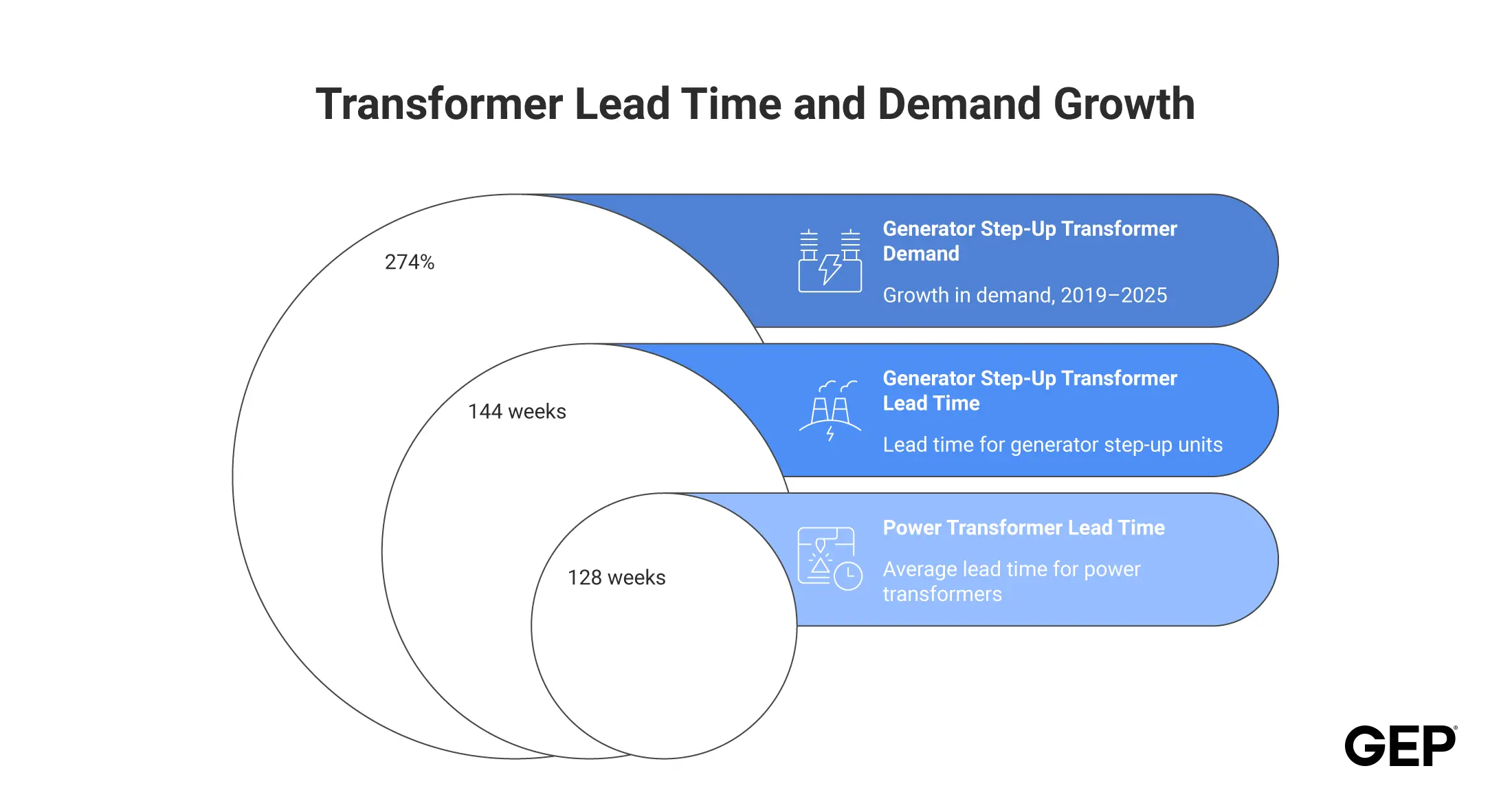
According to reporting by POWER Magazine, power transformers are currently averaging 128 weeks of lead time and generator step-up units 144 weeks. Demand for generator step-up transformers grew 274 percent between 2019 and 2025, driven by data center buildout, industrial electrification and renewable integration. That surge was directionally legible years before it became acute.
The organizations that absorbed it best were the ones whose procurement systems were connected to engineering and planning data early enough to act. With a unified data model connecting supply chain systems, impact from project changes becomes visible in real time rather than weeks later.
Analysis cited by POWER Magazine also suggests that qualification rules and vendor hierarchies at some utilities are preventing access to alternative suppliers who have capacity. The implication here is that organizations with better-connected systems and cleaner data are making faster, better sourcing decisions.
Explore GEP’s – AI-Native Procurement Software
The Data That Already Exists But Is Not Connected
For most utilities, this is not a data creation problem. The information needed to plan better, source earlier and respond faster is almost always already sitting somewhere in the organization, just not connected to the systems that would let it drive action.
Engineering design software holds material-level requirements that procurement never sees until a project is in motion. ERP systems carry supplier performance data that never feeds into sourcing decisions. Capital program timelines live in project management tools with no link to inventory planning. Each system works. None of them talk to each other in a way that lets the supply chain function as a coherent whole.
When system design data flows into procurement planning, when inventory is clean and classified, when supplier relationships function as co-planning platforms — that is when agentic AI can do something qualitatively different. Not automate a task, but orchestrate across the full supply chain.
Why This Is Both a Resilience and a Cost Argument
Data infrastructure work competes for budget against capital programs with more immediate visibility. The payoff is harder to quantify than deploying a new AI tool. That makes it easy to defer. It should not be.
Connected planning data means sourcing ahead of the market, avoiding the premium pricing of emergency procurement, reducing expediting fees and capturing early-payment discounts that tend to slip through the cracks. These are hard cost outcomes, not insurance premiums.
There is also a regulatory dimension that is specific to utilities. Every dollar spent on emergency procurement at premium rates is a dollar that ends up in a rate case. Supply chain organizations that can demonstrate cost discipline through better forecasting and earlier sourcing are making a financial argument that resonates well beyond the procurement function. Reliability and cost discipline stop being competing priorities when the planning horizon is long enough.
Building the Operating Model That Lasts
The efficiency gains from AI are not in question. Utility supply chain teams are already capturing them. But task-level automation and full supply chain orchestration are different things, and the gap between them is not closed by adding more tools.
The transformer crisis is a useful stress test for any supply chain operating model. Organizations that saw it coming and positioned early had something in common: their procurement systems were connected to the planning data that told them what was ahead. That connection is the foundation that lets AI orchestrate, not just automate.
Utilities that build that foundation now are not just better positioned for the next supply crunch. They are defining what supply chain leadership looks like for the decade ahead. The tools are ready. The work now is making sure the data underneath them is too.