


Bill of Lading Types and Errors That Delay Shipments (and How to Fix Them)
- A bill of lading (BoL) is a receipt, a contract of carriage and, in negotiable form, a document of title, so errors on it ripple across customs, payment and delivery.
- Mismatched data, vague descriptions and missing declarations are the most common causes of holds, demurrage and detention charges.
- Digital pre-checks, eBoLs and firm carrier SLAs turn documentation from a delay risk into a safeguard.
October 01, 2026 | Inventory Management 6 minutes read
A container can sit at a port for days because of one wrong digit or a missing endorsement on a single page. The bill of lading is that page. It's easy to treat it as routine paperwork, but it decides whether cargo moves, who owns it, and who pays when something goes wrong.
Understanding the Bill of Lading (BoL) as a Core Legal and Operational Instrument in Logistics
A BoL does three jobs at once. It's a receipt confirming the carrier has taken custody of the goods. It's the contract of carriage, setting out the terms under which the goods travel. And in its negotiable form, it's a document of title, meaning whoever holds the original can claim the cargo.
Because it serves legal, financial and operational purposes together, an error rarely stays contained. A wrong entry can stall a customs filing, hold up a letter of credit payment and trigger storage charges all at once.
The Future-Ready CPO: From Cost Control to Value Protection
Learn how AI-driven risk monitoring and clean data are helping CPOs at P&G, J&J and Schneider Electric protect enterprise value, not just margins.
Why is Bill of Lading Important in Logistics?
Every party in the chain relies on it. Carriers use it to load, route and release cargo. Customs authorities use it to verify what's entering the country. Banks use it to release payment. Consignees use it to collect their goods.
It also acts as the shared record if a dispute arises over damage, shortage or delay. Supply chain leaders increasingly want that kind of shared record. Real-time visibility depends on instant access to accurate information about where goods are and what condition they're in, and paper-based systems and manual tracking are no longer enough for such complex, multi-party networks. A BoL with bad data feeds bad data into everything downstream.
Specialized Bills of Lading for Complex Global Supply Chains
Straight, order and bearer bills cover the basics. But global trade often needs more specialized formats.
Multimodal or Combined Transport BoL
When cargo moves by more than one mode, say truck to rail to ocean vessel, a multimodal BoL covers the whole journey under a single contract. One carrier takes responsibility from origin to final destination, even if it subcontracts individual legs.
That simplifies claims, since the shipper has one party to deal with. The catch is that the handover points between legs need to be documented cleanly. Vague place-of-receipt or place-of-delivery entries are a common source of confusion.
Shipped on Board BoL
A shipped on board BoL confirms the cargo has actually been loaded onto a named vessel, and it carries the loading date. Letters of credit often demand it, because banks want proof that goods are physically on the water rather than sitting on a dock.
A "received for shipment" document doesn't offer that assurance. If a buyer's credit terms call for an on-board notation and the seller presents the wrong document, payment can be refused.
The Financial and Operational Impact of Bill of Lading Execution Errors
A bill of lading error rarely stays a paperwork problem for long. It quickly becomes a cost problem, a compliance problem and a delivery problem. Here's how these errors hit the bottom line and the wider supply chain.
Accumulating Demurrage, Detention, and Terminal Storage Penalties
Once a container arrives, the free-time clock starts. If the BoL is wrong or the originals haven't arrived, the container can't be released, and daily demurrage, detention and storage charges pile up. These fees are small per day and painful over a week.
Customs Holds, Regulatory Insecurities, and UFLPA/Tariff Compliance Audits
Customs relies heavily on BoL data to screen shipments. Vague descriptions or inconsistent details raise flags. Under the Uyghur Forced Labor Prevention Act, importers may be asked to prove where their goods came from, and a thin or inaccurate BoL makes that harder. Tariff classification errors can also trigger audits and back-duty assessments. Regulatory pressure on multi-tier transparency keeps growing, and GEP notes that it's making that transparency more urgent.
Supply Chain Disruption
Delays spread. A held container means a late production run, a missed retail window or a stockout. GEP describes the familiar pattern well: a shipment stalls at a congested port, an alert fires, and a planner scrambles to respond. Many documentation errors are preventable well before that scramble starts.
Unlock GEP’s E-Invoicing Automation Software for Global Finance & Procurement Teams
Critical Document Errors that Cause Severe Shipping Delays
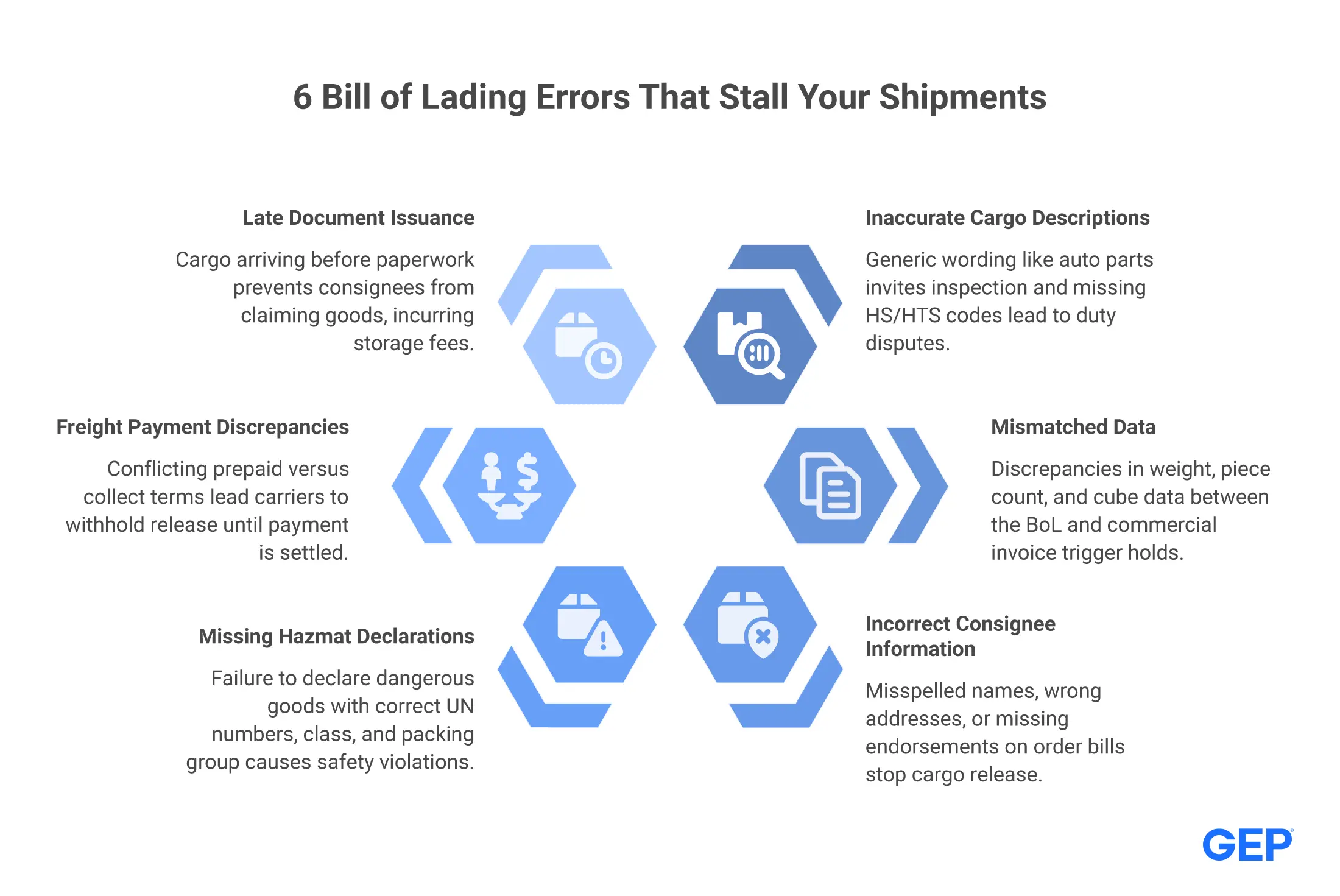
Most BoL delays trace back to a handful of avoidable mistakes rather than rare, complex failures. Here are the six errors that most often hold up cargo, from vague descriptions to late paperwork.
Inaccurate Cargo Descriptions and Missing HS/HTS Tariff Codes
"Auto parts" or "general merchandise" isn't good enough. Customs needs a specific description and, in many jurisdictions, a correct HS or HTS code. Generic wording invites inspection, and wrong codes lead to duty disputes.
Mismatched Weight, Piece Count, and Cube Data Between BoL and Commercial Invoice
Discrepancies between the BoL and the commercial invoice are among the most common triggers for holds. If the invoice says 480 cartons and the BoL says 450, someone has to explain the difference before the cargo moves.
Incorrect Consignee Information or Missing Endorsements on Order Bills
A misspelled consignee name or wrong address can stop release. On an order bill, a missing or improper endorsement means the holder can't prove entitlement. Fixing either usually means amendment fees and days of waiting.
Omission of Hazardous Material (Hazmat) Declarations and UN Numbers
Dangerous goods must be declared with the correct UN number, class and packing group. Leaving these off is a safety violation, and carriers may refuse, hold or return the cargo. Penalties can be steep.
Discrepancies in Freight Payment Terms (Prepaid vs. Collect)
If the BoL says prepaid but the contract says collect, or the reverse, the carrier may withhold release until the payment question is settled. Consignees get surprised by charges they didn't expect.
Late Document Issuance and Arrival Disconnects at the Port of Discharge
Cargo can arrive before its paperwork does, particularly on short sea routes. Late issuance leaves the consignee unable to claim goods that are already in the terminal, and the storage clock keeps running.
Don’t Let Manual Invoicing Slow You Down
Discover how GEP’s e-invoicing solutions streamline compliance, accelerate approvals and reduce risk
How to Standardize and Audit Bills of Lading in Enterprise Operations
Fixing errors one shipment at a time doesn't scale across hundreds of lanes and carriers. Enterprises need repeatable controls that catch problems before documents are issued, starting with pre-vetting checklists and extending to digital formats and carrier commitments.
Implementing Digital Checklists for Pre-Vetting Freight Documentation
Before a BoL is finalized, check it against the purchase order, commercial invoice and packing list. Confirm the consignee, descriptions, codes, weights, incoterms and payment terms. A short digital checklist catches most errors while they're still cheap to fix.
Transitioning to Electronic Bills of Lading (eBoL) under MLETR Compliance Standards
The UNCITRAL Model Law on Electronic Transferable Records (MLETR) gives electronic bills legal footing in adopting jurisdictions. eBoLs remove courier delays, reduce the risk of lost originals and allow data to be validated at entry. Check that your carriers and platforms support them, and that the countries on your lanes recognize them.
Standardizing Carrier and Forwarder SLAs for Rapid Document Generation
Put document turnaround times into contracts. Set deadlines for draft BoLs, correction windows and final issuance relative to vessel cut-off and arrival. Then track performance. Providers who consistently miss deadlines should hear about it.
Conclusion: Transforming Logistics Documentation into a Risk Shield
The BoL isn't just an administrative box to tick. Get it right and shipments flow. Get it wrong and the costs show up as fees, holds and unhappy customers. Enterprises that standardize, pre-vet and digitize their documentation turn it from a point of failure into protection against disruption.




FAQs
The carrier or its authorized agent issues it. In freight forwarding, a forwarder may issue a house bill, while the ocean carrier issues the master bill.
They enforce structured data entry, allow automatic validation against other shipping documents and remove manual re-keying. They also eliminate courier delays and lost originals.
A BoL is a transport document covering receipt, carriage terms and, sometimes, title. An e-invoice is a digital billing document requesting payment for goods or services sold.
Customs and banks compare the two. When quantities, weights or descriptions don't match, cargo can be held for inspection or clarification, and letter of credit payments can be refused until the documents are corrected.