
Your Inventory Problem Is a Balance Sheet Problem
- Enterprises carry excess inventory as a hedge against supply chain disruption, but the cost of that hedge is a finance problem.
- The gap between how CFOs measure inventory (working capital efficiency) and how CSCOs manage it (supply assurance) is contributing to a $1.7 trillion drag on U.S. corporate balance sheets.
- A new generation of supply chain financing structures can dissolve the forced choice between resilience and efficiency.
August 26, 2026 | Inventory Management 5 minutes read
The CFO wants the cost down. The CSCO wants the buffer up.
These are not irrational positions. When tariff volatility can reprice an entire supply base overnight and geopolitical friction can close a trade lane in a week, carrying more inventory is a sensible operational response. At the same time, inventory on a balance sheet is capital that cannot fund growth, reduce debt or respond to the next strategic opportunity.
Both leaders are right, but they are optimizing against different definitions of the same asset. As long as that’s the case, enterprises will keep cycling between being over-stocked and being caught flat-footed by disruption.
According to the Hackett Group's 2025 U.S. Working Capital Survey, $1.7 trillion remains trapped in excess working capital among the top 1,000 U.S. public companies — representing 35% of gross working capital and 11% of aggregate revenue. Much of that excess is inventory held defensively, not strategically.
The fix is not to hold less inventory. The fix is to change where it sits on the books.
Is Your Inventory Working Against You?
See how the Buy-Hold-Sell model delivers supply assurance without the balance sheet burden.
Two Functions, Two Languages
The CFO tracks days inventory outstanding, cash conversion cycle and working capital ratio. The CSCO tracks fill rates, lead time buffers and supplier reliability. Both metrics describe the same inventory from completely different vantage points.
When a supply chain leader requests budget for additional buffer stock, the conversation collapses into a negotiation between these two languages. The CSCO presents a risk scenario. The CFO presents a capital efficiency target. The outcome is usually a compromise that satisfies neither objective.
Resilience investments still compete for capital in finance-controlled budget processes built around a different set of objectives. The result is a mismatch between what enterprises need and what they are willing to fund.
Why Holding More Inventory Is the Wrong Answer
The intuitive response to supply chain uncertainty is to build bigger buffers. That works, at least until the cost of carrying that inventory becomes its own operational drag.
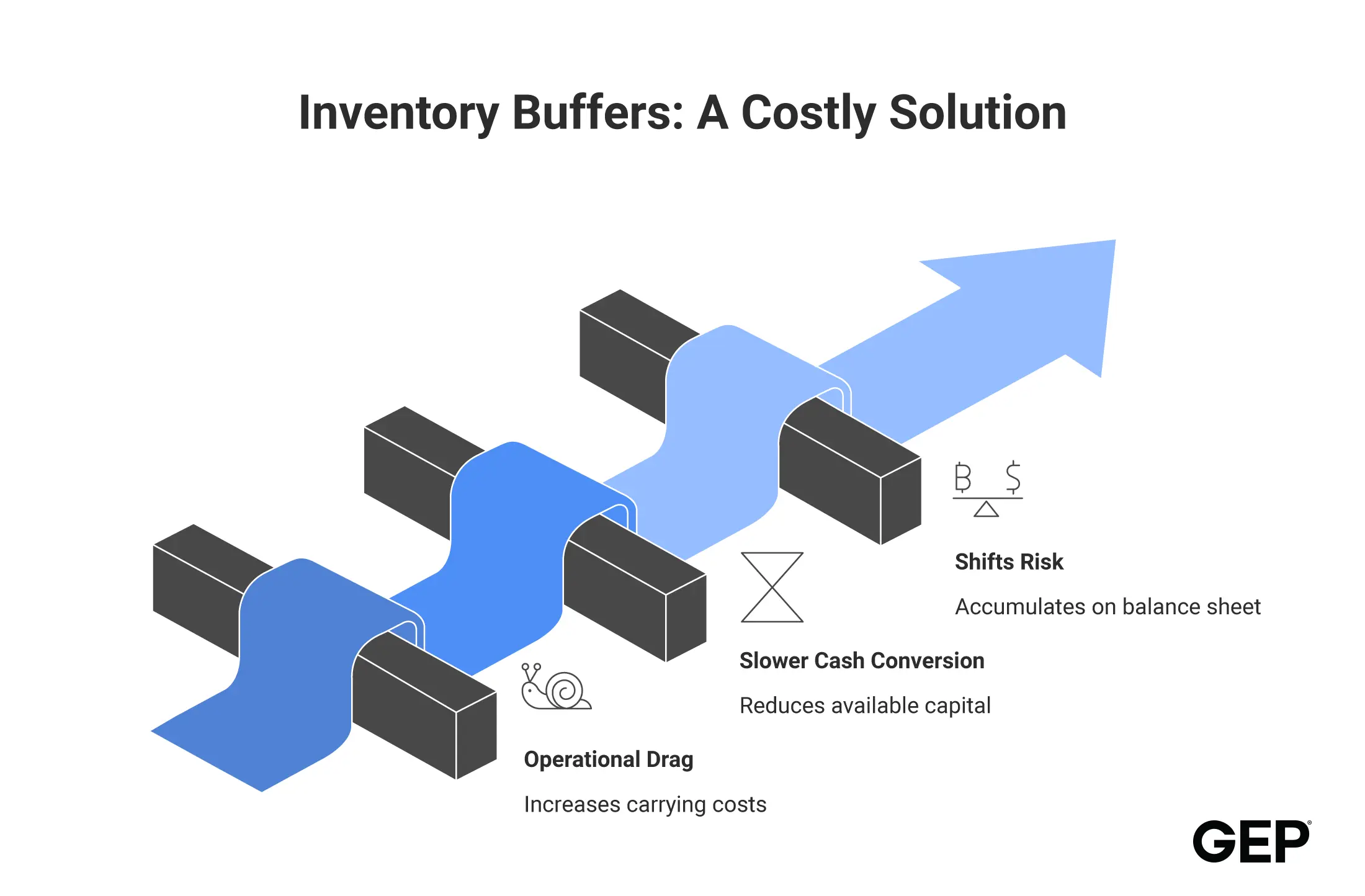
The paradox is hard to ignore. Companies building inventory buffers to protect operations are simultaneously degrading the financial performance that justifies those operations. Higher days of inventory outstanding means slower cash conversion, which means less capital available for technology investments, supplier development and network redesign that would actually reduce the need for buffers in the first place.
Holding more inventory does not solve the underlying problem. It shifts the risk from the supply chain to the balance sheet, where it accumulates quietly until it becomes a problem for the CFO rather than the CSCO.
What Happens When Finance and Operations Share a Lens
How can organizations escape this cycle? Not by asking the CFO to accept more inventory risk, and not by asking the CSCO to accept more supply risk. The model needs to change so that both objectives can be satisfied at the same time.
The problem is not the amount of inventory an enterprise needs; the problem is that the enterprise is the one holding it. A financing partner can purchase and hold inventory on behalf of the enterprise — committing to supply availability without placing ownership on the client's balance sheet — and letting the CFO and CSCO optimize against their primary objectives simultaneously.
This model is called buy-hold-sell, and it reframes the CFO-CSCO conversation entirely. Instead of negotiating how much buffer to carry, the discussion shifts to supply assurance architecture: who holds the inventory, at what cost and under what terms. That is a conversation both functions can engage productively.
Making this work requires an AI-native supply chain platform with real-time visibility across the inventory lifecycle, a global workforce that can execute at the intersection of digital orchestration and physical logistics, and a financing partner with the capital liquidity and trade infrastructure to act as the central holding entity across jurisdictions.
When those elements are in place, inventory becomes a managed capability that is financed externally and aligned with both the CFO's working capital targets and the CSCO's supply assurance requirements.
A New Framework for the CFO-CSCO Conversation
Most CFO-CSCO discussions about inventory start with the question: how much should we hold? That framing guarantees a negotiation between competing objectives.
The better question is: who should hold it, and at what cost? That reframe moves the conversation from a resource allocation dispute to a design problem with a solvable answer.
Finance leaders are ready for this: the Hackett Group's 2025 Finance Key Issues Study found that working capital optimization ranked as the top priority for finance leaders, a significant shift from prior years. CFOs are not looking to block resilience investment; they are looking for resilience that does not require them to absorb the cost unilaterally.
Supply chain leaders need to walk into that conversation with a financial model, not just an operational argument. Presenting inventory as a balance sheet structure, with clear cost-to-coverage ratios and a financing architecture that keeps working capital metrics intact, moves a CFO from gatekeeper to partner.
The Balance Sheet Should Not Be the Last Line of Defense
Supply chain resilience has always cost something. The question is who pays, in what form and when.
For too long, enterprises have answered that question by defaulting to inventory accumulation, shifting risk from the supply chain onto the balance sheet and calling it prudent planning. Past a certain point, however, it limits the very agility resilience is supposed to provide.
The organizations building durable competitive advantage are not choosing between a healthy balance sheet and a resilient supply chain. They’re taking advantage of models where inventory is financed, held and released by a partner ecosystem purpose-built for the role, and where the CFO and CSCO can finally operate from the same map.