



The Future CPO: Skills, Structure, and Strategic Influence
- The future CPO evolves from cost manager to enterprise strategist driving resilience, growth and competitive advantage.
- Agentic AI transforms procurement into an autonomous, intelligence-led function governed by strong executive oversight.
- Organizational structure, digital governance and strategic influence define next-generation procurement leadership.
June 04, 2026 | Procurement Strategy 5 minutes read
Procurement has moved well beyond its traditional role of negotiating contracts and delivering savings. Today’s business environment is shaped by supply disruption, regulatory expansion, ESG pressure and geopolitical uncertainty. In this context, the Chief Procurement Officer (CPO) plays a far more central role in shaping enterprise performance.
The future CPO is not just responsible for sourcing efficiency. They influence resilience, risk exposure, digital direction and long-term competitiveness. As procurement maturity increases across industries, the scope and expectations of the role continue to expand.
This shift is structural. It is not temporary.
Step Into the Future of Procurement
Empower your CPO strategy with agentic AI–orchestrated source-to-pay transformation
From Cost Controller to Enterprise Strategist
For years, procurement performance was measured mainly by savings targets and compliance rates. Those metrics still matter, but they no longer define leadership impact. Today’s CPO must deliver broader outcomes, including enterprise-wide cost resilience, end-to-end supply chain visibility, regulatory readiness, ESG accountability, multi-tier risk mitigation, and supplier-driven innovation.
In many industries, procurement manages more than half of total spend. That level of financial oversight naturally elevates the role. As a result, CPOs are increasingly becoming a part of board-level discussions on risk, sustainability and digital investments.
Procurement is now seen as a driver of business stability and growth, not just operational efficiency — and also as a strategic enabler.
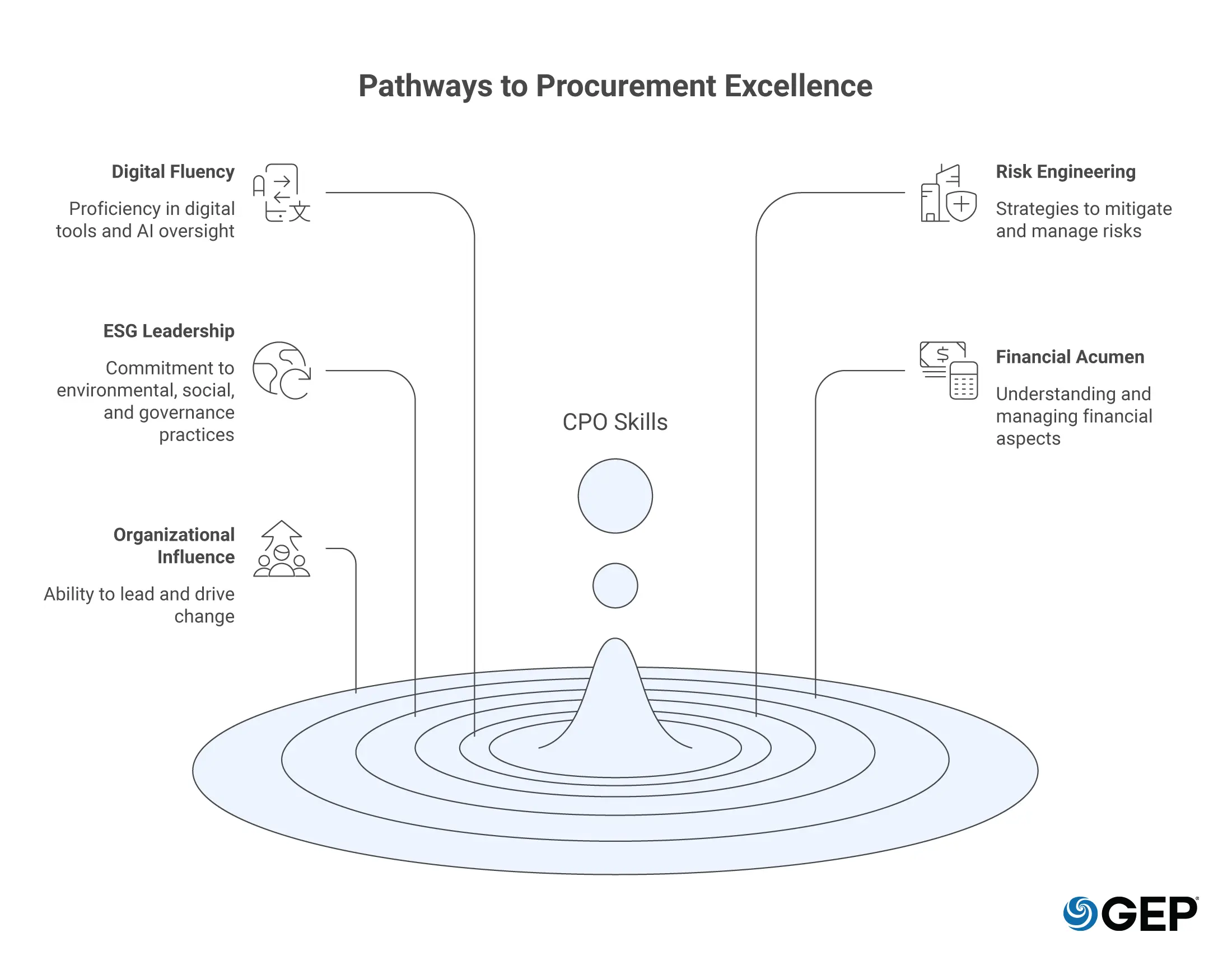
Skills of the Future CPO
The demands placed on procurement leadership have changed. The next-generation CPO blends commercial acumen with digital fluency, risk intelligence, and enterprise leadership.
1. Digital Fluency and Agentic AI Oversight
Procurement systems have moved beyond simple automation. Agentic AI introduces systems that can initiate sourcing events, evaluate supplier responses, and trigger actions within predefined rules.
The CPO must understand how these systems function and how to govern them properly. This includes:
- Autonomously initiate sourcing events based on demand signals
- Analyze supplier bids in real time using market data
- Trigger contract renewals or renegotiations proactively
- Continuously monitor supplier risk exposure
- Recommend optimized award scenarios
This is not about replacing human decision-making. It is about orchestrating intelligent systems that operate within policy-defined governance frameworks. Technology does not replace leadership — it changes its focus.
2. Risk and Resilience Engineering
Global disruptions continue to expose supply chain fragility, layer by layer. The future CPO embeds resilience into procurement design.
Agentic AI can continuously monitor supplier risk signals and surface early warnings. However, strategic decisions around diversification, contingency planning, and supplier prioritization remain leadership responsibilities.
The future-ready CPOs must:
- Map multi-tier supplier dependencies
- Diversify sourcing geographies
- Align procurement with enterprise risk management
- Develop contingency sourcing frameworks
Risk management is evolving from reactive crisis response to continuous intelligence-led monitoring.
3. ESG and Sustainable Procurement Leadership
Sustainability expectations are increasing across industries. Procurement sits at the center of Scope 3 emissions, ethical sourcing requirements, and regulatory compliance mandates.
- Agentic AI strengthens this capability by:
- Monitoring supplier sustainability metrics in real time
- Flagging non-compliance automatically
- Suggesting lower-carbon sourcing alternatives
- Tracking supplier diversity targets
The future CPO integrates sustainability into sourcing strategy, ensuring that procurement decisions support corporate ESG commitments without compromising financial performance.
4. Financial Acumen and Enterprise Value
Procurement decisions influence margins, cash flow and long-term profitability. The future CPO must demonstrate strong financial literacy. This includes:
- Total cost of ownership modeling
- Should-cost analytics
- Cost-to-serve analysis
- Scenario-based forecasting
- Cash flow optimization
While agentic AI can surface insights and model scenarios autonomously, executive judgment remains essential in aligning financial decisions with broader corporate objectives.
The CPO must connect procurement outcomes to EBITDA performance and shareholder value.
5. Organizational Influence and Change Leadership
As procurement integrates autonomous systems, internal roles evolve. Transactional workloads decline, and analytical and strategic responsibilities increase.
The CPO must:
- Redesign workforce roles around analytics and strategy
- Upskill teams in digital oversight and data interpretation
- Foster trust in autonomous systems
- Align procurement, IT, and finance stakeholders
Transformation requires cultural change. Leadership credibility and communication are critical.
Structural Evolution of Procurement Organizations
The expanding CPO mandate is reshaping procurement operating models.
Centralized Strategy, Distributed Execution
Enterprises increasingly adopt hybrid structures:
- Centralized category strategy and governance
- Decentralized execution aligned with business units
- Unified data and technology platforms
This structure enables consistency, scale, and visibility while maintaining operational agility.
Centers of Excellence for Digital and Autonomous Procurement
Leading organizations are establishing procurement Centers of Excellence focused on:
- Agentic AI governance
- Advanced analytics
- Automation architecture
- Contract lifecycle optimization
- Supplier risk intelligence
These centers ensure technology investments translate into measurable enterprise outcomes.
Integration with Enterprise Digital Architecture
Procurement platforms are now embedded within enterprise digital ecosystems. Collaboration between the CPO, CIO and data leadership is critical.
Agentic AI systems require:
- Structured, high-quality data
- API-based system integration
- Cybersecurity safeguards
- Continuous model monitoring
- Regulatory compliance oversight
Procurement is now embedded within enterprise digital infrastructure.
Strategic Influence: The CPO as Growth Catalyst
Modern CPOs do not limit themselves to operational efficiency. They actively shape enterprise growth by strengthening supplier ecosystems, accelerating decisions, and contributing intelligence to executive strategy. The future CPO influences enterprise strategy across multiple dimensions, including.
Supplier Innovation
Strategic suppliers contribute to product development, efficiency improvements, and competitive differentiation. Procurement leaders must cultivate these partnerships intentionally.
M&A and Expansion
During mergers or expansions, procurement drives supplier consolidation, cost synergy identification and supply harmonization. Agentic AI accelerates spend mapping and opportunity identification.
Decision Acceleration
Autonomous sourcing workflows reduce cycle times and increase responsiveness. Faster decisions support agility in competitive markets.
Enterprise Intelligence
Procurement data reveals market shifts, supplier performance trends, and cost drivers. The CPO translates this intelligence into executive insights.
GEP Outlook Report 2026
Explore the dynamics shaping procurement & supply chain and know how to navigate them in 2026
Measuring Success in the Future
Traditional procurement metrics are no longer sufficient to capture strategic value. The future CPO measures performance across resilience, sustainability, automation maturity, and enterprise-wide financial impact. The CPO tracks broader metrics:
- Risk exposure reduction
- ESG impact improvement
- Autonomous workflow adoption
- Cycle time compression
- Supplier-led innovation outcomes
- Working capital efficiency
Procurement performance is evaluated in terms of resilience, sustainability, and enterprise value creation.
Conclusion
The role of the CPO has expanded significantly, encompassing strategy, risk management, sustainability oversight, and governance of agentic AI systems.
While technology changes how procurement operates, leadership remains central. The CPO defines the rules, aligns procurement with business priorities, and ensures responsible execution.
Organizations that elevate procurement leadership and modernize their operating models will be better positioned to manage uncertainty and compete effectively.
The future CPO is not just managing spend. They are shaping strategy.



FAQ's
Agentic AI enables autonomous sourcing events, predictive risk monitoring and proactive contract optimization. The CPO governs these systems through policy guardrails, ensuring intelligent automation aligns with enterprise strategy and compliance requirements.
The future CPO influences strategy by managing enterprise spend, strengthening supply resilience, advancing ESG goals, accelerating digital transformation and enabling supplier-driven innovation that contributes directly to growth and profitability.