


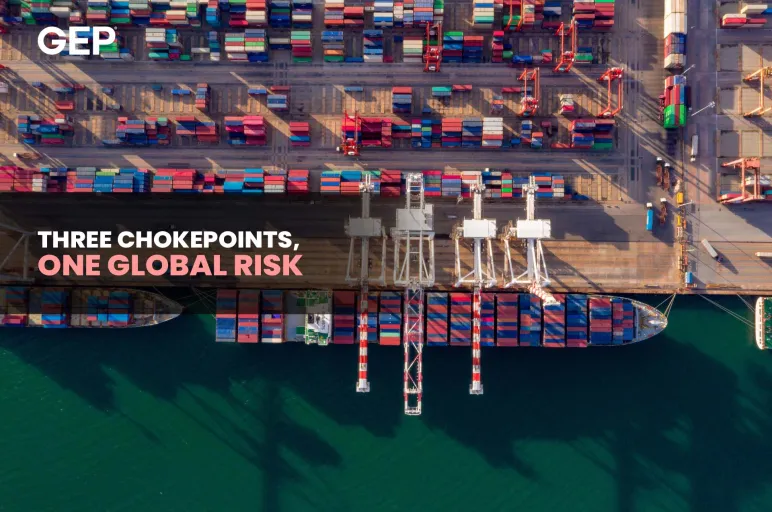
As Geopolitical Risk Mounts, the Race to Diversify Critical Supply Chains Is On
- Three geopolitical flashpoints — the Strait of Hormuz, the Black Sea and Chinese rare-earth export controls — are squeezing energy, food and critical-material supply chains.
- Geopolitical risk is no longer an isolated shock, but a set of pressures that now propagate across shipping routes, commodities and supplier tiers at the same time.
- Procurement teams need continuous, network-wide visibility into where their dependencies concentrate to act before disruption reaches their own operations.
September 29, 2026 | Supply Chain Trends 5 minutes read
Geopolitics is coming for global supply chains. In the Persian Gulf, shipping traffic through the Strait of Hormuz, which normally carries roughly a fifth of the world's seaborne oil, slowed further this week after Iran warned that Gulf energy infrastructure, including U.S. interests, remained a target for retaliation. Just seven commodity vessels transited the strait on September 7, down from eight the day before, per Kpler data reported by Reuters. That’s a small fraction of the roughly 85 to 100 vessels a day that passed through before the conflict began in February, according to Al Jazeera's analysis. Goldman Sachs has already raised its Brent and WTI price forecasts for late 2026 and 2027 on expectations that the disruption persists.
Meanwhile, escalating Russian and Ukrainian strikes on Black Sea ports and grain vessels have knocked out most of Russia's Azov export capacity and left Ukrainian farmers unable to move a strong harvest, according to The Guardian. Wheat futures have hit multi-year highs as a result, Bloomberg reported, since the two countries together account for more than a quarter of global wheat exports.
On a third front, several Chinese rare-earth suppliers have stopped shipping to U.S. customers over fears of repercussions from Beijing, even as licensing delays continue for Japanese and Indian buyers, Reuters reported, ahead of a planned late-September meeting between the two countries' leaders.
None of these developments is unprecedented alone. What's different is that they're happening simultaneously, in unrelated regions, across different categories such as energy, food, and critical minerals, each reinforcing the same story about cost, capacity and reliability.
The Shipping Industry Is Sounding Its Own Alarm
Perhaps the clearest signal is who's now raising the alarm. On September 8, the Consultative Shipping Group — an alliance of maritime authorities from 18 nations, including Japan, Norway, South Korea, Germany and the UK, issued a public statement warning that wars, sanctions and a fast-growing "shadow fleet" of tankers operating outside standard insurance amount to a structural shift in global shipping. It was, by several accounts, the group's first public intervention in more than 60 years.
The group pointed to an estimated 1,500-plus vessels, nearly a fifth of the world's tanker fleet, now moving cargo with limited insurance or oversight. One such vessel, carrying roughly 800,000 barrels of Russian oil, reportedly struck a mine off Oman this summer without standard protection-and-indemnity cover, leaving cleanup costs potentially falling on the Omani government rather than the shipowner.
Since more than 80% of world trade moves by sea, a warning from the infrastructure layer itself suggests the strain on global logistics is becoming systemic rather than confined to companies with direct exposure to a conflict zone.
Unlock GEP’s - AI-Native Supply Chain Management Software
Minerals Are Becoming a Second Bargaining Chip
The rare-earth story is different. Rather than a blocked shipping lane, it’s a supply chain that can be throttled through licensing decisions and informal supplier caution, even without new formal restrictions. China refines roughly 70% of most critical minerals and produces the overwhelming majority of sintered permanent magnets used in vehicles, wind turbines, data centers and defense systems, which gives Beijing leverage without a single new regulation.
For procurement teams outside automotive, electronics and defense, this can look like someone else's problem. It rarely stays that way. Rare earths sit two or three tiers upstream of a large share of manufactured goods, so a slowdown at the mineral level tends to surface later as a cost or availability problem at the finished-component level.
Governments Are Already Repricing the Risk
The response to these risks shows an emerging, if uneven, consensus that concentration risk is worth paying to fix. The G7 has set a target of cutting reliance on any single non-allied supplier for rare earths and magnets to below 60% by 2030. The EU's Critical Raw Materials Act is mobilizing roughly €3 billion toward domestic extraction, processing and stockpiling, and the U.S., Japan and Australia have signed bilateral frameworks to co-invest in mining and refining capacity outside China, per CSIS analysis.
Separately, EU officials have warned that continued Black Sea disruption risks a broader food security and migration crisis reminiscent of 2022 — a reminder that governments are treating these as connected risks, not isolated ones.
These efforts won't close the gap quickly. Diversifying rare-earth supply chains alone would require an estimated $60 billion over the next decade, and refining capacity still lags new mining projects. But governments and large buyers already treat geopolitical concentration as a fundable problem, which changes what reasonable diversification looks like for mid-sized enterprises too.
Turning Warning Signs Into a Playbook
Hormuz, the Black Sea and rare earths each began as a regional or bilateral issue and became a cross-category cost and availability problem within weeks. That's the pattern to plan around now, and it argues for continuous monitoring over periodic supplier reviews.
A few moves are worth prioritizing:
- Map exposure past Tier 1: Identify which countries, ports, processors and shipping lanes sit behind your direct suppliers. Concentration risk often hides two or three tiers upstream of where most reviews stop looking.
- Track substitutability, not just risk scores: For any single-source material or route, ask not how risky the supplier looks today, but how long qualification, capacity ramp-up and switching would actually take.
- Scenario-plan for prolonged disruption, not brief shocks: Hormuz traffic has already cycled through multiple ceasefires and relapses since February. Any plans built for a short-term shock will underestimate a case like this.
- Spend resilience where it counts: Redundant suppliers and inventory everywhere is expensive and often unnecessary; the return is highest where disruption would carry outsized consequences.
Enterprises should aggregate supplier, geographic, material and route data so teams can see where dependencies concentrate, then prioritize mitigation around the risks that would hurt the business most.
Not Sure Where Your Exposure Concentrates?
Talk to our procurement and supply chain experts about building continuous, network-wide risk visibility for your business
The Next Chokepoint Won’t Send a Warning
Geopolitical risk is a variable for the indefinite future. The organizations that build continuous real-time visibility instead of reacting event by event will be the ones still moving product when the next chokepoint closes.



BLOG CATEGORIES
Frequently Asked Questions
By mapping exposure beyond Tier 1 suppliers to the ports, processors, and routes behind them, since concentration risk often hides upstream. This means combining supplier, geographic, and route data continuously, and tracking substitutability, not just risk scores.
Resilience determines whether a company keeps operating when disruption hits. Since shocks like Hormuz, the Black Sea, and rare-earth controls now hit multiple categories at once, resilient companies plan for prolonged disruption and focus resources where the impact would be greatest.
Tools that aggregate supplier, logistics, and geopolitical data in real time, mapping multi-tier networks and flagging emerging disruptions. This enables continuous, network-wide visibility instead of periodic reviews.