


Global Bond Selloff: What Rising Yields Mean for Procurement and Supply Chains
- Long-dated sovereign yields have hit multi-decade highs with Japan's 10-year reaching 3% for the first time since 1996 and Brent trading above $90.
- For procurement, the move is largely confirmation: bond markets are pricing in the energy and freight costs supply chains have been absorbing since the Hormuz disruption began.
- The practical exposure is concentrated in energy-linked categories, contract escalator clauses, and the financing cost of inventory now sitting on longer routes.
September 07, 2026 | Procurement News 4 minutes read
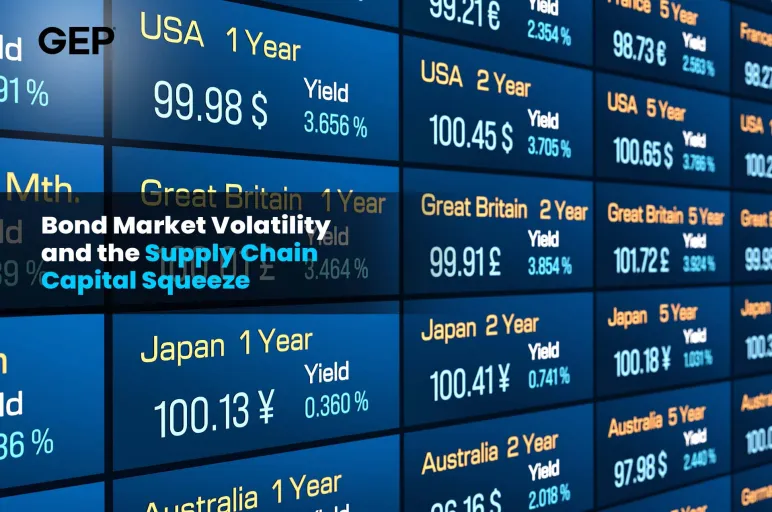
Government bond markets are selling off across most major economies.
The U.S. 10-year Treasury yield reached 4.81% in Asian trading, its highest level in nearly three years, and the 30-year climbed to 5.28%. Brent is holding near $95 after September 1’s 5% jump, which followed U.S. strikes on Iranian targets around the Strait of Hormuz and Tehran's warning that its response would be far larger. Markets are now pricing roughly a 68% chance of a Fed rate hike this month, up from about 40% last week.
Japan's 10-year bond yield reached 3% for the first time since 1996. Britain's 30-year gilt yield climbed to 5.89%, its highest since 1998. German and French 10-year yields climbed to levels last seen in 2011 and 2008 respectively, and U.S. 30-year yields touched their highest since 2007. UK 10-year gilts rose as much as 11 basis points to 5.25%.
There are three overlapping causes: renewed oil price gains on US-Iran tensions, climbing government borrowing with US debt past $40 trillion and G7 debt-to-GDP at or above 100% outside Germany, and a hawkish Jackson Hole speech from Fed Chair Kevin Warsh.
For procurement teams, the causality is worth noting. The Hormuz closure and Red Sea disruption made energy and freight structurally more expensive months ago, and that has since become an inflation problem central banks cannot ignore.
This week’s move is the financial system catching up to a physical disruption that has been in P&L of organizations since February.
Procurement Metrics That Matter in 2026
See the Findings of a Survey of 300+ CPOs and Senior Procurement Executives
What This Means for Procurement and Supply Chains
The exposure is energy-linked categories, not freight across the board
Nitrogen fertilizer, petrochemicals, resins and refined products track gas and crude feedstocks directly. The World Bank projects its fertilizer price index will rise more than 30% in 2026, driven largely by the halt in Middle East urea and ammonia exports. Freight is more selective. Gulf-linked lanes have moved sharply, while mainline east-west rates have risen more modestly because vessel overcapacity is absorbing much of the fuel cost. Worth checking actual lane exposure before assuming broad freight inflation.
Financing has become a second cost layer
Longer routings put more inventory in transit for longer, and that inventory is now funded at yields sitting at multi-decade highs. Rerouting cost and carrying cost compound rather than sitting side by side. This is the genuine connection between the September 1, 2026, bond move and daily operations. It also shifts the arithmetic behind buffer stock levels set when capital was cheaper, and it raises the effective cost of supply chain finance and early-payment programs, which price off the same benchmarks. The liquidity relief suppliers actually receive from those programs narrows as rates climb.
Contract mechanics will matter more than negotiation skills
Energy-indexed and fuel-surcharge clauses are triggering automatically. Fixed-price suppliers in energy-intensive categories are likely to seek reopeners, and smaller or more leveraged suppliers refinancing at current rates have less room to absorb input costs quietly. Strain in a supply base usually surfaces as slower deliveries or requests to reopen pricing well before it looks like anything more serious.
AI capex is competing for physical capacity
Hyperscaler bond issuance reached roughly $220 billion through August 10, according to BNP Paribas data, and much of that funds data center construction. Those orders draw on the same pool of transformers, switchgear and electrical contractors your facilities projects rely on.
What Procurement Teams Should Do Now
- Map contract mechanics before Q4. Identify which agreements carry automatic energy or fuel escalators, which are fixed-price in energy-intensive categories, and where reopener requests are most likely to land.
- Check lane-level freight exposure rather than applying a general inflation assumption. Gulf-linked and mainline routes are behaving differently.
- Revisit inventory carrying cost with an updated cost of capital, particularly for goods on extended routings. Some buffers will still be justified; others were sized against assumptions that have moved.
- Re-screen suppliers in energy-intensive categories for financial headroom, concentrating on single-source and long-lead-time positions.
- Revalidate lead times on facilities and capital projects involving electrical equipment, where AI-driven demand is absorbing capacity.
Nothing here requires action this week. But if your 2027 plan still assumes routing, energy and capital costs normalize, that assumption is the one worth revisiting first.




BLOG CATEGORIES
FAQ's
Rising bond yields drive up benchmark interest rates, which directly increases the cost of supply chain financing. This makes it more expensive for suppliers to fund their operations, hold inventory, and maintain daily liquidity.
Supplier liquidity risk is the danger that a vendor will run out of cash and become unable to fund operations or purchase raw materials. During a credit squeeze, smaller suppliers lose access to affordable bank loans, increasing their risk of insolvency.
An inventory optimization strategy reduces excess safety stock and aligns inventory levels with actual demand. This process releases cash that was previously tied up in physical goods, allowing enterprises to use that capital for other critical operational needs.
Procurement can mitigate financial risks by using proactive supplier risk monitoring, offering early payment programs, and collaborating on inventory reduction. These actions help maintain supplier liquidity and prevent disruptions in the supply chain.