



How AI-Native Demand Forecasting Limits Peak Season Weather Disruptions
- Missed weather signals cascade into stockouts across entire regions within your network.
- Predicting a storm's demand impact days early gives you time to act.
- Teams must trust automated recommendations enough to act during real weather events.
August 19, 2026 | Procurement Strategy 6 minutes read
Every peak season, your supply chain runs on a forecast that was locked in weeks earlier, and any storm system that forms after that point becomes a problem you inherit rather than one you predicted.
Stockouts on fast-moving categories and bloated safety stock sitting in the wrong warehouse are not failures of planning discipline but failures of the underlying forecasting model, which is precisely what AI-native demand forecasting was built to fix.
When weather intelligence is built directly into your forecasting engine, the scramble that defines peak-season planning starts to look avoidable.
This piece breaks down what AI-native demand forecasting does and how it turns weather signals into inventory decisions before disruption hits. You will see the mechanics behind real-time inventory re-routing and have a clear framework to judge whether your current demand forecasting stack is built for peak-season volatility or merely surviving it.
An Overview of AI-Native Demand Forecasting
Most operations leaders already know weather affects demand, but few have connected that knowledge to a system that acts on it before disruption reaches the loading dock.
The reason usually comes down to capability rather than awareness. Teams don’t evaluate whether the forecasting tool pulls in live meteorological data and turns it into automated rerouting decisions at the SKU level. Until that capability exists, weather forecasts inform reports, not the decisions that actually prevent disruption.
AI-native demand forecasting describes systems designed from the ground up to reason over multiple live data streams, rather than legacy platforms with a predictive layer bolted onto historical sales data after the fact.
Instead of relying mainly on last year's sales adjusted for seasonality, these systems continuously absorb signals such as meteorological forecasts and real-time point-of-sale data, then recalculate demand probabilities as conditions shift. Weather does not wait for your quarterly forecast cycle, and a system built to be AI-native was not designed to either.
For large enterprises operating across dozens of distribution centers and regional markets, the cost of forecasting error multiplies with scale. A single missed weather signal can cascade into stockouts across an entire region, while a neighboring facility sits on excess inventory it cannot move fast enough to help.
Enterprises that fold weather intelligence into peak season logistics planning, rather than treating it as an afterthought, are the ones building genuine, automated supply chain resilience instead of just surviving one storm season at a time.
How AI-Native Demand Forecasting Works
Ingesting Weather Data at the Right Resolution
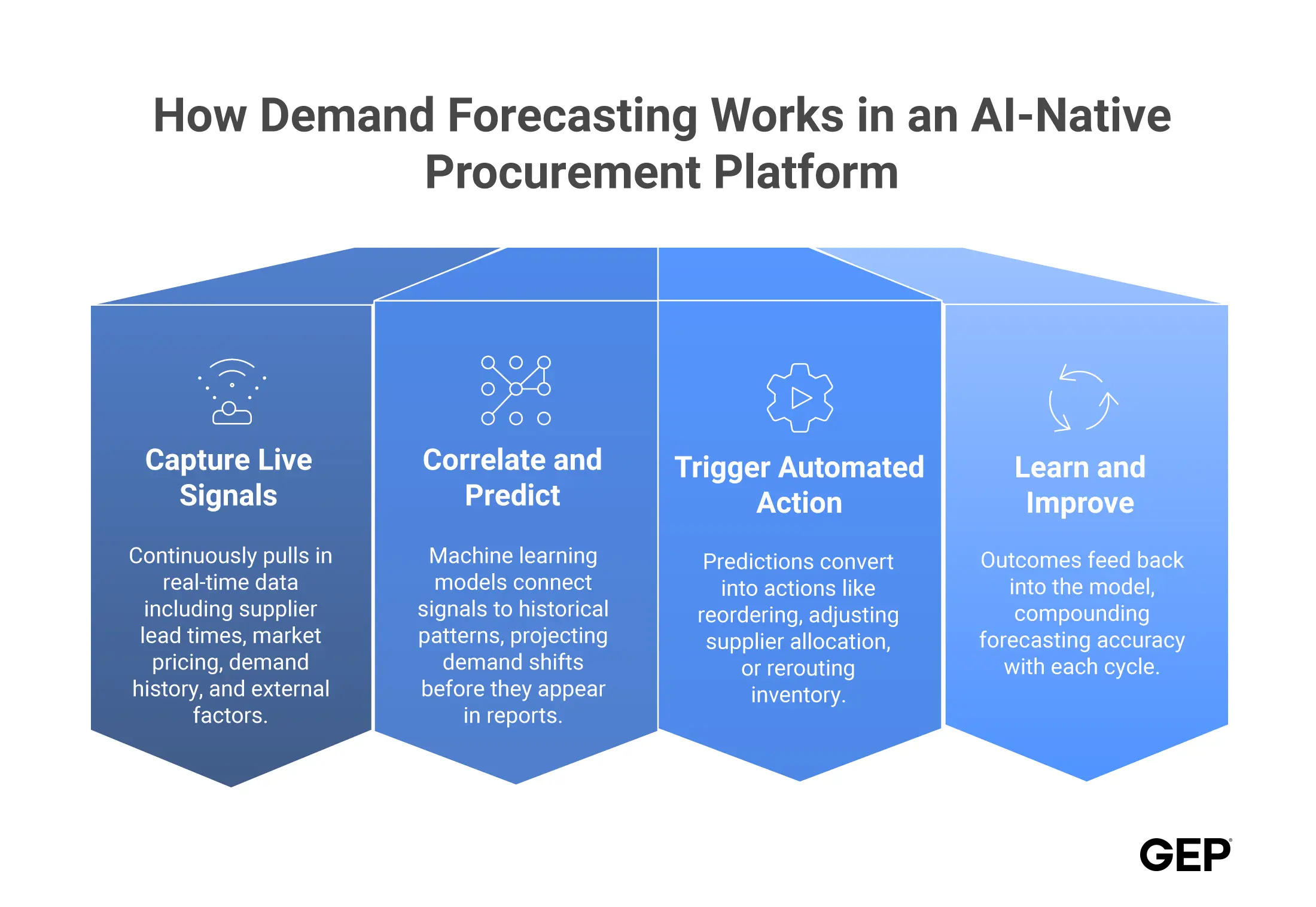
The process starts with data granularity most legacy systems were never built to handle. Instead of a single regional outlook, an AI-native platform pulls hyperlocal forecasts down to the zip code or individual store level, updated continuously rather than once a week. That resolution matters because a hurricane forming three states away behaves very differently from a localized ice storm sitting directly over your busiest distribution hub, and only granular data lets the system tell the two apart.
Translating Weather Signals into Demand Shifts
Raw weather data on its own tells you nothing about inventory. The system has to correlate historical demand patterns with past weather events, learning that a cold snap in one region reliably shifts demand toward certain categories while suppressing others nearby. Machine learning models trained on that correlation can then project how an incoming weather event will move demand at the SKU level, days before the event itself arrives.
Triggering Rerouting Before Disruption Hits
Prediction without action just produces a more accurate warning. The real value shows up when the forecast automatically triggers a response instead of just displaying one, whether that means rerouting shipments already in transit or reallocating safety stock between distribution centers before a storm closes a key transportation corridor. Automated inventory re-routing is the operational core of the system, not a feature bolted on afterward.
Closing the Loop with Continuous Retraining
Every disruption event becomes training data for the next one. A well-built system compares its predicted demand shift against what actually happened, then feeds that discrepancy back into the model so accuracy compounds with each peak season instead of resetting every year. Over time, this turns weather-driven forecasting from an educated guess into a genuinely predictive capability.
Is Your Procurement Platform AI-Native?
Use a practical framework to evaluate vendor claims with confidence
Critical Considerations for Enterprise Adoption
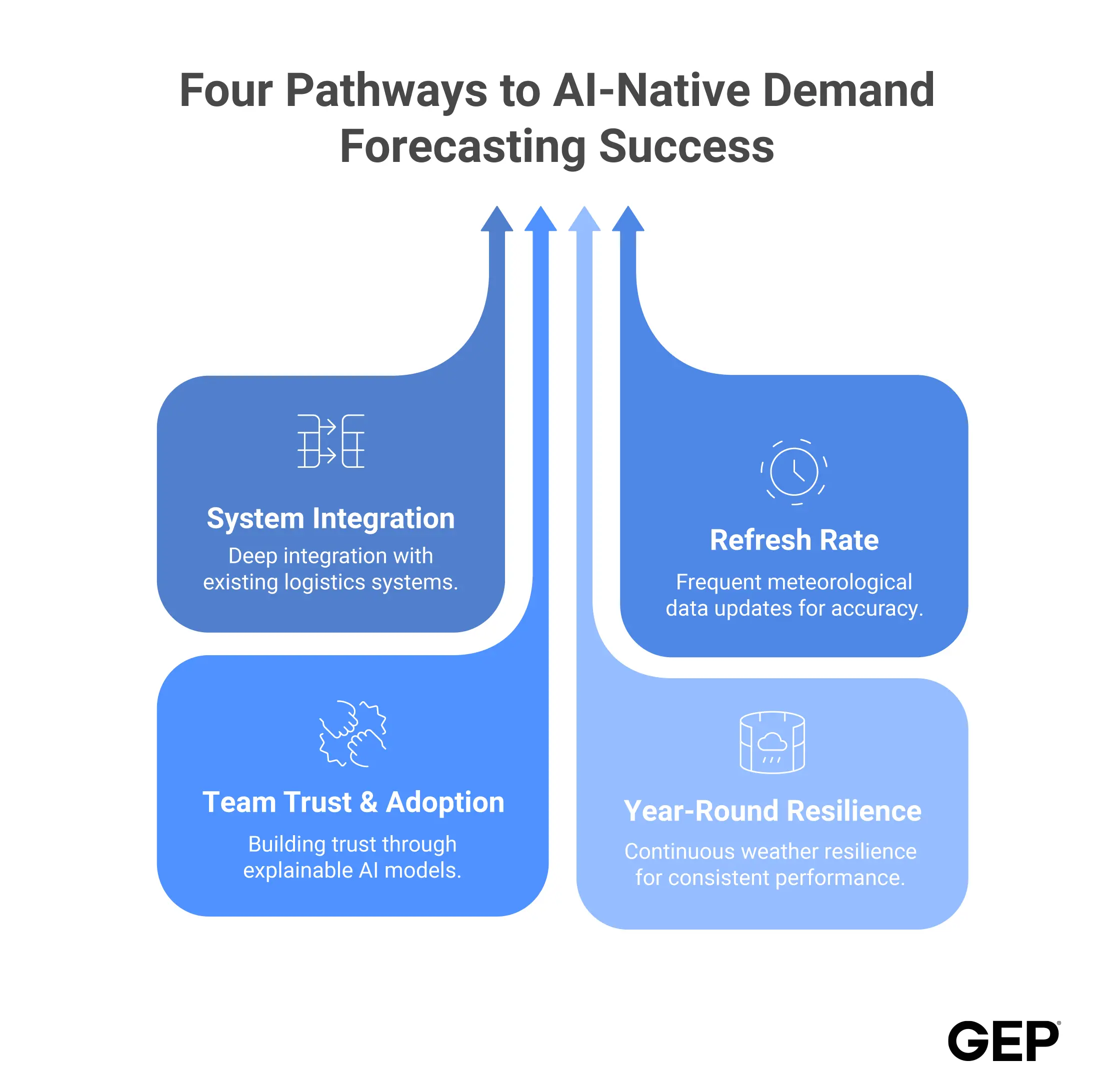
Before committing budget to any AI-native forecasting initiative, look closely at how deeply the platform integrates with your existing warehouse and transportation management systems. A forecasting engine that produces brilliant predictions but can’t talk directly to your logistics execution layer leaves you translating insight into action manually, which defeats the purpose of automation.
Refresh rate matters as much as accuracy. Ask specifically how often the underlying meteorological data updates and how quickly a change propagates into a revised demand signal. A system that recalculates once a day is not meaningfully different from the manual forecasting process you are trying to replace.
Adoption also depends on people, not just technology. Planning and operations teams need to trust the system enough to act on its recommendations without overriding them, so leadership has to invest in explainability alongside the technical rollout. A model that teams do not trust gets ignored during the exact weather events it was built to handle.
Treat peak season weather resilience as a year-round capability rather than a seasonal initiative. Enterprises that only activate weather-aware forecasting during hurricane season or winter storm windows lose the compounding benefit of continuous learning and end up rebuilding institutional confidence every year instead of building on it.
Predict Peak Season Disruptions Before They Happen
Know how AI-native demand forecasting protects your inventory and delivery schedules
The Path Forward for Peak Season Resilience
Weather is only becoming a less predictable input, and static forecasting models built for a more stable climate cycle will keep losing ground to the disruption you did not see coming. Enterprises that treat AI-native demand forecasting as core infrastructure rather than an emerging trend will spend less time reacting to peak season chaos and more time managing it on their own terms.
Supply chain and operations leaders who want to get ahead of this shift should start by auditing how their current forecasting stack handles live external data, not just historical sales trends, and by building the cross-functional trust needed to act on automated recommendations while a storm is still days away. The organizations that wait for a disruptive season to force the decision will be building this capability under pressure instead of on their own timeline.
For enterprises ready to move from reactive planning to predictive control, GEP Quantum Intelligence for supply chain brings weather-aware demand forecasting and automated inventory rerouting into a single AI-native platform, built to help you stay ahead of peak-season disruption rather than recover from it.
Explore GEP’s AI-Native Demand Planning & Forecasting Platform for improved forecast accuracy and planning.




Frequently Asked Questions
The most immediate payoff comes from forecast timing. Rather than working off a static batch update that only refreshes on a fixed schedule, you get demand forecasts that recalculate daily or even hourly as new conditions come in, so your planning stays current instead of trailing reality by days. That same real-time input sharpens allocation precision, directing specific product volumes to the exact regional warehouses facing a localized weather constraint rather than distributing stock evenly across your network and hoping it lands where it's needed. The forecasting layer extends into logistics too, flagging transit delays tied to an incoming weather event early enough for you to reroute shipments before a delivery commitment is actually at risk.
A neural network built for weather prediction works by finding patterns in decades of atmospheric records, learning how variables such as air pressure and humidity typically behave in the hours before a specific kind of storm forms. Once that pattern recognition is in place, the model takes today's live atmospheric readings and runs them through those learned relationships to project how conditions will likely shift over the next several hours or days. The output isn't a single guaranteed forecast; it's a range of probable outcomes weighted by how closely current conditions match patterns the model has seen before, which is why the quality of your live data feed matters just as much as the model driving it.
Most stockouts trace back to a demand signal that arrived too late for anyone to act on it, not an actual shortage of inventory somewhere in your network. AI-led demand forecasting closes that timing problem by treating live signals, including weather data, as an input the model reacts to immediately rather than something it reviews at the next scheduled planning cycle. That immediacy lets you trigger replenishment or shift safety stock between locations while there's still enough lead time to matter, so a demand spike gets absorbed before it ever reaches an empty shelf.