How Climate Geostrategy Is Reshaping Trade
- Climate change is now a driver of global geostrategy, reshaping trade routes, commerce, logistics and geopolitical alignments.
- For supply chain leaders, climate change means chronic disruption at maritime choke points, shifting comparative advantage among nations, and billions in projected costs to ports and shipping.
- The key action should be to integrate climate risk intelligence into sourcing, network design and long-term supply chain strategy, and not as an ESG add-on but as a core resilience discipline.
September 04, 2026 | Supply Chain Trends 4 minutes read
Climate change is driving a new global geostrategy, one that is reshaping trade, commerce, logistics and geopolitics simultaneously, according to recent report by the Financial Times. The core argument: environmental change is no longer just a sustainability issue for governments and businesses. It is redrawing the map of strategic and commercial advantage.
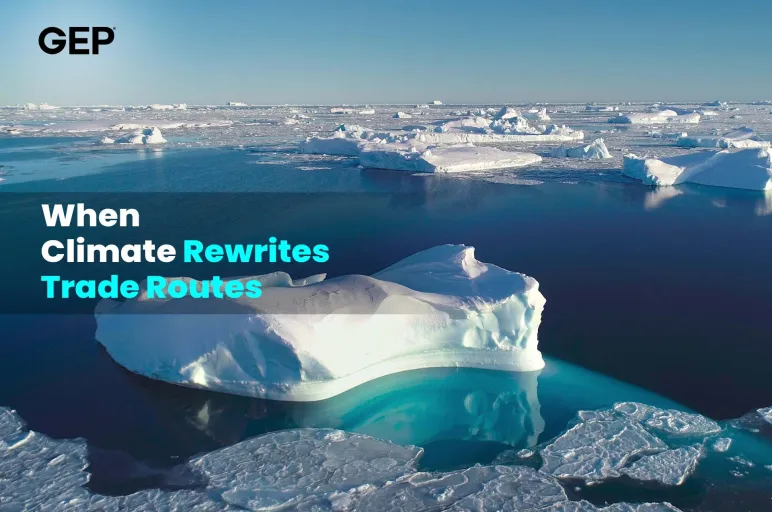
The evidence is already visible. Melting Arctic sea ice is opening the Northern Sea Route, which could cut shipping times between China and Europe roughly in half. Meanwhile, established corridors are becoming less reliable: drought curtailed Panama Canal traffic in 2023 and 2024. Furthermore, low water levels on the Rhine and Danube have repeatedly disrupted European barge shipping and industrial output, even contributing to temporary factory and power plant shutdowns.
For procurement and supply chain leaders, the message is clear: the physical geography of trade is shifting, and long-term strategy must shift with it.
The GEP Global Supply Chain Volatility Index
Get the latest intelligence on global supply chain volatility and anticipate risks before they impact your business
Redrawing the Map: Choke Points, Corridors and Comparative Advantage
Consider the Panama Canal, which handles roughly 5% of global shipping. During the recent drought, daily transits fell from 36–38 vessels to as few as 22, and total transits dropped 29% in fiscal year 2024 — from 12,638 to 9,936, according to a report by the SeatradeMaritime. Canal authorities at the time estimated the drought could cost them $500 million to $700 million in 2024 alone, while carriers imposed surcharges of several hundred dollars per container on Asia–U.S. East Coast routes. GEP's analysis of the Panama Canal drought detailed how these restrictions rippled through container schedules, rates and routing decisions.
The longer-term numbers are equally sobering. Research by RTI International for the Environmental Defense Fund projects that climate impacts could cost the shipping industry up to $25 billion per year by 2100, with annual port infrastructure damage approaching $18 billion. A separate industry report by International Chamber of Shipping found that climate-driven port downtime already puts an estimated $67 billion in trade at risk every year.
Climate is also reordering national advantage. Countries positioned in shipping, batteries, EVs and critical minerals stand to gain as decarbonization accelerates, while economies dependent on vulnerable coastal infrastructure or fossil fuel exports face growing exposure. Trade policy is following: mechanisms like the EU's Carbon Border Adjustment Mechanism are turning emissions into a direct cost of cross-border commerce.
The Dual Challenge: Decarbonization Costs Meet Geopolitical Risk
Supply chain leaders now face a two-sided squeeze. On one side, decarbonization mandates, such as carbon border taxes, Scope 3 reporting requirements, low-emission fuel transitions, are raising the cost and complexity of global sourcing. On the other, climate-driven disruption is amplifying geopolitical and environmental supply chain risk: new Arctic routes create fresh territorial friction, resource-rich nations are tightening control over critical minerals, and water stress is straining relations along key trade corridors.
The uncomfortable reality is that these pressures compound each other. A sourcing decision made purely on cost can concentrate exposure at a climate-vulnerable port. A decarbonization move made without geopolitical analysis can deepen dependence on a single country for batteries or rare earths. Neither risk can be managed in isolation anymore.
Integrating Climate Intelligence Into Sourcing and Network Design
So what exactly should procurement and supply chain teams actually do? Four practical moves stand out:
Map Climate Exposure Across the Extended Network
Go beyond tier-1 suppliers to identify which routes, ports, plants and raw material sources sit in high-risk zones for drought, flooding, storms and heat.
Stress-Test Logistics Against Choke-Point Failure
Model scenarios where the Panama Canal, Rhine corridor or key Asian ports operate at reduced capacity for months, and pre-qualify alternate routes, modes and carriers.
Build Climate Criteria into Sourcing Decisions
Factor physical climate risk and carbon cost exposure (including carbon border charges) into supplier and site selection, and not just unit price and lead time.
Diversify and Regionalize Deliberately
Use dual sourcing, nearshoring and buffer strategies where climate risk concentration is highest, and revisit these decisions annually as risk maps evolve.
How GEP Consulting Helps Build Climate-Resilient Supply Networks
This is where strategy and execution have to meet. GEP's supply chain risk management consulting helps organizations proactively assess, prioritize and mitigate risk across their networks, while GEP's sustainability consulting services help enterprises embed decarbonization and ESG goals into procurement and supply chain operations. Together, these capabilities enable companies to integrate climate risk intelligence into long-term network design — balancing sustainability commitments with operational resilience rather than trading one for the other.
Looking for Ways to Protect Your Business from Disruptions
GEP can help you navigate the unpredictability and protect your margins with confidence
Conclusion: Preparing for a Climate-Disrupted Trade Landscape
Climate geostrategy is no longer a future scenario. It is the operating environment. The companies that treat climate as a structural input to sourcing, logistics and network strategy today will hold the advantage as the trade map keeps shifting.