



How to Design Effective AI Agents for Procurement: Key Non-Negotiable Principles
- Successful AI agents solve real procurement bottlenecks, not theoretical problems.
- Human oversight and explainability are essential for trusted AI-driven decisions.
- Flexible, connected agent ecosystems deliver greater long-term procurement value.
September 16, 2026 | Automation 7 minutes read
If you are serious about getting AI agents right in procurement, you already know the hype is real, but so is the risk of getting it badly wrong. The difference between a transformational deployment and a very expensive disappointment almost always comes down to design. Not the technology itself, just the thinking behind it. So let us get into the principles that actually matter.
Stay ahead of shifting spend dynamics across key categories.
Explore the GEP Spend Category Outlook to inform data-driven decisions
Key Principles for Designing Effective AI Agents in Procurement
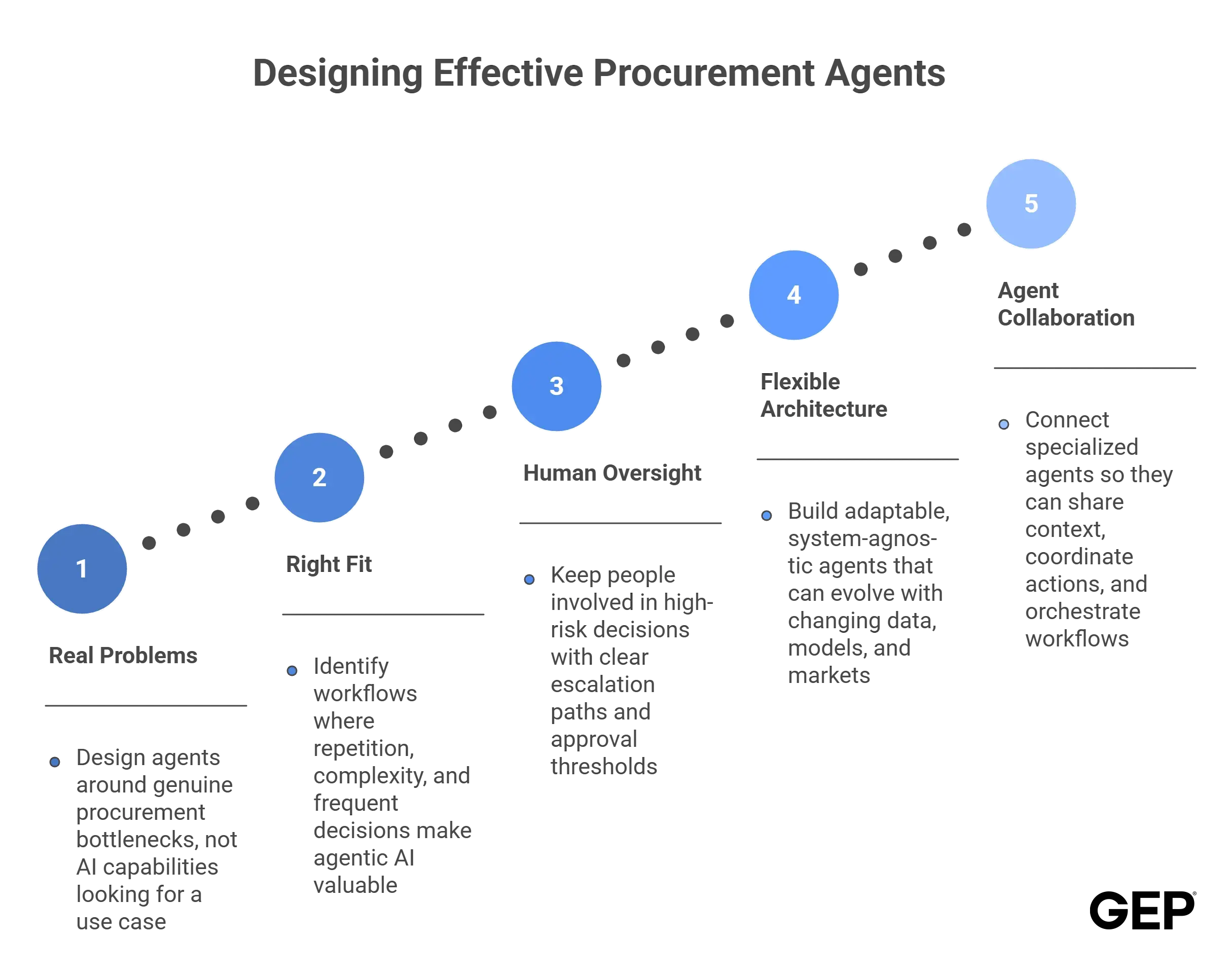
Start with Real Customer Problems: Ground Your AI Agents in Practical Needs
Here is a trap almost every team falls into: they start with the AI and then go looking for problems to solve. Flip that. The only agents worth building are the ones that address something your procurement team is genuinely grinding on every single day.
Before getting into what AI agents can do, it is worth pausing to appreciate just how much of a procurement professional's day is consumed by decisions that, on reflection, are not really decisions at all. They are rules dressed up as judgment calls. Should we reorder this MRO item that has dropped below safety stock? Is this invoice within tolerance for auto-approval? Does this supplier meet our onboarding criteria? Procurement teams spend most of their time on transactional and operational tasks, which means an enormous amount of human intelligence is being applied to problems that do not require human intelligence. They require consistency, speed, and accuracy, which happens to be exactly what AI agents are built for.
That is your starting point: go find those pain points, name them precisely, and design agents that eliminate them completely.
Rigorously Assess 'Agent-Problem Fit' for Optimal Results
Not every procurement problem is an agent problem. Some challenges are too ambiguous, too relationship-dependent, or too politically charged for an agent to navigate well. Your job as a designer is to know the difference before you commit.
Procurement is uniquely complex: a blend of structured processes and nuanced human judgment. This makes it ideal for agentic AI because the field contains repetitive steps such as data preparation; multi-stage workflows such as sourcing and contracting; dependencies on accurate, current information; a need for continuous monitoring across risks and markets; and multiple decision points that require scenario-based evaluation.
Where all of those factors converge, you have strong agent-problem fit. Autonomous procurement agents perform best in categories where complexity and repetition collide. Logistics, MRO, IT services, and tail spend all fit that profile. These areas generate constant decisions but rarely receive sustained attention. Outside of those sweet spots, a well-designed workflow or a skilled human will serve you better.
Build Trust with a Human-in-the-Loop (HITL) Approach in Procurement
Here is where a lot of AI deployments stumble. Teams either put humans in the loop everywhere, which defeats the purpose, or they take humans out entirely, which creates a trust crisis the moment something goes wrong. The answer is calibration.
Yes, AI can make decisions. But should it make every decision? Procurement is not only about efficiency; it is also about ethics, sustainability, and relationships. Humans need to stay in the loop, guiding, approving, and making judgment calls that AI cannot.
The mechanics of this are more nuanced than most teams realise. A false positive in one context may carry little cost, while in another it may trigger unnecessary expense or disruption. The appropriate response is not to apply a uniform threshold but to align intervention with the specific risks embedded in the decision. Decision thresholds cannot remain fixed. They vary within a workflow. That variation requires a more explicit understanding of how decisions are made and what outcomes they influence.
In practice, you should keep humans in the loop for high-risk or regulatory-impact decisions and define escalation paths. Always keep compliance decisions explainable. Decisions tied to supplier risk, contract approvals, or policy violations must be transparent; set up explainability frameworks that document how models reach recommendations and which data points drove each output.
Also Read: Procurement Metrics That Matter in 2026
Design Flexible Solutions: Move Beyond Fixed AI Models
One of the most common and costly mistakes is locking your procurement function into a single AI model or a rigid agent architecture that cannot adapt as the market changes. The best-designed agents are built to be flexible by default.
Agentic AI architecture organizes procurement around goals. Humans define outcomes such as cost stability, supply continuity, or compliance posture. Agents plan actions, pull data across systems, execute tasks, and learn from results. Oversight replaces micromanagement.
The enterprise market is flooded with "Agentic AI" solutions that are just basic chatbots bolted onto legacy systems. They claim to be agents but lack true autonomy. Moving beyond simple task automation means coordinating complex, cross-functional decisions across the supply chain. An open, system-agnostic architecture allows procurement leaders to own their AI strategy, integrating with any data source or LLM rather than being locked into a walled garden.
Optimize for Systemic Thoroughness and Efficiency
A single well-built agent is useful. A network of agents that communicate, hand off work, and continuously learn from each other is transformational. Design for the system, not just the individual component.
Unlike a standard chatbot that waits for a prompt, a truly agentic system is comprised of a network of specialized, autonomous agents that collaborate to achieve a goal. They plan: breaking a complex request into a sequence of necessary steps. They act: not just suggesting an email but drafting it, sending it, and processing the reply. They collaborate: a Market Intelligence Agent can pass data to a Negotiation Agent, which then informs a Contract Creation Agent.
Traditional automation runs on predefined sequences. Each rule or model executes a single task before handing control back to the system. There is little contextual awareness across stages. An intake bot can classify a request but it does not know whether a supplier validation step failed downstream. Separate systems for sourcing, contracts, and compliance each have their own automations; they function well individually but do not share insights in real time. Designing for systemic thoroughness means fixing that gap deliberately.
AI agents are only as effective as the principles behind them.
Explore the key design principles shaping the future of procurement AI
Ensuring Ethical AI in Procurement: Responsible Design for AI Agents
Getting the efficiency principles right is only half the job. The other half is harder to measure but just as important.
In the gold rush to apply AI to improve how companies source suppliers and manage global supply chains, there is a very real risk that organizations will dehumanize decisions and unintentionally ignore waste, CO2 emissions, and inequality, with devastating consequences to business, communities, and the environment.
In the absence of any clear guidelines, the indiscriminate use of artificial intelligence may cause more harm than good. For example, while choosing a supplier, AI may simply look at the prices and go with a supplier that offers the lowest prices. Industry experts believe there is a need to humanize technology, building compassion into the algorithms companies use in procurement to source from suppliers and run the world's supply chains.
Responsible AI adoption is not just an option but an imperative. Enterprises must consider factors such as business strategy alignment, non-monetary gains, technology and data integration, ethical standards compliance, risk assessment, and the integration of agile AI systems into their existing processes. Emphasizing transparency, accountability, and human-centered design, these guidelines lay down the roadmap for businesses seeking to ethically harness AI's disruptive power.
Enterprises should define guardrails, permissions, approval thresholds, and decision policies. This enables ethical and responsible use of AI that aligns with risk tolerance and regulatory requirements.
Conclusion
Designing effective AI agents for procurement is not a technology challenge, it is a thinking challenge. Start with the real operational pain, assess whether an agent is genuinely the right fit, calibrate human oversight with care, build for flexibility and systemic collaboration, and refuse to let ethics become an afterthought.
Agentic AI plans, decides, and executes. It adapts in real time, learns from feedback, and orchestrates procurement with minimal handholding. This is not an upgrade; it is a new way to run procurement. But only if you design it that way from the very start.
Explore GEP’s – AI-Native Procurement Software



FAQs
The biggest challenges are identifying the right problems for agents to solve, ensuring data quality before deployment, designing appropriate human oversight thresholds, and avoiding rigid architectures that cannot adapt to changing market conditions. Each exception in a rule-based system spawns another rule; each workaround adds another branch. Over time, systems built for simplicity become fragile, and change slows because every adjustment risks breaking downstream logic.
If an AI agent hits a problem it cannot solve, it does not just guess. It gathers all the relevant data and presents it to a human with a suggested fix. Once the human decides, the AI remembers that solution for next time. The system looks for patterns, not just rules.
By leveraging AI to manage routine tasks and simultaneously arming human experts with rich, data-driven insights, organizations can harness a partnership that accentuates the strengths of both AI and human intuition. The human role does not shrink; it shifts toward strategic oversight, exception management, and decision validation on the highest-stakes actions.