



Key Procurement Resolutions for Procurement Leaders in 2026 (and what they need to build smarter operations)
- Procurement must drive resilience, visibility, and cross-functional coordination beyond cost savings.
- Agentic AI is most effective with clean data, connected workflows, and focused use cases.
- Continuous risk monitoring and flexible sourcing will be the key to procurement success in 2026.
May 19, 2026 | Procurement Strategy 6 minutes read
Procurement leaders in 2026 have a broader mandate than they had a year ago. Procurement now defines supply continuity, supplier resilience, ESG compliance, working capital, as well as risk (on multiple fronts).
The pressure and the visible risk from tariffs, geopolitical shifts, supplier instability, and compliance expectations will only get worse. Procurement teams that act rigid and continue to work in a fragmented way (accompanied by disjointed processes) will struggle to respond quick enough when disruptions hit.
Procurement strategies in 2026 will have to be focused around operational coordination, cleaner data, faster decision-making, and practical AI adoption tied directly to business outcomes.
Position Procurement as a Strategic Driver of Value Across the Organization
Leadership teams now expect procurement operations to stabilize supply chains, improve resilience, support sustainability goals, and reduce operational exposure. Procurement’s role has expanded across the business. That said, execution still lags behind the ambition.
Furthermore, procurement and supply chain leaders often align strategically but struggle operationally because teams still work in silos. That gap slows decision-making and gradually weakens response times during disruptions.
Procurement leaders need deeper coordination with finance, operations, logistics, and supplier management teams. Shared workflows matter more than quarterly alignment meetings.
Lead with Agentic AI
Build smarter procurement & resilient supply chains with enterprise-proven tech
Streamline Request Intake to Ensure Proper Guidance for Every Inquiry
Most procurement inefficiencies start before sourcing even begins. This ends in procurement losing visibility early in the process, and off-contract spending increases silently.
A fragmented intake model creates bigger downstream problems than many teams realize.
Poor intake reduces spend visibility, slows sourcing, creates supplier onboarding delays, and leads to reporting gaps. It also weakens coordination between procurement and business teams.
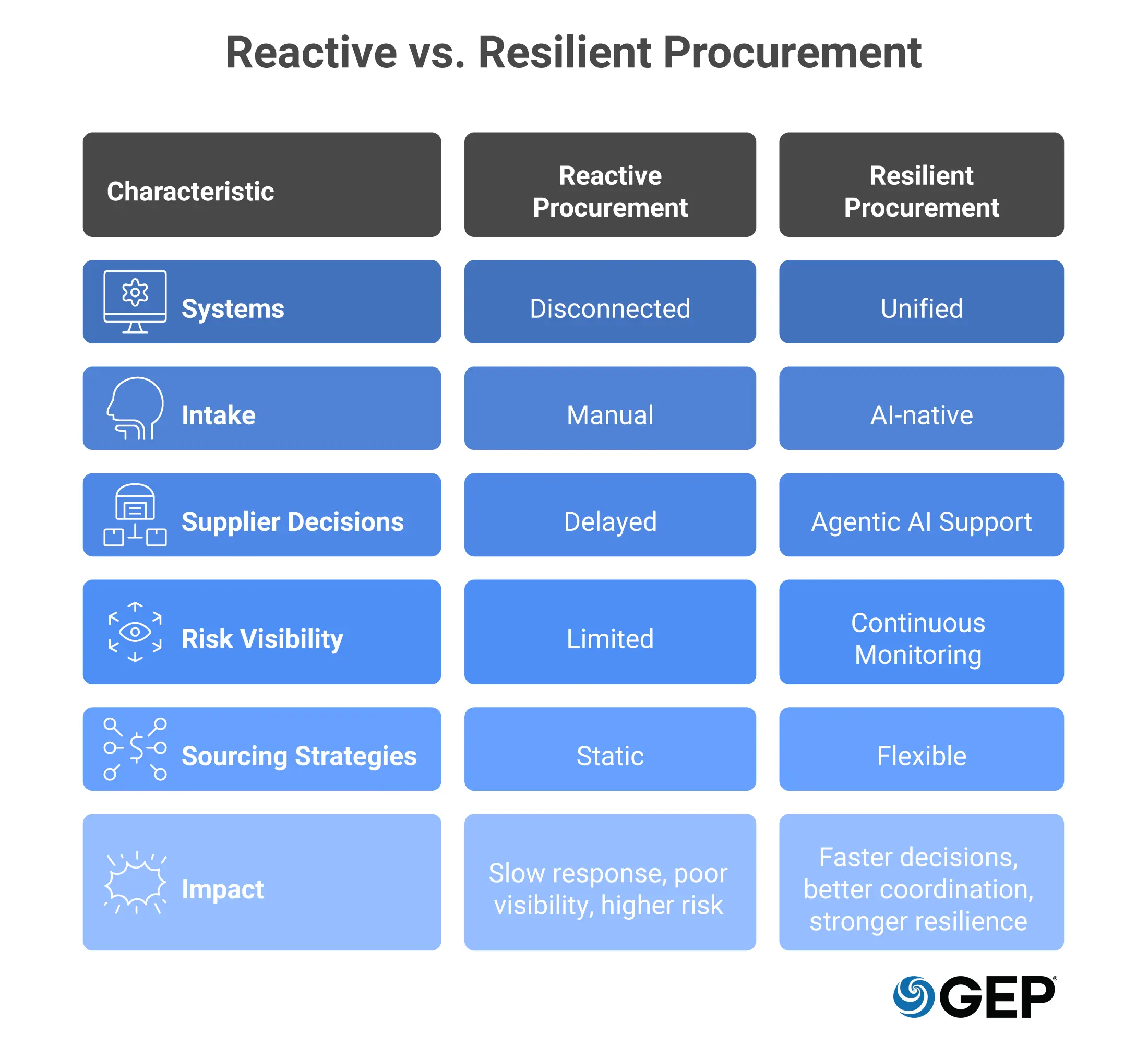
AI-native intake systems now help procurement teams classify requests automatically, route them correctly, recommend approved suppliers, and flag missing information before delays pile up.
The best bet would of course be to look for a procurement solution with intake orchestration.
Transform Disjointed Processes Into a Seamlessly Coordinated Procurement Journey
Many procurement organizations continue to rely on disjointed systems for sourcing, contracting, supplier management, invoicing, and even risk monitoring.
Teams spend too much time reconciling data manually. The fragmentation slows response times exactly when speed matters most.
Procurement orchestration solves this issue by seamlessly connecting workflows across the procurement journey. It’s not just about automating isolated tasks, orchestration coordinates sourcing, contracts, supplier actions, approvals, payments, and risk signals together.
Procurement leaders need to look at multi-dimensional intelligence platform that combines supplier data, market shifts, logistics exposure, pricing signals, and compliance requirements inside one operating layer.
Leverage Agentic AI to Boost Efficiency and Improve Procurement Execution
Agentic procurement is actually moving from experimentation to real deployment in 2026.
Traditional AI tools mostly assist users; they summarize documents, answer prompts, generate reports, and so on. But procurement leaders increasingly need systems that can act autonomously within defined controls. And that is precisely where agentic AI changes procurement operations.
AI-native autonomous agents can enable supplier risk monitoring, initiate sourcing workflows, evaluate bids, recommend actions, as well as escalate exceptions automatically while operating inside policy guardrails.
Procurement leaders should focus first on high-impact use cases with measurable outcomes. Supplier risk monitoring, intake automation, contract review, tail-spend, etc. create practical starting points. Large-scale autonomous deployment can come later.
The 2026 Procurement Executive Insight Report
Explore the factors driving procurement transformation in the next 5 years
Prioritize Data Quality as a Strategic Asset, Not Just a Cleanup Task
Bad data weakens every downstream capability. AI won’t compensate for inconsistent data. It will rather scale the confusion faster.
Further, most organizations approach data cleanup the wrong way. They treat it like a one-time IT initiative instead of an operational discipline tied directly to procurement execution.
Procurement leaders should start by identifying the business decisions they need to improve. Supplier risk visibility. Contract compliance. Predictive sourcing. Spend forecasting. Once those priorities become clear, the necessary data improvements become easier to target.
Research shows that organizations with unified procurement data feel significantly more prepared for agentic AI adoption.
The bottom line — procurement organizations that treat clean data as operational infrastructure will move ahead faster than those still managing supplier records manually across systems.
Develop a Flexible Procurement Ecosystem to Support Long-Term Adaptability
Tariffs shift rather quickly and regulatory expectations evolve without much warning.
If teams cannot adapt fast enough, rigid procurement operations will struggle during volatile conditions.
Organizations heavily dependent on single-region sourcing already understand the cost of inflexibility. Flexibility, as a matter of fact, matters more now than optimization alone.
Procurement leaders should therefore focus on building procurement ecosystems that support orchestration across suppliers, logistics providers, finance systems, and external risk platforms.
Enhance Procurement Function Through New Skills and Strategic Support
Many professionals built their careers around transactional procurement models. The shift toward predictive and autonomous operations changes the skill profile significantly.
A common concern within teams is about losing control. Some feel overwhelmed after years of digital transformation initiatives that delivered mixed operational results. Ignoring those concerns slows adoption.
The need is critical when it comes to stronger capabilities in data interpretation, supplier risk analysis, AI governance, scenario planning, and also cross-functional coordination.
Procurement leaders need structured change management alongside technology deployment. Training, operational clarity, and transparent governance matter as much as software investment.
Create Supplier Experiences That Foster Stronger Collaboration
Suppliers notice operational inefficiencies immediately.
Reliable suppliers prefer customers who operate predictably — because consistency reduces friction during sourcing, onboarding, invoicing, and issue resolution. It also improves responsiveness when disruptions occur.
Procurement leaders should treat supplier experience as part of operational resilience, not merely vendor management.
Autonomous and AI-native workflows can improve supplier interactions through standardized sourcing events, faster approvals, and cleaner communication. Still, technology alone does not build trust. Consistency surely does.
Integrate ESG and Responsible Sourcing at Every Decision Point
Responsible sourcing expectations continue to expand across industries. And with that, procurement teams face increasing pressure around supplier transparency, labor standards, emissions reporting, ethical sourcing, and regulatory compliance.
Supplier certifications, sourcing disclosures, emissions data, compliance records, etc. need to flow through operational workflows continuously. Otherwise, reporting accuracy deteriorates fast.
Now is the right time for procurement leaders to embed ESG controls directly into procurement processes rather than managing them separately through reporting exercises after decisions are already made.
Also Read: New Procurement Benchmarks in the Age of Intelligence
Transition to Proactive Risk Monitoring Throughout the Procurement Lifecycle
Procurement can no longer rely on annual supplier reviews to provide clear visibility. Supplier conditions too shift quickly due to volatility across the board.
What procurement leaders need is predictive monitoring rather than recovery models with a reactionary approach.
Advanced AI-native procurement systems are capable of tracking external risk signals in real time, flagging instability before disruptions escalate into operational failures. Furthermore, autonomous workflows can trigger escalations, pause sourcing events, or recommend alternative suppliers automatically when risk thresholds change.
This level of speed creates options.
Conclusion
Procurement leaders in 2026 face an increasingly difficult operating environment, with the need to reduce costs while improving resilience is critical. They must therefore accelerate decisions without weakening controls and look at ways to adopt AI without adding operational confusion.
There is no quick fix for that balancing act, but the direction is becoming clearer.
The strongest procurement leaders in 2026 will be the ones that do not chase every new technology trend. They are the ones focusing on building procurement operations that remain coordinated, visible, and adaptable under pressure.




FAQs
Procurement teams that unify workflows, improve data quality, improve supplier coordination, and deploy AI carefully inside real operational processes will adapt faster than competitors relying on disjointed systems and manual oversight.
Focus first on the data tied directly to operational decisions such as supplier risk, contracts, spend visibility, and sourcing performance. Instead of trying to clean every dataset at once, improve the data connected to high-impact workflows and AI use cases. Consistent supplier records and connected procurement systems work better than large cleanup projects.
Supplier experience directly impacts responsiveness, trust, and operational stability. Further, slow approvals, inconsistent communication, as well as complex onboarding create friction for suppliers and delay collaboration. Prioritizing clear workflows, faster responses, and better visibility help teams build stronger supplier relationships and improve coordination during disruptions.