



Five Questions to Ask Any Vendor Before You Buy "Agentic"
- Agent washing turns inflated AI promises into expensive operational debt from day one.
- The decision-turn test separates genuine agentic AI from rebranded automation.
- Strong governance and human oversight help procurement teams avoid agent debt before it starts.
September 21, 2026 | Automation 6 minutes read
You've probably noticed it too: every procurement platform on the market suddenly calls itself "agentic." Vendors that were selling workflow automation two years ago are now pitching autonomous agents, and the demos all look impressively similar. But here's the question you should be asking before you sign anything: is this software actually making decisions, or is it just following a script with better marketing?
That gap between the pitch and the reality has a name now: agent washing. And if you're not careful, it can saddle your procurement function with a mess you'll be cleaning up for years.
Stay ahead of shifting spend dynamics across key categories.
Explore the GEP Spend Category Outlook to inform data-driven decisions.
What Is Agent Washing, and Why Is It Dangerous for Procurement?
Agent washing is what happens when a vendor slaps "agentic AI" on a product that's really just traditional automation with a chatbot layer on top. Think rule-based workflows, if-this-then-that logic, and templated responses, all rebranded with words like autonomous, AI-native, and orchestration. The software looks like it's thinking; it isn't.
For procurement, this matters more than in most functions. You're dealing with contracts, supplier risk, spend approvals, and compliance obligations that carry real financial and legal weight. If you buy a tool believing it can autonomously evaluate supplier risk or negotiate terms within guardrails, and it turns out the tool is just automating data entry with a friendlier interface, you've built your sourcing strategy on a false premise. That's not a minor disappointment; it's a structural risk to how your team operates.
The Decision-Turn Test: A Simple Way to Spot a Real Agent
Here's a practical filter you can use in any vendor conversation: ask what happens at the decision turn. A decision turn is the moment where the system has to choose between two or more valid paths based on context, not just execute a predefined step.
Genuinely agentic systems can weigh multiple variables, such as supplier performance history, contract terms, and current market conditions, and then decide which action to take next, often without a human clicking "approve" at every step. Automation dressed up as an agent typically can't do this; it can only move forward when a human or a pre-written rule tells it exactly what to do.
Ask the vendor to walk you through a real decision turn in their product. If they can only describe a sequence of steps, you're looking at automation, not agentic AI. If they can describe genuine branching logic driven by real-time context, you're closer to the real thing.
What Is Agent Debt, and Why Does It Start on Day One?
Agent debt is the accumulated cost of gaps between what an "agentic" system was sold to do and what it can actually do, and it doesn't wait around to show up. It starts on day one, the moment you go live, because that's when the assumptions baked into your rollout plan meet reality.
If you assumed the system would handle exception management autonomously and it can't, someone on your team is now manually catching those exceptions, but without a formal process built for it because the tooling was supposed to handle it. If you assumed it would provide predictive insights into supplier risk and it's really just reporting on historical data, your risk models are quietly out of date from the start. Every one of these gaps is a small IOU, and they compound.
Where Agent Debt Shows Up First: Governance, Audits, and Exceptions
The earliest and clearest signs of agent debt tend to show up in three places.
Governance is the first: if your procurement policies assume a level of autonomous oversight the system doesn't actually provide, you have a disclosure risk on your hands. Regulators and internal auditors increasingly want to know exactly where human oversight sits in any AI-assisted decision; a vague answer here is a real liability.
Audits are the second. When an auditor asks how a sourcing decision was made and the honest answer is "the tool suggested it based on a static rule, not a live evaluation," that's a harder conversation than it needs to be, especially if your documentation claimed otherwise.
Exceptions are the third, and often the most painful day-to-day. A system marketed as capable of full end-to-end handling will inevitably hit edge cases: an unusual contract clause, a supplier that doesn't fit the standard profile, a request that falls outside the training data. If nobody planned for a human to step in at that point, exceptions pile up fast and your team ends up firefighting instead of sourcing.
The Real Cost: What Rebranded Automation Ends Up Costing Procurement Teams
The financial hit from agent washing rarely shows up as a single line item; it shows up as a thousand small inefficiencies. You pay for licenses priced as if you're getting multi-dimensional intelligence, but you're staffing the process almost as heavily as before. You lose time retraining teams on workflows that don't work the way they were promised. You lose trust internally, which makes your next technology pitch to leadership harder, even if the next vendor really is offering genuine agentic capabilities.
There's also a slower, quieter cost: missed opportunity. While you're patching around a system that can't actually do what it claims, competitors using genuinely agentic tools are compounding real efficiency gains, freeing up their teams for higher-value work instead of babysitting a glorified rules engine.
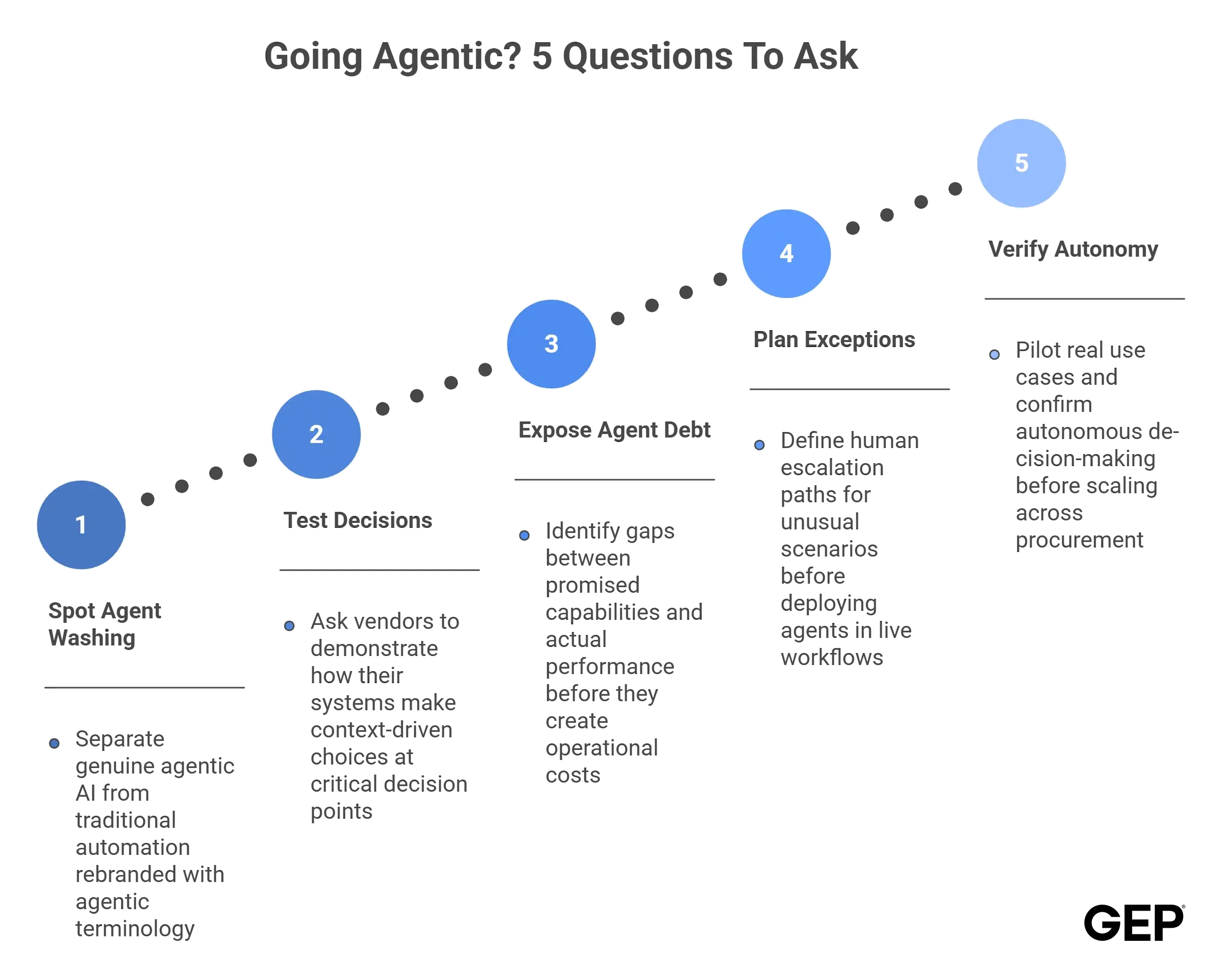
Five Questions to Ask Any Vendor Before You Buy "Agentic"
Before you sign, put these five questions on the table:
- Can you show me a specific decision turn where the system chooses between options without a human or a pre-set rule dictating the outcome?
- What happens when the system hits a scenario outside its training or configuration? Who or what handles it?
- How does the system explain its reasoning in natural language, and can that explanation hold up in an audit?
- What level of human oversight is built in, and is that a design choice or a limitation you're not mentioning?
- Can you point to a live customer environment where this system operates with real autonomy, not just a sandbox demo?
Vendors selling genuinely agentic AI will answer these clearly. Vendors that are agent washing will start talking in circles about roadmaps and future releases.
Don't Let Agent Washing Create Day-One Agent Debt
Build smarter procurement strategy with AI-native software
Getting It Right From Day One: A Checklist for Procurement Leaders
Before you roll anything out, walk through this:
- Map out exactly which decisions the system will make autonomously versus which ones still need a human; write it down and share it with your governance team.
- Build your exception-handling process before go-live, not after the first crisis.
- Set expectations with stakeholders based on what the tool has demonstrated, not what the sales deck promised.
- Revisit your risk and audit documentation to reflect the system's actual capabilities, not its marketing description.
- Pilot with a narrow, well-defined use case first; expand only once you've confirmed the autonomous decision-making actually holds up.
Agent washing isn't going away anytime soon; if anything, as agentic AI becomes the industry's favorite buzzword, you'll see more of it, not less. The teams that come out ahead won't be the ones that avoid AI altogether. They'll be the ones that know exactly how to tell the real thing from the rebrand, and who build their processes on what the technology can actually do, starting from day one.
Explore GEP’s Agentic AI Procurement Platform for real agentic experience.




FAQs
Agent washing is rule-based or templated automation marketed with agentic language, without the underlying ability to make context-driven decisions. Genuinely agentic AI can evaluate multiple variables at a decision turn and choose a path autonomously, within defined guardrails, rather than just executing a fixed sequence of steps.
Run the decision-turn test during vendor evaluation, document exactly which decisions the system handles autonomously, and pilot the tool on a narrow use case before scaling. Watch closely for gaps in governance documentation, audit trails, and exception handling; these are usually where agent debt surfaces first.
Yes. Agent washing is essentially the root cause behind several forms of agent debt, including governance gaps, audit and disclosure risk, exception-handling overload, and the hidden cost of paying for capabilities the system never actually delivers. Spotting agent washing early is one of the most effective ways to prevent agent debt from building up after go-live.