


How to Manage Conflicting Decisions in Multi-Agent Procurement
- AI agent conflict is an authority problem, not a logic one.
- Speed without coordination turns agents into liabilities.
- Winners will have agents working in orchestration.
September 02, 2026 | Procurement Strategy 4 minutes read
Your procurement function now runs faster than any single buyer can keep up with. Sourcing, contracting, and supplier risk all generate decisions in parallel. Multi-agent procurement lets you assign each of these decisions to a dedicated AI agent.
Most procurement teams adopt multiple AI agents solely for speed and scale but rarely plan for what happens when two agents disagree.
Without a plan for resolving conflict, agents slow you down instead of speeding you up. This article breaks down why agents clash and how you can fix it.
What Are AI Agents and How Do They Work?
An AI agent is software that perceives data, makes decisions, and acts on them within defined limits.
In procurement, one agent might flag supplier risk while another negotiates contract terms. Each agent works toward a narrow goal, using rules, models, or learned patterns to choose its next move.
For your enterprise, agents replace slow, manual decision cycles with continuous, parallel processing. You gain speed across thousands of transactions no team could review individually. That speed only helps you if every agent's decision aligns with the others.
What Leads to Multi-Agent Conflict?
Competing Goals on Shared Data
Conflict starts when agents optimize for different goals using the same data. A cost-saving agent might select a supplier that a risk agent would reject. Agents built on different data snapshots can reach opposite conclusions about the same transaction.
Overlapping Authority and Timing Gaps
Overlapping authority makes this worse. When two agents believe they own the same decision, neither defers to the other. Timing gaps compound the problem: one agent acts before another agent's input arrives, locking in a choice that newer data would have changed.
The result is decisions that contradict each other or quietly cancel each other out.
Is Your Procurement Platform AI-Native?
Use a practical framework to evaluate vendor claims with confidence
How to Manage Conflicting Decisions in Multi-Agent Procurement Enterprises
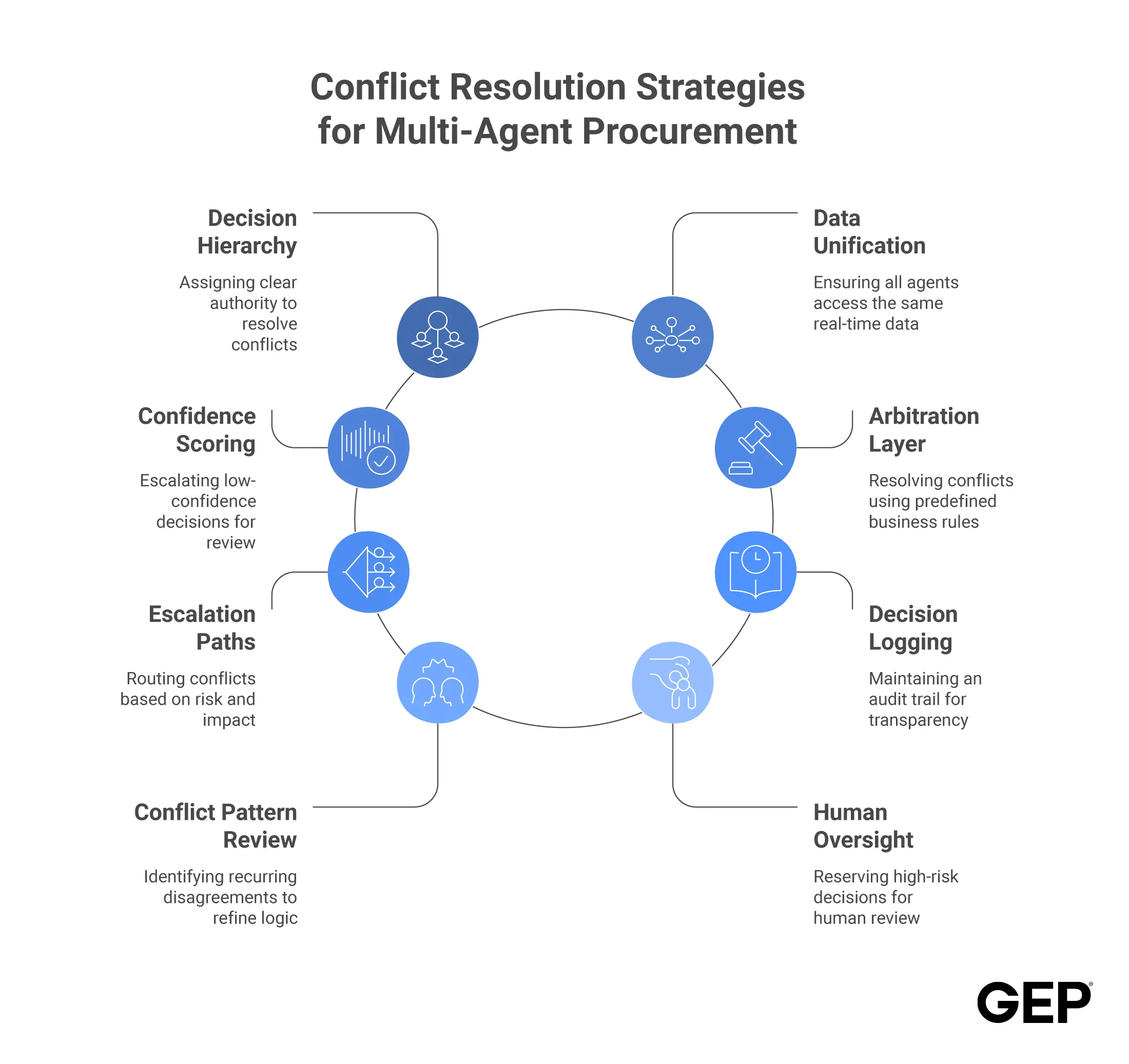
Define a Decision Hierarchy
Before agents start acting, define which one has the final say over each decision type. Without that structure, every disagreement becomes a fire drill instead of a routine resolution.
Unify the Data Layer
Conflicts often stem from agents working with different versions of the same data. A shared, real-time data foundation eliminates that problem before it starts.
Build Confidence Scoring
When an agent's confidence falls below a defined threshold, route the decision to a higher-authority agent or a human reviewer. Low-certainty calls shouldn't reach the system's output unchecked.
Introduce an Arbitration Layer
For disputes that can't be resolved at the agent level, an arbitration layer applies predefined rules you've already approved. It doesn't make procurement decisions. It enforces the logic behind them.
Set Escalation Paths
Not every conflict deserves the same response. A low-value purchase order disagreement can be resolved automatically. A contract clause conflict should reach a human reviewer before any action is taken.
Log Every Decision and Conflict
An audit trail shows you exactly which agents disagreed and how the system resolved it. That record becomes critical when you refine agent rules or need to defend a decision to a stakeholder.
Review Conflict Patterns Regularly
Recurring disagreements between the same two agents signal a deeper misalignment in goals or data. Fix that, and you reduce conflict volume across the board.
Keep a Human in the Loop
Above a defined risk or value threshold, human judgment still belongs in the decision. Agents provide the analysis. People make the call.
Turn AI Agents Into a Connected Workforce
Give every agent a defined role with clear decision authority
Coordination Defines the Next Era of Procurement
Procurement is moving toward systems where agents handle volume and humans handle judgment. The leaders who get this right won't be the ones with the most AI agents, but whose agents work together without constant intervention or conflict.
Over the next few years, expect agent coordination to become a core procurement capability. Teams that design for conflict resolution now will scale faster than teams that bolt it on later. Explore GEP’s - AI-Native Procurement Software




Frequently Asked Questions
Speed kills here. Teams rush to deploy agents and skip the harder question: how do these agents hand off decisions to one another? Ownership goes undefined. When two agents pull in opposite directions, the system collapses. The automation works. The coordination doesn't.
Getting independent agents to reach consistent decisions. An agent can be accurate in isolation and still create chaos when it operates alongside others who work from different data or priorities. Coordination is the problem. Most teams treat it as an afterthought.
Every agent handles exactly one thing, with hard boundaries around it: one agent owns risk, another owns pricing. They don't overlap. This matters because most agent conflicts come from two agents believing they own the same call, not from flawed logic. SoC removes that ambiguity before it becomes a problem.