


Managing Supply Chain Risk Amid Expanding Tariff Powers
- The US Congress is weighing a bill that would give the White House sweeping new tariff authority, including levies as high as 500% on Russian imports.
- Waiting for the legislation to settle before modeling exposure means reacting after the cost has already hit your P&L.
- Friendshoring only works as risk protection if you build it before the shock, not during it.
August 20, 2026 | Supply Chain Risk Management 5 minutes read
Trade policy isn't slowing down long enough for anyone to plan around it. Just weeks ago, the US Senate moved a bill toward a final vote by an 86-12 margin that would hand the administration authority to impose tariffs of up to 500% on Russian imports and 100% levies on the largest buyers of Russian oil and gas. Trade groups told lawmakers directly that duties at this scale would raise costs on everyday goods and manufacturing inputs while making sourcing decisions harder to commit to months in advance.
Here's the part most procurement teams miss. The bill targets Russia on paper. In practice, it hands the administration discretion to decide which countries count as major buyers of Russian energy, and that discretion is where the real exposure sits.
If you're a CPO, a CRO, or you run supply chain for an enterprise with any exposure to global sourcing, this isn't a policy story to skim past. It's a planning problem, and it's due now.
A Step-by-Step Framework for Tariff Risk
Track exposure, assess impact, and quantify costs before the next rate hit
Inside the Tariff Bill's Expanded Reach
The legislation itself is narrow in language and broad in consequence. Because the bill lets the administration determine which nations qualify as major purchasers of Russian energy, tariffs could extend to imports from China, India, and the European Union, three of the largest trading relationships most US enterprises depend on.
This isn't happening in a vacuum. Earlier in 2026, the US Supreme Court ruled 6-3 that the president lacks authority to impose tariffs under the International Emergency Economic Powers Act, striking down the sweeping global levies imposed the year before. That ruling didn't slow anything down. Within hours of the prior global 10% tariffs expiring on July 24, the US administration imposed new tariffs of 10 to 12.5% on more than 60 trading partners, citing allegations that those countries hadn't done enough to stop imports made with forced labor. Within a day, small businesses backed by the same legal group that won the US Supreme Court case filed new lawsuits challenging the tariffs, arguing the administration is trying to reimpose duties already struck down.
Legal pushbacks don’t pause exposure. It extends the period during which duty rates remain unsettled, and that's exactly the period your sourcing team has to keep operating through.
Where Sourcing Plans Break Under Sudden Tariff Shock
Most procurement organizations are still running tariff models built for a slower world. One supplier, one country, one rate, applied at landed cost. That worked when tariff changes came with months of warning.
It doesn't work anymore. Your category teams likely can't trace which SKUs route through Russian energy-linked supply chains once you get past tier one. Finance treats tariffs as a fixed line item instead of a variable tied to legal and legislative developments. Sourcing often has no pre-qualified alternate supplier ready to go, so a shock turns into weeks of emergency qualification instead of a same-week switch.
Each shortfall feeds the next one. A category team that can't trace exposure hands finance a number that's already wrong, and finance builds a budget that sourcing then has to unwind under pressure, in public, usually in front of the board.
Building a Network That Bends Instead of Breaking
Friendshoring sounds like a strategy slide until you actually build it, and even then, it isn't the silver bullet it's often sold as. A late-2025 industry report found that friendshoring and nearshoring were offering brands little real relief heading into peak season, as transshipment tariffs and new trade tensions followed companies even after they diversified away from their original sourcing base.
That doesn't make network redesign pointless. It makes it a discipline instead of a slogan. Suppliers in stable-trade countries still need to be qualified before a tariff forces the decision, not after, and the diversification has to account for where the next round of scrutiny is likely to land, not just where the last one hits. Treat it as ongoing insurance, not a project you finish and file away. Tariff authority under this bill can decide which countries carry exposure based on a single administrative call, so your alternate supplier base needs to stay current, not sit on a shelf from last year's planning cycle.
A Practical Framework for Tariff-Resilient Sourcing
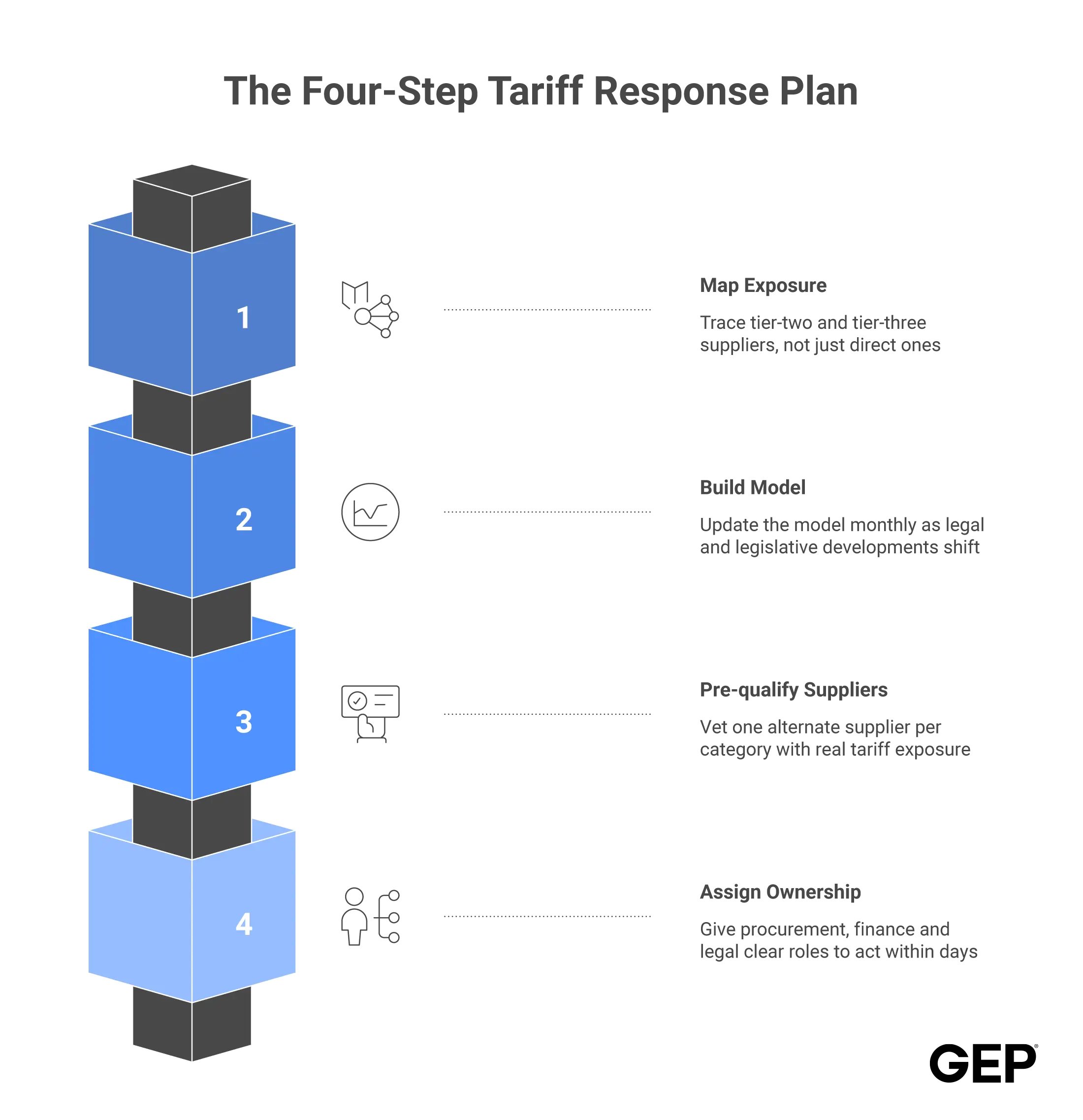
Four moves take a procurement team from reactive to prepared.
- Map tier-two and tier-three exposure, not just direct suppliers. Russian energy links tend to sit several steps back in the chain.
- Build a tariff scenario model that updates monthly, tied to legal and legislative developments instead of a static annual number.
- Pre-qualify at least one alternate supplier for every category with real exposure to affected corridors.
- Assign clear ownership across procurement, finance, and legal, so a new determination triggers action within days.
None of these needs new technology to start. It needs procurement, finance, and legal working off the same exposure data, updated on the same clock.
Model Your Tariff Exposure Before the Next Rate Hits
Map supplier tiers and simulate cost impact before legislation takes effect
The Window Before the Next Vote
The US Senate vote doesn't guarantee the bill becomes law. Even if it does, enforcement will take time to clarify. That uncertainty is your window, not a reason to wait.
Enterprises that treat tariff exposure as an ongoing input to network design, not an annual planning exercise, walk into every legislative cycle with options already qualified. That's the difference between a policy headline that costs you and one you've already priced in.
Explore GEP’s Tariff Reversal Advisory for Procurement & Supply Chain Pros



Frequently Asked Questions
Start with your tier-two and tier-three suppliers, not just your direct contracts. Most exposure hides several steps back in the chain, in the raw materials or components tied to Russian energy or affected regions. GEP's tariff assessment maps that exposure across your full supplier network, not just the vendors you invoice directly.
Now. Contracts without tariff contingency clauses lock you into today's terms regardless of what happens next. Building in pricing flexibility and reopener language protects you whether the bill passes, stalls, or gets challenged in court.
At a minimum, it should define who bears the cost of a tariff increase, at what price threshold pricing is renegotiated, and how quickly either party can trigger that conversation. Vague language here is what turns a tariff shock into a supplier standoff. GEP works with clients to build clause language that holds up under real pressure, not just on paper.